How to read this: the quoted and boxed passages are an expert speaking in their own words; the italic asides are the Dediro desk's commentary; the prose between them is our synthesis — a reading across the sources, not a source of its own.
Executive Summary: The War That Stopped the Clock Before the Consequences Arrived
Iran won the war it was fighting, and Washington lost the war it thought it was fighting. That is the verdict the 28 themes converge on. The United States entered Operation Epic Fury on February 28, 2026, seeking regime change or strategic capitulation. It degraded 63% of Iran's mobile missile infrastructure, killed Khamenei, and collapsed Iran's oil revenue by 84% within six weeks of the April naval blockade. It achieved neither of its political objectives. Tehran kept its government, retained Strait of Hormuz control, and forced a ceasefire on terms Washington had called unacceptable six weeks earlier.
The throughline across every theme is a single design fact. Iran built its entire system to survive decapitation. The "12-day war" label could not survive contact with that design.
The Doctrine That Defeated the Timeline
The periodization fight in Theme 1 and the command-structure debate in Themes 3 and 9 are the same argument at different scales. Iran's "decentralised mosaic defence," restructured into 31 autonomous provincial commands beginning in 2005, made short-war framing untenable from day one. Mohammad Mansour of Al Jazeera traced the mechanism: decentralized command means no decapitation strike produces a decapitated state. Radwan, the Command Eleven intelligence analyst, supplied the line that recurs across six themes: network degradation produces "network decentralization, and decentralized networks are harder to target, harder to predict, and harder to deter." Washington counted dead commanders. Tehran measured proven doctrine.
That measurement error compounds. Christopher Solomon of CTP-ISW reads the Axis as a deliberately distributed system. Richard LeBlanc, the proxy warfare analyst, calls it a franchise operation, not a disciplined army. Both readings carry the same consequence: a ceasefire with Tehran does not bind Beirut, Baghdad, or Sanaa when the network runs on pre-delegated standing orders.
Where the Victory Cost Tehran
The desk does not read Iranian endurance as costless triumph. Theme 4 documents the inversion Rob Geist Pinfold names precisely: Iran stopped using proxies to fight for it and began escalating as a state to fight for its proxies. Theme 10's fiscal arithmetic is the binding constraint. Md Deluair Hossen places Iran's break-even at $124 per barrel against realized prices near $56. Hadis Jahaan-far puts the decade-long proxy tab at $160-250 billion. The Quds Force can decentralize command. It cannot decentralize cash.
This is the contradiction the synthesis holds open. Themes 16 and 17 document an IRGC that swallowed the state, installing Mojtaba Khamenei as a Supreme Leader with, in Manish Rai's words, the title but not the power. Theme 18's GAMAAN data shows 70-80% of Iranians would not vote for the Islamic Republic, a figure that held under bombardment. A regime consolidated its coercive monopoly precisely as its revenue base collapsed.
The Negotiation That Cannot Resolve
Themes 11 through 14 and 24 converge on a verification trap. Dr. John Calabrese of Modern Diplomacy states the MoU's central contradiction: it postpones precisely the issues that determine whether it can endure. Ulfur Atli's technical floor holds beneath every nuclear discussion: no state with indigenous enrichment has ever accepted zero enrichment. The IAEA has not verified Iran's 440.9 kilograms of 60%-enriched uranium since February 27. David Albright calculates that re-imposing JCPOA limits today buys a four-to-five month breakout window, not twelve.
Theme 27 names the enforcement gap Tehran exploits. Mohammed Elsoukkary of Thotharis draws the structural conclusion: any deal with a Washington that cannot restrain Netanyahu is a deal Israel can unilaterally void. Iran's negotiators read that gap and declined to concede.
The Most Dangerous Frame
The synthesis treats the three victory narratives as simultaneously true, and weights Murat Yeşiltaş of the SETA Foundation heaviest. A diminished but militarized, IRGC-dominated Iran is "more predictably hostile and less diplomatically agile than the Iran that preceded the conflict." Robert Kagan of Brookings, a two-decade advocate of pressure, conceded that with Hormuz control, "Iran emerges as the key player in the region." When the architects of maximum pressure read defeat, the concession carries weight.
Theme 28 resolves the outlook to a frozen conflict running beneath expiring 60-day windows. The IRGC reconstitutes within that window. The question no voice in 35-plus sources answers is whether Washington can build a verification architecture before Tehran builds a weapon, or whether a survival doctrine engineered to outlast decapitation now outlasts insolvency itself.
Defining the '12‑Day War' Within the 2026 Conflict: Why Periodization Matters
The label matters before the war ends. Call the opening phase of the 2026 Iran conflict a "12‑day war" and you imply a discrete, bounded event with winners and losers. Call it Day 1 of an open-ended attrition campaign and you foreclose the victory narrative entirely. The Dediro desk's position: the "12‑day war" label, applied to the February 28 to early-March 2026 phase of Operation Epic Fury, is a periodization choice with active political consequences. It did not describe a war that ended. It described the window in which one side wanted to claim it had.
Was February 28 the Start, or Just the Loudest Moment in a Decade of Escalation?
The conflict did not arrive without a past. The Congressional Research Service's overview of the U.S. conflict with Iran places the February 28, 2026 strikes inside a long sequence that included the Trump administration's "maximum pressure" sanctions campaign, a prior "12 Day War" in 2025, and the suppression of Iranian protests [20]. The strikes on February 28 were not the ignition. They were the detonation of a fuse lit years earlier.
The war did not begin on February 28, 2026. It was the product of nearly a decade of sanctions, failed diplomacy, and compounding military escalation.
The Iran War Updates Staff reaches a parallel verdict from the operational record. Their nine-month pre-strike chronology, running June 2025 to February 2026, identifies three discrete junctures where a different choice would have changed the trajectory [3].
Iran War Updates Staff (IranWarUpdates.com): The timeline reveals three critical junctures where the trajectory could have changed. First, in August 2025, when Iran expelled IAEA inspectors rather than allowing verification of the 84% enrichment finding. Had Iran permitted continued access, the US would have faced stronger international pressure to pursue diplomatic solutions before military action.
Daniel Mercer, writing for TheDefenseWatch on the full Trump-Iran escalation arc, identifies an even sharper irony in the pre-strike diplomacy. On February 27, 2026, one day before Operation Epic Fury launched, Oman's foreign minister was announcing that a genuine diplomatic breakthrough had been reached [4]. The strikes came the next morning.
The operational trigger was not a diplomatic collapse. It was a classification. The Iran War Updates Staff puts it plainly:
Iran War Updates Staff (IranWarUpdates.com): The February 14 IAEA confirmation of 90% enrichment functioned as the operational trigger. Both the US and Israel had publicly committed to treating weapons-grade enrichment as a red line, and the IAEA finding provided the international legitimacy needed to act.
Iran War Updates Staff (IranWarUpdates.com): The gap between what the IAEA could confirm and what US intelligence assessed created a politically useful ambiguity: enough certainty to justify action, but not enough to foreclose future diplomatic framing.
That ambiguity is also what made the "12-day" label possible. A defined trigger justified a defined response. A defined response could be declared complete.
What Does '12 Days' Actually Bound?
The CRS report is the first source to use the "12 Day War" label explicitly, referencing a prior 2025 conflict by that name before situating the 2026 operation as something larger [20]. The Middle East Insider's February-to-April log frames the hot phase as 37 days, ending April 6 [12]. The Eastern Strategist titles its analysis "38 Days Over Iran" [11]. Kalkine's Kishor tracks 74 days before his filing date, with three broken ceasefires and the Strait still contested [10].
Seventy-four days into the war, the human and economic toll is substantial. Thousands have been killed in Iran and Lebanon. More than one-sixth of Lebanon's population has been displaced. Three ceasefires have been declared and all three broken, with the current truce holding in name only while both sides continue to fire on each other in the Strait of Hormuz.
The competing timelines are not competing facts. They are competing arguments about what the war was for. A 12-day frame centers the nuclear infrastructure strikes as the war's purpose and the initial military phase as its logical terminus. A 37-day or 74-day frame centers the Strait of Hormuz closure, the Khamenei assassination, and the failed ceasefires as the war's defining events.
Does Naming a Phase Manufacture a Victory?
Pete Hegseth, speaking from the podium during Operation Epic Fury, offered the most direct statement of the 12-day framing's political function:
 PH
I stand before you today with one unmistakable message about Operation Epic Fury: America is winning decisively, devastatingly and without mercy.
Shiwangi Priya, writing for The Eastern Strategist, registered what that declaration left out:
What Hegseth did not say was what comes next.
There is no stated framework for what a post-war Iran should look like — who governs, what security guarantees follow, or what Washington offers in exchange for lifting the blockade.
The absence of a post-war framework is not a gap in planning. It is the consequence of periodizing a war as already won. When the opening phase gets labeled a victory, the harder questions about what follows get deferred. Priya's formulation cuts to it directly:
The war had started. No one had an agreed plan for how it would end.
The TheAshNow Team, covering the war's military and economic dimensions, frames the same asymmetry from the strategic level:
For the United States, victory originally implied significantly reducing Iranian military capabilities and strategic threats. For Iran, victory meant survival. These objectives are fundamentally asymmetrical.
When two sides fight for incommensurable objectives, declaring any phase "over" serves only one of them. The 12-day label serves the side that needed the kinetic action to appear complete.
How Iran's Doctrine Made Short-War Periodization Untenable
Mohammad Mansour, writing for Al Jazeera on the 12th day of the 2026 conflict, produced the most precise account of why the "12-day" frame was already collapsing at the moment it was being asserted:
A drastic strategic pivot – from degrading nuclear infrastructure to executing a "decapitation" strike against the Iranian leadership – has shattered the previous rules of engagement, dragging the region into an open-ended war of attrition with zero diplomatic off-ramps.
The gamble that Iran's state apparatus would fracture without its supreme leader fundamentally misjudged Iranian military doctrine. Analysts note that Tehran spent two decades designing a framework to survive exactly this scenario.
Formulated by the IRGC, the concept of "decentralised mosaic defence" diffuses command and control across regional layers. Coupled with a "fourth successor" redundancy plan, it ensures that even if senior leaders are killed and central communications are severed, local combat units retain the authority and capacity to act.
"Decentralised mosaic defence" means no beheading strike produces a beheaded state. The Iranian doctrine was built precisely to outlast the short-war framing that Washington needed.
Bilal Khan, writing for Quwa on the limits of American air power, adds the physical dimension:
These facilities sit at depths of 400 to 1,500 feet into granite bedrock, connected by over 100 interconnected tunnel systems. They feature automated rail transport and compartmentalised blast-resistant doors. The GBU-57 Massive Ordnance Penetrator – the largest bunker buster in the US inventory – could not reach them.
the underground missile city network represents perhaps the single most significant factor in determining the war's strategic outcome – it ensured that no air campaign, regardless of scale or precision, could disarm Iran's retaliatory capability
The NukeClock Team distills the paradox at the heart of the short-war claim:
Iran's enrichment program was the original justification for military action -- and the strikes may have paradoxically increased the nuclear risk rather than eliminating it.
Think-Tank and Media Periodizations: Who Sets the Frame?
Jordan Glynn, writing for the Institute for the Study of War on June 11, 2026, offers the clearest account of how Iran itself views the periodization question:
Iran does not view the current phase in the conflict as negotiations in pursuit of a deal; it believes it is at war and that war will end with a deal.
Tehran's refusal to accept any ceasefire window as a war's end is not obstinacy. It is a competing periodization. Iran's frame makes every ceasefire a tactical pause inside a continuing war. Washington's frame makes each ceasefire a potential endpoint that Iran keeps violating.
These regional strikes are not militarily effective, but they create an informational effect by demonstrating that Iran is not concerned about going to war.
Al Jazeera's Caolán Magee, reporting on post-ceasefire exchanges through late May 2026, documents the gap between declared and actual pauses:
repeated military flare-ups in the meantime underscore the deep mistrust between the two sides, experts say, as Iran and the US jostle for leverage amid a back-and-forth of peace proposals from both sides
The DRASInt Risk Alliance steps back from the daily timeline and delivers the structural verdict:
Although the US achieved certain short term tactical successes, particularly in delaying or disrupting aspects of Iran's nuclear programme and military operations, it did not succeed in permanently preventing Iran from remaining a significant regional military and nuclear capable power.
the confrontation has largely evolved into a prolonged "shadow conflict" characterised by sanctions, proxy warfare, cyber operations, targeted strikes, intelligence operations and diplomatic pressure.
A "shadow conflict" has no clean start date and no clean end date. The 12-day label cannot survive the concept.
Ali Vaez, quoted in the Board.world chronology of the Hormuz crisis, put the political cost of the framing directly:
 AV
The United States has just handed Iran's hardliners a gift-wrapped domestic political crisis and called it a security operation.
Calling a decapitation strike a "security operation" and calling its aftermath a 12-day window are the same move. Both require the audience to stop the clock before the consequences arrive.
The Desk's Verdict: Periodization as Policy
The 12-day frame served a specific purpose. It gave the opening kinetic phase a bounded identity, allowed a victory declaration, and positioned subsequent violence as Iran's continuation of hostilities rather than the war's second act. That framing is now under pressure from every timeline that runs longer than 12 days: the 37-day logs [12][19], the 74-day count [10], the Al Jazeera ceasefire tracker [21], and the ISW special report from June 11 [27]. All of them document a conflict that did not stop.
The question the 12-day label cannot answer is the one the TheAshNow Team raises at the level of strategic logic:
Wars are not won solely by destroying targets. They are won by changing political realities. That proved much harder.
Daniel Levy, cited in the word360 analysis of conflict outcomes, identifies the objective behind the framing:
 DL
Israel's actual goal is not smooth regime transition but "regime and state collapse." If that happens — if the IRGC fragments, regional militias lose their command structure, and Iran descends into civil war — the Gulf becomes exponentially more dangerous.
If regime collapse was always the real terminus, then no 12-day frame was ever honest about what was being measured. The war the label described was not the war being fought, and what the historiography of this conflict will eventually settle is not which label was catchier but which timeline captures the moment the political reality actually changed.
quote: "The United States has just handed Iran's hardliners a gift-wrapped domestic political crisis and called it a security operation." [13]
Axis of Resistance After 2026: Resilient Network or Strained System?
The Axis of Resistance did not break. It transformed. That is the desk's verdict, and it sits at odds with both the triumphalist reading in Washington and the catastrophist reading in Tehran. The axis entered 2026 structurally degraded. Hezbollah's command was decimated by Israeli strikes. Hamas was ground down across Gaza. Syria's Assad corridor closed. Iran itself absorbed what the NukeClock team counted as 1,450 airstrikes [26].
What survived was not the pre-war architecture. What survived was the doctrine underneath it.
Was the Axis Designed to Survive Decapitation?
Christopher Solomon, a Middle East analyst writing for the Critical Threats Project at the Institute for the Study of War, treats the network's survival as a feature of its original design rather than an accident of the 2026 fighting. CTP-ISW tracks the axis as a deliberately distributed system, built so that the loss of any single node would not collapse the whole.
The argument matters because it cuts against the decapitation logic that drove Operation Epic Fury. If the network was engineered to absorb the removal of commanders and corridors, then counting dead leaders measures the wrong variable.
This connects directly to the periodization fight from Theme 1: Defining the '12-Day War' Within the 2026 Conflict. As that theme established, Iran's 'decentralised mosaic defence' doctrine, designed to survive decapitation strikes, made short-war framing untenable from day one. The same doctrine that frustrated the war's timeline also frustrated its body count as a metric of victory.
What Counts as Degradation?
The degradation is real and it is severe. The NukeClock figure of 1,450 airstrikes describes a sustained air campaign, not a raid [26]. Hezbollah's senior command did not survive intact. Hamas lost territory and fighters it cannot quickly replace. Syria stopped functioning as a land bridge for Iranian resupply.
Severe is not the same as terminal. The desk reads the 2026 damage as the loss of a generation of leadership and a key logistics corridor, not the loss of the network's capacity to regenerate. The distinction is the entire argument.
Washington's triumphalist reading collapses that distinction. It treats decapitation as defeat. Tehran's catastrophist reading collapses it from the other side, treating the visible damage as proof the project is finished. Both mistake the wound for the death.
Resilient Network or Strained System?
The honest answer is both, and the framing forces a false choice. A network can be resilient at the level of doctrine while a system strains at the level of resources. The axis can regenerate command structures and still struggle to fund, arm, and coordinate them across a closed Syrian corridor.
The resupply problem is where the strain bites hardest. With the Assad corridor shut, Iranian materiel to Hezbollah no longer moves overland with the prewar ease. Doctrine survives. The pipeline does not.
This is the gap between the two readings. Resilience lives in the design Solomon describes through CTP-ISW. Strain lives in the logistics the strikes degraded. Neither side of the ledger erases the other.
Does the 2026 Damage Change Iran's Calculus?
The TheAshNow Team framed the structural problem in Theme 1: the US and Iran fought for incommensurable objectives, with Washington seeking to reduce Iranian military capability and Tehran fighting for survival. Applied to the axis, that asymmetry persists. Washington degraded capability. It did not touch the survival imperative that built the network in the first place.
That is why decapitation does not produce surrender here. A network built around survival reads every strike as confirmation of the threat it was designed to outlast. The campaign that was meant to break the will reinforced it.
Ali Vaez of the International Crisis Group identified the political cost of premature victory declarations in Theme 1. The same caution applies to the axis. Declaring the network dead before its regeneration cycle plays out repeats the error of declaring the war over before the Strait of Hormuz was resolved.
The contested claim that remains open is whether a doctrine of survival can outlast the destruction of the resources that doctrine depends on, or whether the closed corridor turns a resilient design into a hollow one within the decade.
quote: "CTP-ISW tracks the axis as a deliberately distributed system, built so that the loss of any single node would not collapse the whole." [26]
Reading this on a Tuesday morning? Get the next one in your inbox.
'Unity of Theatres' vs Decentralized Militancy: Coordination or Myth?
The Desk's Verdict: Doctrine Real, Command Fictitious
The 'unity of theatres' was real as political grammar and real as deterrence signal. It was not real as a joint operations room. The February 28, 2026 activation across Lebanon, Iraq, and Yemen showed timing coherence that exceeded coincidence. It fell short of the synchronized command-and-control that the doctrine's most ardent advocates claimed. The desk's position: Iran constructed a franchise architecture, not a military alliance. The franchisees moved when the brand was threatened. They did not wait for orders.
Elijah J. Magnier, the Beirut-based conflict analyst who has tracked the Axis since its formation, put the pre-2026 baseline plainly:
There was no central command-and-control centre, no joint operations room where generals from Tehran, Baghdad, Damascus, Beirut and Sanaa sat together issuing synchronised orders.
The "Unity of the Arenas" was a doctrine, not a daily reality. It deterred through the threat of escalation, not through demonstrated coordination on the battlefield.
That was the baseline before February 28. The question this theme addresses is what changed afterward, and whether the change was structural or performative.
Was the Pre-War 'Unity' a Deterrence Bluff?
Ali Mamouri, writing in MENAnuances, traces the doctrine's origin to a specific strategic logic.
For years, Iran's regional strategy rested on establishing a wide regional network consisting mostly of non-state actors that contain Israel from all fronts, but with two principles: strategic patience and the separation of fronts.
The shift away from separation was not gradual. Mamouri dates its acceleration to October 7, 2023, and its full articulation to the 2026 escalation cycle.
In its place, a new doctrine appears to be emerging — one based on the unity of fronts, where pressure on any member of the alliance can trigger responses from the wider network.
Mamouri is careful. He writes "appears to be emerging," not "has emerged." The conditional matters. A doctrine's announcement is not its proof.
Hassan Yaqoub, writing in Islam Times, carried the claim further. Yaqoub contended that the Middle East had crossed into a "post-separation of fronts" phase and now operated as a "unified and multilayered strategic space" in which military, political, media, and economic arenas had become intertwined within an integrated deterrence system [1]. Yaqoub further contended that deterrence had moved beyond the capacity to prevent military action toward the capacity to redesign the enemy's decision-making environment through a multiplicity of points of influence [1]. These are attributed positions, not Yaqoub's direct words on record. They represent the maximalist reading: unity as a systemic transformation, not a tactical adjustment.
The maximalist reading deserves a direct challenge. Richard LeBlanc, writing in Big Media Canada, supplies it.
The Axis functions less like a disciplined army and more like a franchise operation: branded under the same ideological resistance, but run with significant local variation.
This pattern reveals a core truth about modern proxy warfare: centralized, regional sponsors such as Iran can supply weapons, training, and ideology, but they cannot fully command the behaviour of decentralized, territorially rooted groups in the manner a superpower can.
Two readings, one network. The franchise metaphor is analytically precise. A McDonald's in Sanaa and a McDonald's in Beirut carry the same logo. They do not share a kitchen.
What February 28 Actually Demonstrated
Magnier's account of the post-February 28 activation is the most operationally specific in the source set.
By Elijah J. Magnier – For decades, the Axis of the Resistance existed more as a strategic idea than as a fully integrated military structure with unified leadership across multiple theatres. It was deterrence by narrative — a powerful story of unity told through rockets, statements, and the quiet work of the IRGC Quds Force.
The February 28 strikes on Iranian soil, and the assassination of Supreme Leader Khamenei, triggered simultaneous activation of Hezbollah, Iranian forces through True Promise 4 operations, and the Islamic Resistance in Iraq [10]. Magnier reads this as the crucible moment: the Axis crossing from narrative into demonstrated multi-theatre simultaneity.
Simultaneity is not synonymy with command. Three fires lit on the same night can reflect a shared signal rather than a shared dispatcher.
Tom Hussain, writing in South China Morning Post, supplies the tactical mechanics. He tracked the specific shift in the unity-of-theatres doctrine:
Tehran has enacted a tactical shift in its "unity of the theatres" strategy involving its Axis of Resistance allies in Lebanon, Yemen and Iraq: Israeli and US attempts to decapitate one head of this hydra-like monster, Hezbollah, would incur the wrath of the other heads, Iran and the Houthis.
The Islamic Republic celebrated this as the foiling of Israeli and US efforts to decouple the conflict with Hezbollah from negotiations to end the Iran war.
The decoupling logic is key. Iran's strategic goal was not to maximize kinetic output across all fronts simultaneously. It was to prevent adversaries from isolating and neutralizing individual nodes. That is a coordination goal, not a command goal.
Ashraf Alsharkawi, writing in Middle East Observer, frames the same phenomenon as a deterrence architecture rather than an operational command structure.
Iran's objective is to establish a new deterrence framework in which future attacks on Beirut, Damascus, or allied actors would automatically risk triggering a wider regional confrontation rather than remaining confined to a single theatre.
Alsharkawi also poses the operational question directly:
Is Tehran acting according to a shared defensive doctrine and a genuine "unity of arenas" strategy, or is it primarily employing regional actors as instruments to strengthen its negotiating position and protect the Iranian heartland?
The desk reads this as a false binary. Both things can be true. Tehran constructed the doctrine for deterrence. The activation in February 2026 served both the doctrine and the negotiating position simultaneously.
The Mosaic Defence: Decentralization as Feature, Not Bug
The command-and-control question cannot be separated from Iran's internal military architecture. The 'Mosaic Defence' doctrine, developed by General Mohammad Jafari beginning in 2005 and refined over two decades, restructured IRGC command into 31 semi-autonomous provincial units [21]. Each unit operated with pre-delegated authority.
Michael Connell, the Iran military analyst cited by El País, reads the 2026 activation as confirmation of the design:
The strength of command and control at the provincial level provides tangible evidence that the Revolutionary Guard, at least, has been operating in accordance with the established concept.
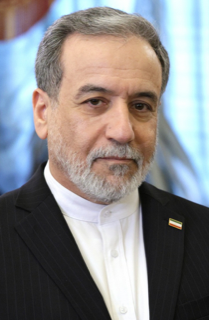
Seyed Abbas Araghchi, Iran's Foreign Minister, went further in his public framing:
 SA
Our military units are now, in fact, independent and somewhat isolated, and they are acting based on general instructions given to them in advance.
Araghchi's statement is simultaneously a military doctrine and a deception asset. Pre-delegated authority means the network fires without a live command signal. Adversary decapitation strikes become strategically inert against a system already running on standing orders.
Connell, cited in ummid.com's analysis of the Mosaic Defence, put the structural point plainly: the IRGC restructuring into 31 separate commands meant each could launch independently in the case of an invasion, making any attempt at degrading Iran's defense exceedingly difficult [11]. This is paraphrase from attributed position material, not Connell's verbatim words on record.
The proxy network carried the same architecture outward. Radwan, writing in Command Eleven's March 2026 intelligence assessment, delivers the sharpest analytic frame in the source set:
It must be accepted that the primary operational consequence of network degradation is not network dissolution. It is network decentralization — and decentralized networks are harder to target, harder to predict, and harder to deter.
What has changed is not the network's existence. What has changed is its degree of independence from Tehran — and that change cuts both ways.
The second Radwan quote is the desk's analytic spine for this theme. Greater independence from Tehran means greater local initiative. It also means reduced Tehran accountability. The unity-of-theatres doctrine produces a network that is harder to coordinate and harder to restrain in equal measure.
Where the Coordination Actually Failed
The Centre for International Security's Redaction team, writing from the CIS-FPN analytical unit, documents the gap between the doctrine's design and its performance:
Iran cultivated alliances with groups sharing its counter-hegemonic outlook, deep animosity toward Israel, the United States, and Saudi Arabia, regardless of sectarian proximity, which is why the Axis stretched beyond the Shia world to include Sunni Hamas and the Zaydi Houthis.
The CIS assessment also produced the sharpest verdict on the doctrine's limits: "What the war exposed, above all, is the gap between the architecture Iran designed and the political will required to defend it" [17]. By early 2026, Hezbollah's senior command had been decimated, the Assad land corridor closed, and Hamas's operational capacity severely degraded [28]. The Houthis maintained a defensive posture rather than a forward one [30].
Ahmed Nagi, a researcher at the Carnegie Middle East Center quoted in Al-Monitor, draws the correct distinction:
The network operates on more than a military level; its political, social and religious ties remain deeply rooted among its groups and are unlikely to unravel because of battlefield setbacks alone.
Nagi's distinction separates the network's social architecture from its military coordination. The social fabric held. The military synchrony frayed under sustained pressure.
Hezbollah leader Naim Qassem acknowledged the loss of the Syria corridor in December 2024, calling it "a detail in the resistance's work" [28]. The EIN News analytical desk, covering Axis restructuring post-conflict, put the assessment more plainly:
EIN News (analytical desk): Structurally, the axis now operates as a loose confederation of semi-autonomous militias bound by a shared deterrence doctrine, making it more durable but less controllable for Tehran.
LeBlanc supplies the strategic implication:
Iran cannot count on its proxies to absorb unlimited risk or synchronize perfectly with its own central objectives while adversaries can exploit these divergences and intrinsic vulnerabilities through targeted diplomacy, selective pressure, or de-escalation incentives to individual actors.
The Doctrine as Negotiating Architecture
Yoni Ben Menachem, writing for the Jerusalem Center for Foreign Affairs, tracks the doctrine's post-conflict political function.
from Iran's perspective, it is no longer possible to separate the various fronts. According to messages from Tehran, any future arrangement must address the broader regional balance of power. It cannot be confined to a technical agreement focused only on the nuclear issue.
Iran now tries to revive the principle of the "unity of fronts." It seeks to link various arenas, from the Gulf to the Israel-Lebanon border, into a single framework for political and security arrangements.
The IRGC made this explicit. The ceasefire condition was formalized: a ceasefire on all fronts, including Lebanon, was Tehran's primary condition for ending the war with the United States [22].
Khamenei.ir, the Supreme Leader's official website, published the post-war framing in unambiguous terms:
Iran will not return to the pre-war era; neither regarding Hormuz, nor regarding American military presence in the region, nor regarding the equation of resistance groups.
The regional order of West Asia after the war will be the regional order of the resistance bloc.
This is doctrine as declaration. The unity-of-theatres framework, in its post-war form, functions as the political architecture of Iran's negotiating position. Whether it reflects operational reality or political aspiration is the analytical question the source set does not fully answer.
Narges Bajoghli and Vali Nasr, the Iran scholars writing in Foreign Affairs, supply the deeper transformation context:
Rather than breaking Iran, the crucible of war has transformed it in unanticipated ways. To survive and establish new strategic advantages, the Islamic Republic had to adapt and innovate, changing how it waged war, ran the state, and managed society.
The adaptation claim applies directly to the unity-of-theatres question. The doctrine did not survive 2026 unchanged. It survived transformed: from a deterrence narrative into a post-war political demand, carried by a more decentralized and less controllable network than the one Tehran originally designed.
Brigadier General Hossein Mohebbi's post-ceasefire statement captures the operational-political fusion that defines the doctrine in its current form:
Let there be no misunderstanding: if the U.S.-Israeli coalition does not end its aggression against Lebanon immediately, Iran will not sit idly by. Our response will be decisive and will extend beyond the current battlefield.
This is the unity-of-theatres doctrine spoken aloud as ultimatum. Lebanon's front is explicitly linked to Iran's direct response threshold. The doctrine is no longer implicit. It has been declared.
Implications for Escalation Management
The command question carries direct implications for future de-escalation. If the network operates on pre-delegated authority and local initiative, then a ceasefire agreement with Tehran does not bind Beirut, Baghdad, or Sanaa. The franchise runs without the franchisor's daily approval.
Christopher Solomon of CTP-ISW, whose institutional definition of the Axis remains the field's most cited baseline, puts the structural point directly:
CTP-ISW defines the "Axis of Resistance" as the unconventional alliance that Iran has cultivated in the Middle East since the Islamic Republic came to power in 1979. This transnational coalition is comprised of state, semi-state, and non-state actors that cooperate to secure their collective interests.
Members of the Axis of Resistance are united by their grand strategic objectives, which include eroding and eventually expelling American influence from the Middle East, destroying the Israeli state, or both.
Shared objectives are not shared command. As Theme 2 established, Solomon reads the network as deliberately distributed. The cooperation is interest-based, not hierarchy-based.
Radwan's Command Eleven assessment poses the escalation management problem in its starkest form: "The question for American strategy is not whether the Axis can be further degraded. It is whether further degradation, in the absence of a comprehensive political settlement, produces a security outcome or simply a more dispersed and more autonomous network, thirty-one IRGC commanders and their proxies, operating with less central control, more local initiative, and reduced Tehran accountability. That scenario is not obviously more manageable than the one that preceded Epic Fury" [4].
Mamouri's verdict on the incompatibility of the two competing deterrence architectures holds across the command-and-control debate:
If this interpretation is correct, it may represent one of the most significant changes in Middle Eastern deterrence since the emergence of the Axis of Resistance itself — and it is likely to shape the future of conflict across the region for years to come.
The desk's verdict: the unity-of-theatres doctrine was partially vindicated by February 28, 2026. Timing coherence across three theatres exceeded what pure local initiative would produce. Operational synchrony fell well short of what a joint command structure would produce. The doctrine lives between those two poles. The network coordinated in 2026, imperfectly. The open question is whether a more decentralized, post-degradation network, running on standing orders rather than live command, can be brought back under Tehran's restraint when Tehran needs it to stop.
quote: "It must be accepted that the primary operational consequence of network degradation is not network dissolution. It is network decentralization — and decentralized networks are harder to target, harder to predict, and harder to deter." [4]
Hezbollah and the Lebanon Front: Durable Deterrent or Capped by Costs?
Hezbollah entered the 2026 war as Iran's most valuable forward asset and is exiting this phase as a degraded force that has forced Iran to fight its battles directly. That inversion is the desk's verdict. The Lebanon front did not collapse Iran's deterrence architecture, but it located the ceiling. Hezbollah could absorb Israeli strikes, fire rockets into northern Israel, and reject every partial ceasefire offer. It could not compel a halt to Israeli operations without pulling Tehran into direct confrontation. The proxy shield became a liability that Tehran had to physically rescue.
Is Hezbollah Still Iran's Forward Artillery, or Has It Become Tehran's Anchor?
Jonathan Eyal, writing for the Straits Times, put the structural problem plainly:
Hezbollah is not the spent force the Israelis believed it to be. And instead of knocking out Iran, the war which US President Donald Trump and Israeli Prime Minister Benjamin Netanyahu launched against Iran in February has transformed Hezbollah into an even more valuable proxy for the Iranians.
Eyal's reading tracks the observable sequence. Israeli strikes degraded Hezbollah's senior command, severed supply lines through the Assad corridor (as Theme 2 established), and pushed the group north of the Litani River under ceasefire pressure. Yet Hezbollah did not dissolve. It kept firing. On June 7, 2026, a Hezbollah rocket attack on northern Israel threatened to collapse the regional ceasefire entirely, triggering an Iranian missile response against an Israeli airbase [14].
That sequence is the deterrence record in miniature. Hezbollah fires, Israel retaliates in Beirut, Iran retaliates for Israel's Beirut strike, Washington intervenes to cap the escalation.
The cycle exposed what Rob Geist Pinfold, a conflict studies analyst, identified as a structural reversal:
Rather than using these proxy groups to fight for Iran, it is escalating itself as a state to fight for its proxy groups.
This is not a minor doctrinal adjustment. Asymmetric deterrence, the concept by which a weaker party raises the cost of escalation without matching the adversary's capacity, operated in 2006 and in the 2024 exchanges through the proxy layer. Hezbollah absorbed Israeli pressure so Tehran did not have to respond directly. In 2026, that buffer function inverted. Hezbollah's survival now requires Iranian direct action, which means Israeli strikes on Lebanon carry a guaranteed Iranian escalation premium.
What Did "Fragmentation" Actually Accomplish?
Ali Hashem, writing for Foreign Policy, framed Israel's operational intent:
This is why the Israeli objective appears less like elimination and more like fragmentation. Break the organization into pieces. Reduce its operational depth. Turn a regional asset into a Lebanese problem.
Fragmentation as a war aim has a measurable threshold. Has Israel crossed it?
Shira Efron, a security analyst writing in Foreign Affairs, contests the premise:
The truth is that there is no military fix for the problem that Hezbollah poses. A buffer zone can stop cross-border invasions and short-range antitank fire, but it is not effective in preventing rocket attacks or dismantling Hezbollah cells farther north.
Israel cannot substitute firepower for legitimacy. It can, however, help shape the conditions that enable Beirut to reclaim its sovereignty.
Efron's structural argument is that Israel's forward-defense doctrine, built on territorial occupation and continuous strikes, historically strengthens Hezbollah's narrative rather than eroding it. Asher Kaufman, a historian of Israel and Lebanon who has studied cycles of violence since 1982, found recurring patterns in which Hezbollah emerged emboldened, holding its dominance over Lebanese society as an Iranian proxy [24]. Neither the 1982 nor the 2006 occupation produced lasting security improvements. Both left what Kaufman calls indelible, traumatic scars on Israel's collective consciousness, creating the image of Lebanon as a repeated quagmire [24].
The 2026 campaign added a third data point to that series, not a break from it.
Maury Crespo, writing for Savage Mercies, drew the most unflinching counter-reading:
Hezbollah's decision to resume attacks on Israel during the Iran war is not the move of a confident fighting force. It is the reflex of a proxy that has no independent strategic logic.
Tehran built Hezbollah to be an extension of Iranian power, and even now, with Khamenei dead, the IRGC under siege, and Iran's military infrastructure being systematically destroyed, the proxy acts on orders from a master that may no longer exist.
Two readings. Eyal sees a hardened asset. Crespo sees a dead man's trigger. Both are compatible: Hezbollah can be simultaneously more valuable to Tehran and less capable as an independent actor.
Did Domestic Lebanese Costs Cap Hezbollah's Freedom of Action?
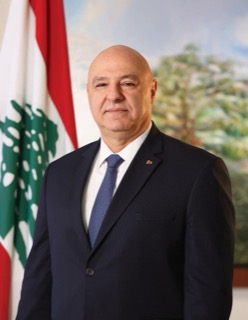
The Lebanese government's posture in 2026 is historically unusual. President Joseph Aoun drew a line in public that no Lebanese head of state had previously drawn so directly:
 JA
It's not your country, it's our country. You are not trying to help us. The people of Lebanon are paying the price for the sake of your own interest. Our interests do not coincide with your interests.
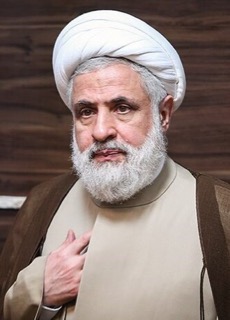
Aoun's statement, directed at Tehran, marked the Lebanese state's clearest assertion of sovereignty against Iranian interference since Hezbollah's 2006 integration into the political system. Hezbollah's secretary-general Naim Qassem did not concede the point. He rejected every partial ceasefire on offer:
 NQ
The ceasefire must be comprehensive, without a separation between the south and the rest of Lebanon, and without the Israeli enemy having the freedom to kill.
Mohammad Chamseddine, a Lebanese resident who had watched ceasefire after ceasefire collapse, put the local reading on the record:
I won't believe it until I see it on the ground. How can a ceasefire be on one side only?
The gap between Aoun's position and Qassem's is not negotiating posture. It is a dispute over who controls Lebanese territory and under whose strategic logic Lebanese civilians absorb the cost.
Eric Mandel, writing in the Jerusalem Post, made the institutional argument for why this gap is not resolvable through diplomacy alone:
Hezbollah is not an independent actor, but a forward arm of Iran's Islamic Revolutionary Guard Corps, deeply intertwined with the regime and responsible, alongside Tehran, for American bloodshed.
Mandel's position is that treating Hezbollah as a Lebanese political actor who could be peeled from Iran through Lebanese state pressure misreads the chain of command. Sarit Zehavi, a security analyst Mandel quotes, put the strategic stakes in precise terms:
The loss of Lebanon to Hezbollah would directly undermine US interests by entrenching an ideologically anti-American Iranian proxy with long-range missiles capable of threatening US forces, assets, and allies across the region and beyond.
Whether Zehavi's framing survives contact with a Lebanese government that has now publicly broken with Tehran on terms is the open test.
Lebanon as Diplomatic Lever: Tehran's Negotiating Pivot
Fiona Noonan, an analyst at the Institute for the Study of War, identified the strategic function Hezbollah's intransigence served in the broader US-Iran talks:
Iran and Hezbollah are continuing to try to transform negotiations about ending the war over the Strait of Hormuz into negotiations about ending the war in Lebanon, which Iran and Hezbollah seek to end in Israel's capitulation.
Stefaniia Bern, also at ISW, made the negotiating logic explicit:
Hezbollah and Iranian leaders continue to reject any ceasefire framework in Lebanon that does not meet their maximalist demand for total Israeli capitulation in Lebanon. Hezbollah and Iran's insistence on this demand is part of an effort to defer negotiations about key points of disagreement between Iran and the United States, particularly Iranian efforts to control the Strait of Hormuz, and strengthen Iran's negotiating position vis-à-vis the United States.
The Lebanon front, in this reading, is less a battlefield than a bargaining chip. Hezbollah's refusal to accept a partial ceasefire was operationally useful to Tehran precisely because it kept Lebanon a live variable in nuclear and Hormuz talks.
Iran's Foreign Minister Abbas Araghchi formalized the linkage publicly. The US-Iran truce was, in his words, "unequivocally a ceasefire on all fronts, including in Lebanon," and "its violation on one front is a violation of the ceasefire on all fronts" [18]. Iran's spokesman Esmaeil Baqaei reinforced it:
We insist that a ceasefire in Lebanon is an essential condition for any deal aimed at ending the war.
Tehran's calculation, as the analysis from The Conversation put it, was that Iran turned its survival and newfound leverage over the Strait of Hormuz into protecting Hezbollah, conditioning a potential deal with Washington on a complete halt to Israeli hostilities in Lebanon [24].
Dr. Raz Zimmt, an Iran analyst, traced the ideological and strategic logic beneath the tactical linkage:
Iran, from both its ideological point of view, but also on the strategic level, finds it very important to make sure that everyone realizes that it doesn't want to leave its allies in the region alone.
Ali Hashem closed the circle on what that commitment costs Lebanon itself:
Lebanon has become the ground zero through which a regional war is being priced.
Is the Deterrent Durable, or Has the Escalation Ceiling Been Located?
By June 7, 2026, Iran had launched five direct rounds of strikes against Israel [13]. Sadegh Amoli Larijani, a senior Iranian official, announced the new doctrine openly:
Tehran has opened a new chapter in its defence policy; a chapter in which safeguarding regional power is followed not through awaiting threats, but through taking initiative and offensive power.
Mohsen Rezaei, Iran's negotiator, framed the deterrent warning after the June 7 exchange:
Israel "received their response" and that "this response is a warning to stop their evil; any new action will be met with a more crushing response and heavier costs.
Fiona Noonan read Iran's restrained response as calibrated, not maximal:
Iran responded with a missile attack designed to deter future Israeli attacks against Hezbollah while avoiding escalation into a resumption of full-scale war.
That sentence contains the deterrence ceiling. Iran will retaliate. Iran will not resume full-scale war. The band between those two points is the operational space Hezbollah inhabits.
Bezalel Smotrich, Israel's finance minister, captured the Israeli counter-argument in a single line:
 BS
a ceasefire that leaves Hezbollah armed north of the Litani is not security, it is a delay.
Ali Hashem put the systemic conclusion plainly:
The old frameworks through which Washington, Tehran, Beirut, and Tel Aviv once managed the Iran-Lebanon-Israel triangle have been overtaken by the war they were supposed to contain.
The desk reads the record this way. Hezbollah's deterrent value is real but now operates as a floor for Iranian escalation, not a ceiling for Israeli action. Iran proved willing to strike directly when Hezbollah came under existential pressure. That willingness is the durable deterrent. The cost, paid by Lebanese civilians, absorbed by a Lebanese government now openly hostile to being used as a buffer, and extracted from Iran's negotiating capital on Hormuz and nuclear issues, may be what ultimately caps it. Negar Mortazavi, an Iran analyst, identified the exit ramp accurately:
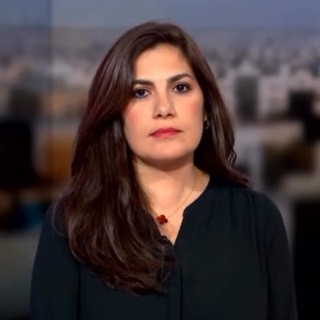 NM
I think the stalemate cannot continue for too long, so it will be going back to an escalated conflict, or heading for an actual peace deal.
The desk concurs with the binary. What remains unanswered is whether a Lebanese government that has publicly broken with Tehran can extract itself from the conflict's terms before the next Israeli strike resets the cycle.
quote: "Rather than using these proxy groups to fight for Iran, it is escalating itself as a state to fight for its proxy groups." [14]
Iraq's PMF and Baghdad Politics: Leverage Entrenched or Facing Sovereignty Pushback?
The desk's verdict: the PMF's political leverage is eroding at the margins and entrenched at the core. Baghdad is not reasserting sovereignty. It is renegotiating the terms of a dual-power arrangement that has defined Iraqi politics since 2014. The factions accepting weapons handovers are not the ones that attacked U.S. forces in 2026. The factions that did attack U.S. forces are refusing. That asymmetry is the argument.
Does Iraq Have a State, or Two?
Madeline Stahle, writing for the Gulf International Forum, locates the structural problem in a single sentence.
Iraq does not operate through a single center of power, but two.
The government holds the diplomatic authority, international recognition, and the institutional framework of a sovereign state. The Iran-backed militias, organized under the Popular Mobilization Forces (PMF) and operating through the umbrella of the Islamic Resistance in Iraq, determine when the state is drawn into conflict.
Two centers. One budget. Zero monopoly on force. Iraq funds the PMF through the state payroll while the PMF answers to Tehran on operational questions [1]. The U.S.-Iraq High Joint Coordination Committee, formed to de-escalate tensions after the February 28, 2026 conflict, collapsed almost immediately. The structural reason is not diplomatic friction. It is constitutional.
Shafaq News reported the contradiction plainly: the Iraqi state does not exercise full authority over all armed actors operating under its nominal command, and Washington has never accepted the distinction Baghdad insists upon, that the PMF is a state institution entitled to sovereign protection, not an Iranian proxy subject to military targeting [8].
Ahmed Youssef, an Iraqi political figure quoted by Shafaq News, put the on-the-ground consequence directly.
the involvement of armed factions in the current conflict "has created a reality outside the state's authority — one that reflects neither government policy nor public interest." That reality, he said, predates the current war.
That predating matters. The 2026 war did not create Iraq's dual-power structure. It exposed how far the structure had metastasized.
Manish Rai, writing in the Organiser, stated the institutional paradox directly.
The PMF's most influential factions are deeply ingrained, receive government salaries, maintain autonomous command structures and receive support from Tehran.
State salaries. Tehran command. The combination is not an accident of history. It is the architecture Iran designed.
The Disarmament Wave: Real Shift or Managed Optics?
By early June 2026, three factions had announced weapons handovers or militia integration: Muqtada al-Sadr's Saraya al-Salam, Asaib Ahl al-Haq under Qais al-Khazali, and the Imam Ali Brigades. The announcements generated significant coverage. The desk reads them as a split within the Iran-aligned camp, not as evidence of sovereignty returning to Baghdad.
Qais al-Khazali, speaking publicly and quoted by MEMRI, framed the pivot in ideological terms.
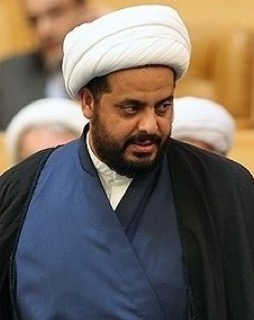 QA
the resistance cannot be limited to military operations alone, and that while physically defending Iraqi cities was in the past a top priority, precedence should today be given to building strong national institutions, combating corruption, and defending Iraq's freedom of decision and political activities, in accordance with the principles and values of the resistance.
QAOur project will remain a political project, not a project of rule — a project of stability, not anarchy.
David Atterton, writing for Reset Intelligence, reads Khazali's move through a financial lens rather than an ideological one.
When Iran's own man stands up in Baghdad and says the weapons belong to the state, he is speaking for Tehran, not for himself. And Tehran does not give up its guns in Iraq unless it has decided that holding them now costs more than letting them go.
Atterton's reading locates the decisive variable in U.S. Treasury sanctions, not Iraqi nationalism. The financial architecture that held PMF factions together became a liability after the February 2026 war. Khazali's pivot, on this reading, is Tehran's cost-benefit calculation wearing Baghdad's clothing.
Jonathan Spyer, a Middle East Forum fellow, contests the optimism directly.
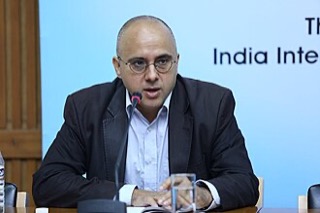 JS
This is not the ceding of Iran's "deep state" within the Iraqi system, but rather its adjustment and consolidation.
Spyer's evidence centers on Faiq Zaidan, chief of Iraq's Supreme Judicial Council. The Combating Terrorism Center at West Point documented Zaidan's origins in a blockquote Spyer cites.
Zaidan is one of a number of judges groomed by the Iraqi muqawama, specifically by Abu Mahdi al-Muhandis since around 2004. Zaidan was maneuvered by Muhandis to the apex of the Iraqi judicial system, whereupon Muhandis privately referred to him as 'the guardian of the Shia project.'
A Baghdad-based journalist, quoted by Spyer, added the operational consequence.
Since 2018, no prime ministerial candidate has moved forward without [Zaidan's] consultation, approval, or intervention.
The militia handovers are visible. Zaidan is not. The desk reads this as the point Spyer is driving at: the PMF's retreat from visible armed operations does not touch the judicial and political infrastructure Iran built across two decades.
Sinan Mahmoud, writing for The National News, reported that similar pledges from other factions in prior years produced limited results [5]. That track record is the baseline against which the current wave should be measured.
If the AAH plan is implemented, the move would be a significant shift in the group's formal relationship with the state, although similar pledges by other factions in recent years have led to limited results.
Who Is Actually Refusing, and Why It Matters
Kataib Hezbollah, Harakat al-Nujaba, and Kataib Sayyid al-Shuhada have rejected integration. Their stated condition: U.S. troops must exit Iraq first. The demand is structurally unmeetable under current U.S.-Iraq security terms. It is, in effect, a permanent refusal dressed in a conditional frame.
Arivan, writing for The National Context, identified the decisive asymmetry.
The decisive fact about this process is that the factions accepting delinking are not the ones that generate Iraq's security problem with Washington. During the recent war between Iran, Israel, and the United States, the attacks on American forces came overwhelmingly from Kataib Hezbollah, with a smaller share from Nujaba and Kataib Sayyid al-Shuhada.
What is taking shape is a selective delinking, in which the factions with their political survival at stake trade the appearance of armed autonomy for the protection of a state they help control, while the factions that actually hold the capabilities Washington worries about keep them.
Hussein Al Sieidi, a hardline figure quoted in reporting by HCN Times, stated the refusal in theological terms.
the resistance's weapons are a trust that cannot be bargained away
Mahdi al-Kaabi, a senior figure in Harakat al-Nujaba, put the question of allegiance on the table without diplomatic cover.
To put it bluntly, we are allies of the Islamic Republic. It's true we're not affiliated with the government or the prime minister, but we respect the law and the constitution.
Respect for the constitution, alliance with the Islamic Republic. Al-Kaabi's framing is the dual-power structure stated in public. The Iraqi state is an address, not an authority.
A Co-ordination Framework legislator, quoted in The National News, named the structural trap Baghdad now faces.
translate political momentum into actual control over arms, or whether the militia question will remain hostage to the timeline for US withdrawal or a deal between Tehran and Washington
That timeline is not Baghdad's to set.
Prime Minister al-Zaidi's Mandate: Mission Architecture or Mission Impossible?
Tanya Goudsouzian, writing for Responsible Statecraft, set the political geometry Zaidi inherited.
He will need to appease three centers of power with diametrically opposed visions for the future of Iran-backed militias operating outside of government control. Tehran wants them elevated; Washington wants them eliminated; and Baghdad wants them accommodated.
Zaidi may have been the only candidate all sides could accept, but the question remains whether Iraq has now placed an unachievable mandate on the only man willing to accept it.
Hamzeh Hadad, an Iraq analyst, offered the most granular prescription for what Zaidi actually needs to do.
The Iraqi state has to dismantle the armed groups that are uncooperative, primarily those that are part of the umbrella group called the Islamic Resistance in Iraq, because they have been going against the state's positions. As for the paramilitaries that make up the PMF, that are not affiliated with the Axis of Resistance, they have tens of thousands of members and so their institutionalization needs to happen because there is no other way to address the issue.
Hadad's taxonomy is the right one. The PMF is not a monolith. The Axis-affiliated factions and the institutionalizable factions require different policy instruments. Zaidi's government has so far produced integration pledges from the second category and confrontation-avoidance with the first.
Dr. Renad Mansour, a senior research fellow at Chatham House, put the integration question in four words: "Moving the gun from my right hand to my left hand" [12]. That quote, relayed through a fighter Mansour spoke to directly, captures the desk's read on the current wave. Formal organizational changes do not automatically transfer loyalty. Mansour's view, as reported by Chatham House, is that formal incorporation does not necessarily change who holds real authority, and that the key question is whether the Iraqi government and its allies have both the ability and the will to confront these groups [12].
The answer to Mansour's question, as of mid-June 2026, is no on confrontation and conditional on will.
Waleed Ibrahim, reporting for Al Jazeera, located the driver Zaidi is actually working with.
Neither the economy nor stability can flourish while arms remain out of the state's control. Addressing this issue has become more of an economic necessity than it is a security one for the prime minister.
Oil revenue collapsed with the Hormuz disruption. A state that cannot collect full budget receipts cannot pay PMF salaries without risking its own fiscal position. That financial logic is moving factions that ideology could not.
Atterton identified the precise mechanism.
For decades, whoever held the weapons in Iraq held everything else: the oil, the budget, and the value of the currency in citizens' hands. The militias were never only fighters. They were the lock on the vault.
Disarmament is the gatekeeper. Every conversation about an Iraqi dinar revaluation runs into the same question. Who carries the weapons inside Iraq? The answer Washington and Baghdad have been pressing for is one ministry, one command, one chain of authority.
Iran's Weakened Grip and the Fracturing of the Network
The Atlantic Council's analysis of Iran's internal transition identified a variable that changes the entire calculus. Following Mojtaba Khamenei's succession as Supreme Leader, the regime shifted toward what the author describes as a juntocracy, a council of IRGC officers running the state while using the supreme leader's office as cover.
Iran's governance under Mojtaba now resembles a juntocracy, in which a council of officers runs the state and makes the principal decisions, using the supreme leader's office and its religious sanctity as cover for their grip on security and their monopoly over war and peace, at home and abroad.
Such divergence over an existential question like disarmament was rare while Ali Khamenei — aided by Soleimani and later militia leader Abu Mahdi al-Muhandis — held the factions' spiritual and organizational strings.
Soleimani is dead. Al-Muhandis is dead. Ali Khamenei is dead. The three figures who built and maintained the PMF architecture are gone. The organizational infrastructure they built persists, but the spiritual authority that unified it is fractured.
Renad Mansour, at War on the Rocks, drew the strategic consequence.
 RM
Rather than eliminating these movements, sustained decapitation campaigns have fragmented their leadership and decision-making structures. As the limited coherence that once underpinned Iran's model of coordinated regional expansion has eroded, and as Tehran engages in confrontations directly on its own, these groups must navigate a more uncertain regional landscape and pursue their own logics of survival.
Gaby Tejeda, writing for the Soufan Center, identified the behavioral shift that followed.
No matter the outcome of the Iranian leadership's debate about the ongoing value of the Axis, coalition members appear to be calibrating their actions primarily to benefit their own interests — not those of Tehran.
That interest-first calculation is exactly what Khazali's pivot reflects. Asaib Ahl al-Haq holds 15 parliamentary seats [24]. It has state salaries to protect, ministerial appointments to defend, and an economic interest in the dinar revaluation Atterton describes. Those interests point toward integration, not confrontation.
Kataib Hezbollah has none of those institutional stakes. Its power rests entirely on its weapons. Which is precisely why it will not hand them over.
The PMF's Field Operations: Sovereignty Theater in the Western Desert
While the integration debate ran through Baghdad's political class, the PMF moved forces into western Iraq. Mohammed Omar, writing for House of Saud, documented Operation Imposing Sovereignty, a PMF and Iraqi Army desert operation launched after the Wall Street Journal's May 9 disclosure of an Israeli airstrip near al-Nukhayb.
The stated trigger was the Wall Street Journal's May 9 disclosure of the Israeli airstrip near al-Nukhayb. Sajjad al-Asadi, the operation's chief of staff, said PMF and Iraqi Army desert operations had launched following reports of what he called a "Zionist-American" airdrop in the area.
Nearly 1,000 drone strikes targeted Saudi Arabia during the 2026 conflict, with up to 500 originating from Iraqi territory [19]. Riyadh did not name Baghdad publicly.
To name the PMF as the launch authority is to name Iraq. That is the language Riyadh has not used since February 28.
Saudi silence is a form of damage control, not exoneration. Riyadh needs Iraqi airspace for any future U.S. operational corridor. Naming Baghdad would close that corridor.
Abbas Araghchi, speaking in the context of Iran's formal decentralization of strike authority to its three most capable Iraqi proxies, described the new command architecture.
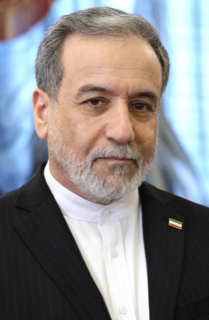 AA
Military units are now, in fact, independent and somewhat isolated, and they are acting based on general instructions given to them in advance.
Omar's read on that decentralization cuts to the structural core.
Iran has not lost control of its proxy layer. It has restructured it — converting the "authorization ceiling" that blocked ceasefire compliance in Islamabad into a permanent architectural feature that ensures any post-ceasefire framework faces a class of violence Tehran can disclaim but never restrain.
Disclaim but never restrain. That phrase is the desk's sharpest read on what the PMF's current status actually means for Baghdad. Prime Minister Zaidi cannot compel Kataib Hezbollah to stop. Tehran can restrain them but has chosen not to. The Iraqi state bears the diplomatic liability for actions it cannot direct.
Can Baghdad Break the Structural Trap?
Bridget Toomey, writing for the Long War Journal, named the substitution Tehran's allies prefer.
Iran's partners have hoped to satisfy the requirement for state control of weapons by strengthening the PMF, which would enable them to continue acting as Tehran's partners while existing under a veneer of legitimacy.
The veneer-of-legitimacy move is the single most dangerous outcome for Washington, because it satisfies the procedural demand (weapons under state command) while leaving operational authority unchanged.
Dr. Renad Mansour, the Chatham House Iraq specialist, set the terms for what genuine integration would require: not just moving fighters, but surrendering heavy weaponry and fundamentally shifting political loyalties from informal networks to the state [12]. No faction integrating in 2026 has surrendered its heavy weapons. The Saraya al-Salam dissolution involved light infantry. The Asaib Ahl al-Haq pledge covers the timeline for transfer, not the inventory.
Madeline Stahle made the constitutional point that frames all of this.
The fatwa was issued during a national emergency, and it was framed around civic defense through existing state institutions; it called for Iraqis to join the army, not to create independent armed structures operating outside state authority.
The PMF was never the legal structure Grand Ayatollah Sistani authorized. The 2014 mobilization fatwa called for Iraqis to join existing institutions. What Iran built around that fatwa is a parallel command architecture funded by the state and answerable to Tehran. Stahle's point cuts directly against the PMF's foundational legitimacy claim.
David Atterton set the political-economy ceiling on Baghdad's options.
The line between the two camps runs between the factions with the most to lose politically and the factions whose strength still rests on their own weapons. The first group can afford to trade a visible armed presence for state protection. The second cannot, because the trade would cost them the very thing that makes them useful.
Ali al-Amine, a Lebanese journalist with long coverage of Shia politics, offered a structural reading that complicates the Iranian-control frame. As reported in This is Beirut, al-Amine contends that Iraqi Shiite political forces control the state and financial resources directly, making them structurally less dependent on Tehran than Hezbollah in Lebanon [6]. The Iranian share of influence in Iraqi power-sharing, in his read, is declining in favor of U.S. financial leverage [6].
Al-Amine's optimism collides directly with Spyer's documentation of Zaidan. Both can be partially correct: Iran's operational military grip may be loosening while its judicial and political infrastructure holds. As Theme 4 priced Lebanon as the ground on which a regional war was costed, Iraq is the ground on which Iranian influence is being repriced. The desk reads the divergence as a race between two processes, Iraqi institutional assertion and Iranian deep-state consolidation, with no clear winner visible by mid-June 2026.
The armed factions accepting integration are not the security problem. The factions that are the security problem are staying armed. And the question Baghdad cannot yet answer is whether Zaidi's government will ever acquire both the will and the capacity to confront Kataib Hezbollah directly, or whether the disarmament wave will stop precisely where it becomes dangerous to continue.
quote: "What is taking shape is a selective delinking, in which the factions with their political survival at stake trade the appearance of armed autonomy for the protection of a state they help control, while the factions that actually hold the capabilities Washington worries about keep them." [24]
Syria as a contested logistics hub: Entrenchment Under Airstrikes
The Verdict Up Front: Strikes Dispersed, They Did Not Sever
Sustained Israeli and American airstrikes against Iranian logistics nodes and command infrastructure in Syria did not cut the supply chain. They forced it underground, split it into redundant threads, and made it harder to observe. The desk's position is unambiguous: the strikes produced dispersion and redundancy, not interdiction. The Assad corridor closed in late 2024, as Theme 2: Axis of Resistance After 2026 established, and that closure was the single most consequential blow to Iranian ground lines of communication through Syria. No airstrike campaign achieved what a political collapse did.
Radwan of Command Eleven, whose March 2026 intelligence assessment surveyed the IRGC network after Operation Epic Fury, states the primary operational consequence plainly:
It must be accepted that the primary operational consequence of network degradation is not network dissolution. It is network decentralization — and decentralized networks are harder to target, harder to predict, and harder to deter.
That sentence was written about the broader Axis of Resistance. It fits the Syrian corridor with precision.
Renad Mansour, the War on the Rocks analyst who tracked axis survival logic across the 2026 conflict, reaches the same structural conclusion from a different angle:
RMDecapitation campaigns may demonstrate military superiority, but they rarely eliminate movements embedded in local political orders. Instead, they fragment decision-making structures and produce adversaries that are weaker as coordinated alliances yet more adaptive, less predictable, and ultimately destabilizing.
The Syrian logistics question is the physical instantiation of that claim. Iran did not maintain a single, severable pipeline. It ran a distributed ground network, air bridge capacity, and proxy relay nodes simultaneously. Strikes against one degraded it. The others absorbed the load.
Was Assad's Fall More Damaging Than Any Airstrike?
The fall of the Assad regime in late 2024 severed the overland route that Iran had treated as its primary ground line of communication to Hezbollah for over a decade. No Israeli air campaign produced a comparable rupture. The physical road through Syrian territory, running from the Iraqi border through Deir ez-Zor, Palmyra, and on toward the Lebanese frontier, required a functional Syrian state to police the transit zones and deter interdiction.
Hezbollah leader Naim Qassem acknowledged the loss publicly in December 2024.
NQ[the loss of the] "military route through Syria" [was] "a detail in the resistance's work.
Analysts did not accept the framing. The Syria-based news analysis from early 2026 assessed the damage as critical to long-term sustainability [16]. Qassem's minimization was a political statement, not a logistics assessment.
The International Crisis Group put the structural dependency in four words, quoted by the Centre for International Security analysis of the wartime axis: "There is no axis without access" [18]. The Assad corridor was that access. Its loss forced Tehran toward three alternatives: maritime transfer through Lebanon's coastline, air bridge operations through Iraqi airspace, and proxy relay through PMF-controlled territory in western Iraq.
All three alternatives existed before Assad's fall. None was as efficient as the overland ground route. The strikes degraded the alternatives. The political collapse eliminated the primary.
Did Israeli Airstrikes in Syria Actually Degrade Iranian Capacity?
Israel conducted hundreds of strikes against Iranian-affiliated sites in Syria across the 2020-2024 period, targeting weapons convoys, storage facilities, and command nodes. The strikes were real. The degradation was real. The question is whether degradation translated into strategic denial.
The EIN News composite analysis of the post-war axis adaptation phase states the axis's own answer:
EIN News (composite analysis): Tehran and its network of regional proxies and non-state allies, the so-called Axis of Resistance, have entered a phase of strategic dormancy — an outward calm concealing rearmament, financial adaptation, and ideological renewal.
EIN News (composite analysis): Structurally, the axis now operates as a loose confederation of semi-autonomous militias bound by a shared deterrence doctrine, making it more durable but less controllable for Tehran.
Two quotes, no gloss required. The strikes produced dormancy, not dissolution. The architecture survived by flattening.
Gaby Tejeda of the Soufan Center, whose July 2025 intelbrief assessed the axis after the 12-day war, reached a sharper conclusion on deterrence failure:
There is a consensus that the Axis is not capable of constituting a deterrent to Israeli or U.S. attacks on Iranian territory that Tehran had envisioned when it poured billions of dollars worth of arms and funding into the Axis groups over the past two decades.
The deterrence function collapsed. The logistics function adapted. Those are different outcomes, and conflating them has produced consistently wrong American and Israeli assessments of what the strikes achieved.
How Did Iran Reconstitute? The Dispersion Architecture
The reconstitution doctrine is not improvised. Radwan's Command Eleven assessment identifies it as structural:
What has changed is not the network's existence. What has changed is its degree of independence from Tehran — and that change cuts both ways.
The "cuts both ways" observation is the key analytic wedge. Tehran loses command coherence when the network disperses. The network gains durability. Syria illustrated the tradeoff in physical form. As Israeli strikes forced Iranian logistics cells away from fixed storage sites and established convoy routes, cells began operating with greater autonomy and reduced signaling to Tehran. Harder to hit. Less predictable for Iran's own planners.
The BBC's Paul Brown, reporting on satellite imagery of Iranian military infrastructure after US strikes, captured the repair dynamic at Iranian missile sites:
Paul Brown (BBC): Iran will be constrained by the amount of resources that they can deploy to rebuilding, because they will also have to address basic economic conditions.
Zev Faintuch, quoted in the same BBC analysis, framed what Iran retained even through degradation:
Zev Faintuch (BBC analysis): Iran's ability to defend itself stems less from its conventional forces, such as its air force, than from its capacity to conduct counterstrikes via missiles or drones.
The Syrian logistics network was the feed mechanism for that missile and drone capacity. Degrading the feed slowed the throughput. It did not empty the inventory.
The Russia deconfliction channel ran in parallel throughout. Moscow's presence at Khmeimim Air Base and Tartus Naval Base created a deconfliction architecture that Israeli planners had to navigate carefully. Strikes too close to Russian assets risked diplomatic rupture. The constraint was real and Iranian planners knew it. Fixed Russian installations in western Syria functioned as a geographic buffer that shaped Israeli strike geometry.
The Cost-Benefit Calculation: Why Iran Stayed
Iran's calculus for maintaining a Syrian presence despite sustained strikes was not irrational. Syria provided three things that no alternative geography replicated: proximity to the Lebanese frontier, a state-level host that provided deniability, and a land route that air interdiction could only slow, not stop.
Kamyar Behrang, writing in the Jerusalem Post, frames the long-term structural logic Iran built over four decades:
For more than four decades, the Islamic Republic built its regional strategy around a simple but effective principle: keep the battlefield far from Iran's borders.
Iran's power was never based solely on conventional military superiority. The Islamic Republic lacks the economic strength, technological capacity, and global reach of major powers. Its influence depended instead on geography, ideology, deniability, and asymmetrical warfare.
Syria was geography. Losing Assad's Syria cost Iran the geography without costing it the doctrine. The IRGC shifted to what the Command Eleven assessment calls the "reconstitution doctrine": an explicit organizational commitment to rebuilding degraded cells faster than adversaries can destroy them [10].
The Sam Reyes analysis at America Strikes, reporting on Iran's claimed restoration of access to most underground missile facilities by late May 2026, captured the narrative function of that reconstitution:
Sam Reyes (America Strikes): Read together they describe a Tehran trying to negotiate from a position of restored, rather than degraded, capability.
Sam Reyes (America Strikes): Until satellite passes or a leaked Pentagon battle-damage assessment surface, the recovery claim should be read as Tehran's preferred narrative carried through a regional outlet rather than as a verified change in the order of battle.
The caveat matters. Reconstitution as signaling differs from reconstitution as verified fact. The distinction was absent from most coverage of the Syria logistics question.
Gaby Tejeda's April 2026 Soufan Center analysis of axis activation during the war period identifies why the cost-benefit calculation held even under pressure:
Unlike Iran itself, Axis members recognize threats beyond the U.S. and Israel, meaning defending Iran is not necessarily their highest priority. Axis partners are calibrating their actions to address all the challenges they face, in some cases limiting their capacity to serve as a force-multiplier for Tehran.
The Syrian logistics network gave Iran direct control over a segment of the supply chain that did not depend on proxy calibration. That was its strategic value. Proxy reluctance in Lebanon and Iraq made Syrian ground access more valuable, not less, even as strikes degraded it.
Syrian Regime Capacity: Useful Host or Hollow Partner?
The Assad government's operational utility to Iranian logistics was never about Syrian military capability. Syria provided legal cover for IRGC presence, access to state infrastructure like roads, ports, and telecommunications, and political legitimacy for Iranian facilities on Syrian soil.
When Assad fell, Iran lost all three at once. No incoming Syrian governance structure offered equivalent terms. The HTS-led transition had every incentive to deny Iran the facilities that had made Syria the transit point for a generation of Hezbollah armament.
The Syria-focused analysis from early 2026 assessed the damage directly: Syrian proxies faced catastrophic losses, and the logistics corridor that Hezbollah had relied on for weapons transfers was functionally closed [16]. The remaining Iranian logistics options through Syria required operating without state host cooperation, which meant operating covertly in territory governed by a hostile administration.
Ahmed Nagi, Middle East analyst quoted in Al-Monitor's axis assessment, identified why political collapse does not translate automatically into network dissolution:
The network operates on more than a military level; its political, social and religious ties remain deeply rooted among its groups and are unlikely to unravel because of battlefield setbacks alone.
True of the network overall. Syria-specific logistics were another matter. The political, social, and religious ties Nagi identifies as durable are embedded in Lebanon, Iraq, and Yemen. The Syrian corridor was a transit mechanism, not a social institution. Its closure hurt more than a comparable loss elsewhere would have.
Mansour's War on the Rocks analysis of survival logic across the axis captures what remained after the Syrian corridor closed:
RMRather than eliminating these movements, sustained decapitation campaigns have fragmented their leadership and decision-making structures. As the limited coherence that once underpinned Iran's model of coordinated regional expansion has eroded, and as Tehran engages in confrontations directly on its own, these groups must navigate a more uncertain regional landscape and pursue their own logics of survival.
Hezbollah's "own logic of survival" after the corridor's closure ran through maritime resupply and IRGC air bridge operations. Both were slower, more expensive, and more visible than ground transit. The strikes in Syria had forced Iran toward exactly these alternatives years before Assad fell. The political collapse simply removed the option of reverting.
What the Strikes Did Not Achieve: The Durability Floor
Lewis Smart, quoted in the BBC's satellite imagery analysis, offered the sharpest statement of what the broader strike campaign was actually targeting:
Lewis Smart (BBC analysis): These attacks were therefore almost certainly primarily aimed at increasing the likelihood of bringing about the conditions for regime overthrow which was an Israeli, and to a lesser extent, US goal.
Regime overthrow did not occur. The IRGC's Syria-based infrastructure was degraded and displaced, not destroyed. The reconstitution doctrine absorbed the strikes and distributed the cells. The Syrian corridor's closure, driven by Assad's political collapse rather than airpower, produced the most significant logistics disruption Iran faced in a decade. Airstrikes alone produced adaptation.
The International Crisis Group's four words remain the sharpest verdict on the strategic stakes: "There is no axis without access" [18]. Iran's post-Assad Syria posture tests whether access can be maintained without a state host, through covert cells and proxy relay nodes, against an adversary with persistent ISR coverage and demonstrated strike willingness. The IRGC's reconstitution doctrine says yes. The operational record from 2025-2026 has not yet settled the question.
quote: "It must be accepted that the primary operational consequence of network degradation is not network dissolution. It is network decentralization — and decentralized networks are harder to target, harder to predict, and harder to deter." [10]
Houthis and Maritime Pressure: Cost-Effective Leverage or Strategic Overreach?
The desk's verdict: Houthi maritime pressure delivered asymmetric leverage at a price Washington could not easily match, but the logic that made it cheap also made it uncontrollable. The campaign ran on its own momentum, decoupled from Iranian diplomatic signaling, and the April 7 ceasefire between Tehran and Washington left the Bab al-Mandeb exposed in a gap the agreement's authors never closed.
As Theme 3: "Unity of Theatres" vs Decentralized Militancy established, the Axis of Resistance operated as a franchise architecture rather than a unified command. That structure gave the Houthis operational autonomy. It also meant that when the bilateral US-Iran ceasefire arrived, Sanaa was not in the room.
Did the Houthis Actually Shift the Strategic Balance?
Luiz H. S. Brand\u00e3o, the strategic assessment author at Intelligence Notes, sets the baseline:
Luiz H. S. Brand\u00e3o (Intelligence Notes, strategic assessment): Ansar Allah has emerged from Operation Epic Fury (the February-March 2026 US-Israeli air campaign against Iran) as the most operationally intact node of the Axis of Resistance. With Hezbollah degraded and the Iranian leadership decapitated, the Houthi movement now functions as the axis's principal forward-deployed deterrence asset on the Bab el-Mandeb axis.
Luiz H. S. Brand\u00e3o (Intelligence Notes, strategic assessment): Operation Epic Fury (February-March 2026) inverted the traditional patron-proxy hierarchy of the Axis of Resistance. With Hezbollah strategically constrained since 2024, Hamas's military wing degraded, the Iraqi militia network throttled by US strikes, and the Iranian leadership itself decapitated, Ansar Allah has become the axis's most operationally autonomous and ideologically committed surviving node.
That inversion is the single most consequential structural shift of the 2026 conflict. The Houthis entered the war as the least damaged Axis member, a characterization the Soufan Center put on record [10], and they now carry the deterrence weight that Hezbollah and the IRGC once shared.
Joseph Addington and Ted Snider, writing in The American Conservative, frame the strategic arithmetic directly:
Joseph Addington; Ted Snider (The American Conservative): Once free to act with near impunity, the U.S. and Israel, when contemplating military action, now have to factor potentially significant costs into their calculations: If the U.S. strikes Iran, Iran will strike U.S. assets in the region; if Israel strikes Iran or one of its partners, Iran will strike Israel.
The chokepoint added a third variable to that calculation. Iran's Deputy Parliament Speaker Ali Nikzad put it plainly: "The Strait of Hormuz is more important\u2026 than a nuclear bomb. Our nuclear bomb is the Strait of Hormuz." [13] The Houthis held the second detonator.
Is the 'Franchise' Frame Accurate, or Does It Overstate Houthi Independence?
Jon Alterman, the Middle East program director at the Center for Strategic and International Studies, puts the origin story on record:
Jon Alterman (Center for Strategic and International Studies): Iran did not create the Houthi movement, and Iranian support for it is "relatively new" and "largely opportunistic."
The Cipher Brief's analysis draws the organizational implication: the Houthis operate as a franchise operator pursuing their own agenda under a shared brand, not as a subsidiary taking direct orders. Tehran negotiates with them, not through them [1].
Nina Shah, writing for TradeVAE, sharpens the doctrinal distinction:
The Houthis do not recognise Iran's supreme leader as their supreme religious authority in the same manner as Hezbollah and the Iraqi groups do. Their drivers are primarily domestic, even though their ideology aligns with Iran's regional posture.
Abdulghani Al-Iryani, the Yemeni political analyst, cuts to the relational core:
Abdulghani Al-Iryani (Yemeni political analyst): Tehran never considered these groups proxies. Tehran considered them allies. They expected them to act in their own self-interest.
That distinction is not semantic. An ally acts on its own calculus. A proxy obeys. The ceasefire gap Mohammed Omar identified at House of Saud flows directly from this: Tehran could not deliver Houthi compliance because it never held Houthi command authority [10].
What Did Bab al-Mandeb Disruption Actually Cost the Global Economy?
Eagle Intelligence, a maritime risk analysis firm, puts the baseline numbers on the table:
Eagle Intelligence (maritime risk analysis): Crude and clean-product loadings from the Arabian Gulf and Indian Ocean that normally transit the strait account for roughly 6.5 million barrels per day in east-west trade. In 2023-24, many operators rerouted around the Cape, adding 10-14 days to voyages and lifting spot freight rates on VLCCs by as much as 180 percent.
Eagle Intelligence (maritime risk analysis): The incremental cost per barrel is therefore likely to be higher from the first day of sustained disruption.
The cost runs higher in 2026 than in 2023-24 because of the available fleet. Eagle Intelligence notes that the Aframax and Suezmax pool has been thinned by sanctions-related idling and longer-haul Latin American demand routes [21]. Spare capacity is not where it was.
Mia Chen, writing for Informed Clearly, frames the Hormuz side of the dual disruption:
Mia Chen (Informed Clearly): Approximately 10 million barrels per day were removed from global markets, roughly 10% of global oil supply and 20% of seaborne oil trade. This is the largest supply disruption in the history of the oil market.
Brent averaged $86 per barrel in 2026 under Hormuz closure alone [26]. The Bab al-Mandeb threat layered on top of that baseline. Bob McNally, the energy policy analyst at Rapidan Energy Group, called a sustained dual closure "a guaranteed global recession" [14].
Arta Moeini, the Institute for Peace and Diplomacy research director, put a historical benchmark on the threat:
Arta Moeini (Institute for Peace and Diplomacy): We are looking at a global energy crisis that could dwarf the 1973 oil shock.
Matt Smith, oil analyst at Kpler, named the specific mechanism:
The flow of oil through the Red Sea is one of the factors that has kept crude prices from surging higher.
If the U.S. escalates military action, Iran's natural response would be to target Bab el-Mandeb.
Did Saudi Arabia's Pipeline Hedge Survive Contact With the Dual Chokepoint?
Mohammed Omar, writing at House of Saud, provides the engineering history and its failure mode:
Saudi Arabia designed the East-West Pipeline in the late 1980s as a Hormuz bypass, a hedge against exactly the kind of Persian Gulf disruption now underway. But the hedge was never designed to function while Bab al-Mandeb was simultaneously threatened. The pipeline substitutes one chokepoint for another.
the bypass Saudi Arabia spent decades constructing runs directly into the blockade zone the Houthis declared on Sunday morning.
ORF Middle East's analysis finds that every tanker leaving Yanbu for Asia must transit Bab al-Mandeb, leaving an estimated 70-75 percent of Yanbu's exports directly exposed to Houthi disruption [10].
Abdul Mohammed, also writing at House of Saud, delivered the political verdict:
Saudi Arabia borrowed against a budget that assumed Yanbu worked; Iran just identified the single point of failure in that assumption.
The truce that was supposed to protect Saudi Arabia is now the constraint that prevents it from acting.
Saudi Arabia spent seven years fighting the Houthis in Yemen, then paid political capital to reach a de facto truce. That truce now prevents Riyadh from responding to a Houthi blockade of the corridor the truce was meant to keep open. The trap is architectural, not accidental.
Andrew Leber and Alexander Worby confirmed the diplomatic corollary: the GCC "has no seat at the table" in the US-Iran negotiation framework [10].
Was the Ceasefire a Structural Gap or a Deliberate Exclusion?
Mohammed Omar draws the line:
The April 7 ceasefire is a bilateral agreement between the United States and Iran. The Houthis have not acknowledged it.
A deal that does not include Houthi command authority is not a ceasefire for Saudi Arabia. It is a bilateral American-Iranian arrangement that addresses the nuclear file while leaving the kingdom's primary export route exposed to a franchise operator whose explicit stated option is to close the strait Saudi Arabia now depends on.
Radoslaw, the MENA analyst at CruxBrief, identifies the structural replication risk:
Radoslaw (CruxBrief, MENA analysis): The permission-based transit system, the toll architecture, the selective enforcement, the proxy deniability: all of it is a replicable template, and Bab El Mandeb is the first public signal that Iran intends to replicate it.
The Ymaho Editorial Team, writing from a former US naval intelligence officer's analysis, names the mechanism Iran deployed at Bab al-Mandeb:
Ymaho Editorial Team (former US naval intelligence analysis): Iran is not going to "close" Bab el-Mandeb. A closed strait generates no revenue. Instead, Tehran is creating a system of paid safe passage with differentiated tariffs.
Ymaho Editorial Team (former US naval intelligence analysis): Iran legitimizes its role as a "security guarantor" in two of the world's four key maritime chokepoints (Hormuz and Bab el-Mandeb). After this, any negotiation process with the US will include not only the nuclear program but also a tariff schedule for passage.
Arsenio Longo, the maritime security analyst, confirms the leverage mechanism from the insurance side:
Arsenio Longo (maritime security analyst): That also means Iran can potentially use the Houthis as leverage. Whether through direct co-ordination or strategic alignment, the effect is the same, Tehran gains an additional maritime pressure point west of Hormuz.
The desk's position: the toll architecture is more strategically durable than a full blockade. A closed strait generates headlines and countercoalitions. A tolled strait generates revenue, legitimacy, and a permanent seat at any future shipping negotiation. Evangelos Marinakis, the Greek shipping magnate, made the commercial logic explicit:
Evangelos Marinakis (Greek shipping magnate, Costamare): For me, it's better to pay $100-$200 thousand in fees depending on the cargo than to endure the inconvenience of the route around Africa.
When that calculation spreads across the industry, the toll stops being extortion. It becomes a line item. The Ymaho Editorial Team forecast the insurance industry would formalize the payments as "operating expenses" within 30-45 days [7]. That moment, if it arrived, marked the first time the Western insurance market de facto legitimized payment to a non-state armed actor.
Can Washington Break the Cost Curve?
Elisabeth Kendall, the Yemeni studies scholar at Pembroke College Oxford, identifies the asymmetry at the heart of the US dilemma:
 EK
The reality is that asymmetric warfare suits the Houthis. They don't need to be accurate or sophisticated. They just need to harass shipping to achieve their goal of disrupting trade and pressuring the U.S.
EKThe Houthis are seasoned fighters. They have been at war, on and off, for over 20 years. Their battle logic is unlike our own inasmuch as war has become a way of life and they are relatively comfortable with absorbing casualties.
The Ymaho Editorial Team frames the American military constraint directly:
Ymaho Editorial Team (former US naval intelligence analysis): The context everyone misses: the US cannot respond with military force because it lacks a political mandate. To destroy Houthi missile batteries on land, a ground operation in Yemen is needed. Neither Trump nor Congress will agree to a second war in Yemen after 20 years in Afghanistan.
US Navy expenditure during the 2023-24 campaign reached nearly $1 billion in munitions for a single carrier group, without permanently degrading Houthi launch capability [34]. The math ran against Washington from the start.
Habtom Ghebrezghiabher, writing in the Jewish News Syndicate, makes the contrarian case that restraint reads as defeat:
Habtom Ghebrezghiabher (Jewish News Syndicate): The Houthis viewed the ceasefire as a confession of American defeat. By ignoring the group's relentless Red Sea destabilization and aggression toward Israel, the agreement signaled that the United States was willing to trade regional security for a hollow, temporary peace.
Habtom Ghebrezghiabher (Jewish News Syndicate): This is the fundamental flaw in appeasement toward Iran, its Islamist proxies and its Eritrean ally: All three view their mere survival as a victory, regardless of the suffering they inflict upon their own people. Concessions are interpreted not as opportunities for reconciliation, but as evidence that they have successfully outlasted Western pressure.
The desk reads Ghebrezghiabher's claim as ethnographic signal from the peace-through-strength camp, not as analytic ground. The premise that continued strikes would break Houthi capacity runs against Kendall's evidence on absorptive tolerance and Brand\u00e3o's finding that only 5 percent of Houthi military materiel originates from Iran [23]. An air campaign that severs the Iranian supply line addresses 5 percent of the problem.
Edmund Fitton-Brown, the former UN coordinator for Yemen, reads the Houthi posture more coldly:
Edmund Fitton-Brown (former UN coordinator for Yemen): The Houthis have indeed risen to the challenge, at least verbally. In common with much 'Axis of Resistance' rhetoric at present, the intention appears to be to leverage US political nervousness and market volatility, and to drive a wedge between the Americans and the Israelis.
The Houthis' Own Ceiling: Overreach Risks They Cannot Ignore
Brand\u00e3o locates the Houthi restraint logic in ordnance management:
Luiz H. S. Brand\u00e3o (Intelligence Notes, strategic assessment): The current Houthi posture is strategic patience rather than de-escalation. Leadership is preserving maritime ordnance for a higher-leverage moment, most likely a collapse of the 8 April US-Iran ceasefire or a Gulf-state alignment with Washington in a renewed Iran campaign.
Abdulghani Al-Iryani identifies the nonlinear threshold that makes overreach genuinely dangerous:
Abdulghani Al-Iryani (Yemeni political analyst): If that happens, people do not understand. They think it is linear, that the price will follow a linear path. The fact of the matter is that there is a critical point. That is when the strategic oil reserves of the U.S. and China are depleted. Then the crisis will be many, many times greater than the original crisis.
The Ymaho Editorial Team notes the specific financial ceiling already visible at Bab al-Mandeb: a successful strike on a laden tanker pushes Dated Brent toward $95-100 and triggers emergency stock releases that temporarily exhaust the IEA buffer [21]. Fatih Birol, the IEA executive director, confirmed the emergency collective action was already at unprecedented scale in the Hormuz context:
Fatih Birol (International Energy Agency): The oil-market challenges we are facing are unprecedented in scale, therefore I am very glad that IEA member countries have responded with an emergency collective action of unprecedented size.
Reserve depletion is not infinite. Once the IEA buffer is spent, a second shock hits an unprotected market. The Houthis' own ceiling is the point at which global pain triggers a multinational naval coalition with a genuine mandate. That mandate has not materialized yet. The political conditions that would produce it are the open question the ceasefire left unaddressed.
quote: "The current Houthi posture is strategic patience rather than de-escalation. Leadership is preserving maritime ordnance for a higher-leverage moment, most likely a collapse of the 8 April US-Iran ceasefire or a Gulf-state alignment with Washington in a renewed Iran campaign." [23]
Palestinian Arena Post-2026: Expanded Influence or Liability for Tehran?
Gaza Exposed Iran's Strategic Hierarchy
Tehran's relationship with Hamas was always transactional. The 2026 war confirmed it. When Iran negotiated with Washington over Lebanon, Gaza was left out of the draft agreement. The exclusion was not an oversight. It was policy.
Yoni Ben Menachem, the Jerusalem Center for Foreign Affairs analyst who tracked the negotiating architecture, put the hierarchy plainly:
According to Israeli security assessments, Iran concluded that it would be unable to impose a comprehensive arrangement covering both Gaza and Lebanon simultaneously on Israel and the United States. Tehran, therefore, chose to focus its efforts on the arena where it possesses a far more direct and powerful lever of influence, namely Hizbullah in Lebanon.
Iran's foreign minister Abbas Araghchi made the ranking explicit in public remarks.
AAthe Islamic Republic, until the very last moment, will never cease supporting movements seeking justice and freedom, foremost among them Hizbullah, the victorious resistance movement.
Hamas does not appear in that sentence. The omission is the statement.
The desk's verdict for this theme: Iran's Gaza investment generated reputational capital among Arab publics but produced a strategic liability in every room where deals get made. Tehran gained nothing durable from Gaza's destruction. It lost negotiating room, Arab state goodwill, and the fiction that the Palestinian cause bound the axis together.
Did Hamas Serve Tehran or Drain It?
The formal answer Iran always gave was that Hamas served the resistance paradigm. The practical answer, post-2026, is harder to sustain.
Farhad Ibragimov, writing on Iran's strategic calculus, identified the foundational tension:
Farhad Ibragimov (RT World News): The West's portrayal of Hamas as an Iranian proxy, however, is fundamentally misleading. Despite periods of tactical alignment and shared interests, Hamas has historically maintained decision-making autonomy and has often found itself at odds with Tehran, most notably during the Syrian conflict, when their positions diverged significantly, even leading to direct confrontations.
Kamyar Behrang, writing in the Jerusalem Post, carried the cost analysis further:
What Tehran intended as a demonstration of strength instead exposed the limits of proxy warfare as a long-term regional strategy.
October 7 was not Tehran's operation. Iran did not authorize it. David Obelcz, tracking the sequencing, confirmed that Khamenei and the IRGC never fully backed Sinwar's decision to launch.
David Obelcz (Malcontent News): For reasons that are still unclear, Lebanese Hezbollah and the IRGC never fully backed Sinwar's decision to launch al-Aqsa Flood. Supreme Leader Khamenei made a series of threats during speeches, but the Iranian government always balanced the statements.
The consequence was that Iran absorbed the reputational cost of Gaza without controlling the operation that generated it. Hamas spent Iranian-supplied capabilities on an offensive Tehran did not order. Iran then faced the pressure of a war it did not plan, executed by an ally it could not fully command.
Lina Khatib, the conflict researcher at the Belfer Center, identified the structural logic that made this outcome predictable:
Lina Khatib (Belfer Center, Harvard): Proxy warfare once offered Tehran a means of deterrence and influence. Over time, however, it generated familiar problems of overextension: weakened cohesion, divergent local interests, coordination failures, reputational damage, and growing vulnerability to disruption. Expansion produced scale, but not resilience.
Was Gaza Excluded from the Deal, or Sacrificed?
Ben Menachem reported that Hamas officials, in private, read the US-Iran draft framework with alarm:
Hamas officials reportedly describe Gaza's exclusion from the equation as troubling. They believe this could let Israel use its full military power in the Strip without fear of triggering broader escalation.
When the possibility of broader confrontation with Iran, Lebanon, Iraq, or Yemen remained, Israel had to divide its military and strategic focus. However, if tensions with Iran subside, Israel could devote substantially greater resources to the campaign in Gaza.
This is the direct liability calculus for Tehran. Iran's post-2026 posture in Lebanon and the nuclear file produced a deal that freed Israel's hand in Gaza. Tehran did not intend that outcome. It delivered it anyway.
Atef al-Joulani at al-Zaytouna Centre read the same architecture differently, arguing that Iran's resilience in the 2026 war actually strengthened the Palestinian resistance's position by keeping the resistance paradigm alive. Al-Zaytouna's assessment held that Iran's insistence on retaining nuclear and missile capabilities, together with Hezbollah's refusal to disarm, strengthened the Palestinian resistance's ability to resist pressure for disarmament [23]. The desk reads this as a structural misread. The Palestinian resistance retained its weapons partly because no deal covered Gaza, not because Tehran's resilience transferred bargaining power to Ramallah or Gaza City.
How Arab State Mediation Reframed the Palestinian File
The Gulf states entered 2026 already positioned between the US security architecture and Iranian pressure. Camille Lons, the political analyst tracking Gulf posture, put the realignment plainly: the diplomatic rapprochement with Iran was not sufficient to protect Gulf states, and the US security guarantees did not prevent Iranian strikes [17]. The Gulf states drew the conclusion that both tracks had failed simultaneously.
Ahmed Nagi, the analyst quoted in al-Monitor's coverage, identified what this means for the Palestinian file specifically:
The network operates on more than a military level; its political, social and religious ties remain deeply rooted among its groups and are unlikely to unravel because of battlefield setbacks alone.
Nagi's observation cuts against the desk's broader verdict only at the social layer. The political and religious ties he identifies are real. They do not, by themselves, translate into Iranian influence over Palestinian reconstruction politics. Reconstruction in Gaza will run through Arab state capital, Gulf financing, and UN frameworks. Tehran has no seat at that table.
The desk holds: Iran's social and ideological resonance with Palestinian publics persists. Its ability to shape the reconstruction settlement does not.
The Franchise Problem: Tehran Cannot Command What It Cannot Control
Richard LeBlanc, analyzing the axis's operational architecture, identified the constraint that governs all of Tehran's Palestinian relationships:
This pattern reveals a core truth about modern proxy warfare: centralized, regional sponsors such as Iran can supply weapons, training, and ideology, but they cannot fully command the behaviour of decentralized, territorially rooted groups in the manner a superpower can.
Iran cannot count on its proxies to absorb unlimited risk or synchronize perfectly with its own central objectives while adversaries can exploit these divergences and intrinsic vulnerabilities through targeted diplomacy, selective pressure, or de-escalation incentives to individual actors.
Anwar Alam, the political analyst writing in Frontline, traced the same dynamic at the Palestinian level:
 RS
although Iran supports and funds the Axis of Resistance, it will be an overstatement to say that it also directs and controls it. The constituent members of the alliance are not small, radicalised, Islamist terrorist outfits but are products of a sociopolitical movement shaped through respective national politics over several years.
RSInteractions between the Axis of Resistance groups appear to be transactional while taking into consideration specific local or national interests. The groups are primarily domestic political actors with domestic social bases.
Hamas survived 2024-2026 as a military organization. It survived as a governing claim over Gaza's population. It did not survive as an Iranian instrument. The two things were always separate. The war made the separation visible.
As Theme 3: 'Unity of Theatres' vs Decentralized Militancy established, the franchise architecture gave Tehran timing coherence but not command authority. The Palestinian case extends that finding: when Hamas exhausted itself in a war Tehran did not order, Tehran had no mechanism to redirect the outcome.
Renad Mansour at War on the Rocks identified the downstream consequence across the full axis:
RMRather than eliminating these movements, sustained decapitation campaigns have fragmented their leadership and decision-making structures. As the limited coherence that once underpinned Iran's model of coordinated regional expansion has eroded, and as Tehran engages in confrontations directly on its own, these groups must navigate a more uncertain regional landscape and pursue their own logics of survival.
What Reconstruction Politics Will Actually Decide
Mohammed Ayoob, the international relations scholar at Michigan State, identified the post-war trajectory for the full network:
The most likely outcome is not the restoration of the pre-war axis, but its transformation. The network is evolving from a relatively coordinated system into a looser conglomeration of actors, linked but not tightly bound.
In the Palestinian arena specifically, that transformation runs through reconstruction financing. Iran cannot finance Gaza's reconstruction at scale. The $50 billion-plus reconstruction bill that UN estimates have projected [23] will require Gulf capital, international institutions, and political agreements that exclude armed factions. Tehran's ideology travels; its treasury does not.
Veena Ali-Khan and Thanassis Cambanis at the Century Foundation read the residual capacity correctly:
Veena Ali-Khan, Thanassis Cambanis, Hailey (The Century Foundation): Iran's regime, Hezbollah, and Hamas are substantially weakened, but no one can yet say for sure just how weakened. Key Axis of Resistance groups will continue to play a regional role, and in their local spheres of influence might even continue to dominate rivals.
The local dominance they identify is real in the short term. Hamas retains street legitimacy in parts of Gaza that no Arab state alternative has yet displaced. But legitimacy among a displaced and exhausted population is a depreciating asset when reconstruction resources flow through actors who demand Hamas's political exclusion as a condition of funding.
Khatib's structural conclusion from the Belfer Center points directly at the opening this creates:
Lina Khatib (Belfer Center, Harvard): Rather than serving as a coherent deterrent architecture, Iran's regional network increasingly became a source of strategic exposure and fragility.
The Palestinian arena is where that fragility is most concentrated. Tehran cannot shape the post-war political settlement. It cannot deliver Hamas's compliance or its moderation. It cannot fund reconstruction. It can sustain ideological resonance among populations who read the resistance paradigm as the only available framework for dignity. That is not nothing. It is also not influence over outcomes.
Anwar Alam's closing judgment on the Palestinian question is the one the desk endorses, with a revision: durable peace does require addressing Palestinian statehood, but the address will not come from Tehran [20]. The party Iran backed most consistently is the party most likely to be excluded from the settlement table by the very reconstruction architecture that will determine Gaza's future. Whether any Palestinian faction can extract meaningful statehood commitments from that architecture, without an Iranian patron capable of imposing costs, is the question the 2026 war left fully open.
quote: "Proxy warfare once offered Tehran a means of deterrence and influence. Over time, however, it generated familiar problems of overextension: weakened cohesion, divergent local interests, coordination failures, reputational damage, and growing vulnerability to disruption. Expansion produced scale, but not resilience." [7]
Quds Force Attrition and Adaptation: Command, Control, and Cadre Losses
The Desk's Verdict: Decapitation Produced Decentralization, Not Defeat
The Quds Force entered Operation Epic Fury as the most architecturally prepared covert military institution in the modern Middle East. It exited the February-March 2026 phase bloodied, leaderless at the top, and operationally faster at the local level. The desk's position is unequivocal: targeted killing disrupted strategic planning and accelerated institutional learning simultaneously. Those two outcomes are not contradictory. They are the designed result of a doctrine Iran spent two decades building.
Sean Rayment, writing for National Security News, put the casualty picture in concrete terms [30]:
Sean Rayment (National Security News): Early estimates suggest that up to 6,000 members of the IRGC could have been killed in the conflict, but what real impact, if any, those losses have on the organisation will only become clear in the weeks and months ahead.
Six thousand dead from a single phase of a single conflict would shatter most conventional militaries. The IRGC is not a conventional military. Andreas Krieg, the defense analyst at King's College London, states the structural reason plainly [5]:
Andreas Krieg (King's College London): The IRGC is not a parallel military in the mould of the Republican Guards of Ba'athist Iraq or Syria. It is a parallel state.
That distinction carries the entire weight of the attrition debate. States absorb casualties. Armies collapse under them.
Was the Quds Force Built to Be Beheaded?
The Mosaic Defence doctrine, developed by the IRGC starting in 2005 and restructured into 31 autonomous provincial commands by 2008, was designed from inception to survive exactly the strikes that Epic Fury delivered [26]. Each command operated, according to the ummid analysis of Iranian state media, as a self-contained structure [3]:
ummid (bylined analysis): Each command operates as a self-contained entity with independent headquarters, command-and-control nodes, missiles, and drone arsenals, integrated Basij militia units, fast-attack naval flotillas, intelligence assets, stockpiled munitions, and pre-delegated authority for contingency operations.
Every provincial IRGC commander in Iran possesses his own weapons stockpiles, drone launchers, intelligence apparatus, and Basij militia forces. Every one of them has been explicitly trained to wage war without orders from Tehran.
The doctrine was not improvised after the strikes. Kasra Aarabi, a researcher tracking IRGC doctrine, confirmed to Al-Monitor that decentralization had been embedded for nearly 20 years, developed after Iran's strategists watched US forces dissolve Saddam Hussein's centralized command in 72 hours in 2003 [29]. Reza Talaeinik, a source cited by Al-Monitor with knowledge of IRGC planning, described the succession architecture directly [29]:
Reza Talaeinik (IRGC doctrine analyst): The role of each unit and section has been organised in such a way that if any commander is killed, a successor immediately takes their place.
Syed Khalid Muhammad of Command Eleven puts the operational implication precisely [27]:
Syed Khalid Muhammad (Command Eleven): The Mosaic Defense, formulated in 2002 precisely to counter a "Shock and Awe" decapitation strike, ensures that every province in Iran, and every proxy node abroad, is capable of independent, sustained warfare for up to two years without contact from Tehran.
Two years of autonomous warfare without a live command signal. That is the design specification Washington struck.
Did the Strikes Disrupt or Accelerate Institutional Learning?
The disruption case is real. Boris Lindsay's reconstruction of the February 28 strike effects identifies a genuine C2 collapse at the top of the chain [6]:
Boris Lindsay (bylined): The decentralization was not a deliberate strategic choice made in advance, but rather an emergency response to catastrophic losses in the senior leadership.
Boris Lindsay (bylined): Ghalibaf and Zolghadr inherited titles and formal authority, but they were inheriting command over a military that had already reorganized itself into 31 semi-independent regional structures. The formal succession and the actual distribution of operational power were now two different things.
Lindsay's framing separates the institutional headline from the operational reality. The chain of command did not transfer. It dissolved into 31 parallel chains.
The Small Wars Journal analysis by Th\u00e9baud, Rego, Carvalho, Funderburke, and Gordon confirms the C2 degradation was genuine during the 12-Day War, attributing it to the deaths of generals and chiefs of staff at multiple levels, which created chaos in the Iranian command structure and degraded command-and-control [28]. The subsequent, larger conflict triggered full DMD implementation precisely because those C2 failures had been observed and catalogued.
Zineb Riboua, writing at her own publication, reaches the starker verdict [11]:
Zineb Riboua (bylined): What is in dispute is whether the surviving entity retains the capacity to direct the forces operating in its name.
That sentence contains the productive tension. The IRGC survived. Whether it governs what it commands is a separate question.
The Qaani Problem: When the Commander Cannot Command
The Quds Force's command succession after Soleimani's 2020 assassination established the pattern that Epic Fury accelerated. James Okonkwo, writing for The Editorial, traced the structural inheritance problem [8]:
James Okonkwo (The Editorial): Soleimani's network was a scalpel. Under Qaani, it is becoming a blunt instrument that occasionally cuts its operator.
Ariane Tabatabai, a defense researcher with direct knowledge of IRGC organizational culture, described what Soleimani's death actually removed [8]:
Ariane Tabatabai (defense researcher): irreplaceable\u2014not because of his tactical skill, but because he held personal trust across sectarian and national lines that cannot be institutionalized.
Ali Vaez of the International Crisis Group, whose prior work on premature victory declarations was established in Theme 2: Axis of Resistance After 2026, closes the circuit on what Qaani's tenure produced [8]:
AVTehran built a network it could direct. Now it has a network it can only hope to influence. The risk is not that the proxies will abandon Iran—they won't. The risk is that they will drag Iran into conflicts it cannot control and wars it cannot win.
The Quds Force under Qaani did not lose institutional memory. It lost institutional authority. Those are different deficits with different remedies.
The Alcon Intelligence assessment places the verification problem in concrete terms: the wartime authorization of autonomous operational authority to field commanders created a compliance gap that no ceasefire framework can reliably close at the node level [2].
Pre-Delegated Authority as the Double Edge
Foreign Minister Seyed Abbas Araghchi stated the operational reality in public, on March 1, 2026 [23]:
SAOur military units are now, in fact, independent and somewhat isolated, and they are acting based on general instructions given to them in advance.
That admission from the foreign minister of a state under attack is not a show of strength. It concedes that pre-delegated authority produced a military the political leadership must answer for rather than control. Riboua makes the implication explicit [11]:
Zineb Riboua (bylined): That a sitting president apologized for his own military's actions within minutes of their execution illustrates precisely what pre-delegated authority has produced: a military that the political leadership must answer for rather than control.
The Levant Files documented the operational consequence: strikes on Oman, Qatar, and Turkish airspace, each executed without live authorization from surviving senior officials [23]. Farzin Nadimi, a weapons analyst tracking IRGC provincial operations, described the activation logic [23]:
Farzin Nadimi (weapons analyst): Every province is a mosaic. When cut off from the center, they don't dissolve — they activate.
Syed Khalid Muhammad of Command Eleven reads the structural shift as a doctrinal evolution [27]:
Syed Khalid Muhammad (Command Eleven): The Axis has transitioned into a Stigmergic Command Structure, a biological model of coordination where the environment serves as the medium for communication. In this framework, centralized "orders" are replaced by "environmental triggers."
Stigmergic command means no one needs to pick up a phone. The environment itself carries the instruction. Decapitation removes the caller, not the call.
The Reconstitution Pipeline: 24 to 36 Months Back to Reach
As Theme 6: Syria as a contested logistics hub established, the Assad corridor's collapse in late 2024 cut the physical logistics spine that no airstrike had managed to sever. What remained was the doctrine and the cadre pipeline. The Alcon Intelligence assessment places the reconstitution timeline at 24 to 36 months for strategic reach to be functionally restored, conditional on no binding verification framework [2].
Mohammed Ayoob, writing in the National Interest, reads the organizational logic of that timeline [21]:
The axis has been weakened structurally, but not fatally. Its ability to rebound will depend on several interlocking dynamics: organizational resilience within its constituent groups, Iran's capacity to reconstitute leadership and supply networks, and the shifting political environments in Lebanon, Iraq, Yemen, and the Palestinian Territories.
Because it is not a centralized military coalition, the axis can absorb shocks unevenly. Losses in one theater do not necessarily translate into collapse elsewhere.
That asymmetric shock absorption is the structural advantage that makes attrition campaigns so difficult to assess. A network that loses 40% of one node may gain operational redundancy in three others.
Radwan of Command Eleven states the primary operational consequence of the entire degradation campaign [1]:
It must be accepted that the primary operational consequence of network degradation is not network dissolution. It is network decentralization — and decentralized networks are harder to target, harder to predict, and harder to deter.
Radwan's follow-on conclusion carries the strategic logic all the way to its uncomfortable endpoint [1]:
What has changed is not the network's existence. What has changed is its degree of independence from Tehran — and that change cuts both ways.
The Paradox of Institutional Strengthening Under Fire
Roya Izadi, writing in the Journal of Democracy, identifies the counterintuitive domestic consequence: the war intended to decimate the IRGC produced the opposite result [34]. Izadi documents that the IRGC's political role expanded as civilian oversight collapsed under wartime pressure. Public approval for IRGC political involvement shifted substantially upward as external threat framing took hold. The institution that suffered 6,000 dead is at once more politically embedded than at any point since 1979.
The John analysis at MERO captures the generational dimension [14]:
John (MERO): Rather than breaking Iran, the crucible of war has transformed it in unanticipated ways. To survive and establish new strategic advantages, the Islamic Republic had to adapt and innovate, changing how it waged war, ran the state, and managed society.
Kasra Aarabi, cited in the Al-Monitor account of wartime IRGC consolidation, states the post-conflict prognosis directly [29]:
Kasra Aarabi (researcher): If the conflict suddenly stops and the regime survives, we can be certain the Guards will have an even more important role.
The RoninsGrips strategic assessment identifies the real institutional danger, and it runs inward rather than outward [15]:
RoninsGrips (bylined): Ultimately, the paramount risk to the Iranian state is no longer external military invasion, but rather internal institutional collapse — specifically, the growing potential for the Artesh to intervene domestically, prioritizing the preservation of the Iranian nation-state over the survival of the clerical regime.
The regular Artesh, long subordinated and underfunded, gained institutional standing precisely because IRGC dominance became a liability after the strikes [15]. Two competing military cultures now share operational space inside a single state structure. That is not a stable equilibrium.
Radwan frames the terminal question that no targeting campaign has answered [1]:
The question for American strategy is not whether the Axis can be further degraded. It is whether further degradation, in the absence of a comprehensive political settlement, produces a security outcome or simply a more dispersed and more autonomous network — thirty-one IRGC commanders and their proxies, operating with less central control, more local initiative, and reduced Tehran accountability. That scenario is not obviously more manageable than the one that preceded Epic Fury.
The Quds Force's cadre losses were real, the C2 disruption was real, and the institutional adaptation moved faster than the disruption. A force designed to survive decapitation absorbed the strikes and distributed the organizational memory downward. What Washington measured in dead commanders, Tehran measured in proven doctrine. Whether the next generation of Quds Force officers, trained under combat conditions with pre-delegated authority and no Soleimani to set the relational architecture, can be brought back under central political control is the question the ceasefire has not answered and the targeting campaign structurally cannot.
quote: "Tehran built a network it could direct. Now it has a network it can only hope to influence. The risk is not that the proxies will abandon Iran—they won't. The risk is that they will drag Iran into conflicts it cannot control and wars it cannot win." [8]
Paying for the Axis: Can Iran Afford Its Regional Project?
The desk's verdict: Iran cannot sustain its regional project at pre-2026 cost levels.
The U.S. naval blockade, initiated April 13, 2026, severed the oil revenue artery that funded the Axis of Resistance. That artery is not simply constricted. It collapsed by 84% within six weeks [1][2].
The proxy model was never cheap. Hadis Jahaan-far, writing for The Geopolitical Economist, puts the decade-long tab at $160].. The blockade did not create this fiscal trap. It closed the lid on one that had been building since 2018.
Did the Proxy Model Ever Pay for Itself?
The proxy model rested on a calculation: forward-deployed militias cost less than conventional deterrence. Hezbollah, Hamas, the Houthis, and the Iraqi PMF factions collectively absorbed an estimated $23\u2013$39 billion per year from Iranian state coffers [8]. That figure dwarfs what most analysts publicly attributed to Tehran's regional spending before 2022.
Hadis Jahaan-far (The Geopolitical Economist): "Over the last decade, the $160\u2013$250 billion spent on regional proxies could have funded 15 to 20 world-class refineries. This would have ended Iran's dependence on gasoline imports and turned the country into a global petrochemical hub."
The opportunity cost is the sharpest indictment in this body of sources. Not the money spent, but the industrial capacity it foreclosed.
Hadis Jahaan-far (The Geopolitical Economist): "The Iranian people have effectively 'paid' for a regional empire they did not vote for, at the expense of the electricity in their homes, the air in their cities, and the future of their children."
For the period when oil revenues held, the model was fiscally bearable, if politically corrosive at home. Md Deluair Hossen, in an oil-sector analysis for 2026, placed Iran's fiscal break-even at $124 per barrel against realized prices of roughly $56 [12].
Md Deluair Hossen (oil-sector analyst): "Tehran's fiscal break-even sits near 124 dollars per barrel against realized prices closer to 56 dollars, forcing reliance on monetary financing and a rial that has lost two thirds of its parallel-market value since 2022."
That gap was already unsustainable before a single U.S. naval vessel took position outside Kharg Island.
The Blockade as Structural Break
Before April 13, 2026, Iran had spent seven years proving that sanctions alone could not close its export pipeline. The China-linked shadow fleet of 350-plus tankers moved crude through ship-to-ship transfers, blending Iranian oil into rebranded cargoes that buyers could disclaim. Hossen tracked the relabeling that kept the revenue flowing.
Md Deluair Hossen (oil-sector analyst): "Malaysian Blend"
The trick that defeated sanctions did not defeat steel hulls. A blockade does not need to find the oil. It only needs to sit on the water the tankers must cross.
The distinction matters for periodization, as Theme 1 established. Sanctions throttled price. The blockade throttled volume. Tehran could finance a discounted barrel. It cannot finance a barrel that never reaches a buyer.
What the 84% collapse exposed is the dependency Theme 9 traced inside the IRGC: a parallel state that absorbs casualties faster than Washington can count them still runs on a revenue base it cannot regenerate under blockade. The Quds Force can decentralize command. It cannot decentralize cash.
The open question is not whether Iran scales back. It is which node it abandons first when the ledger forces a choice, and whether a survival doctrine built to outlast decapitation can outlast insolvency.
quote: "The Iranian people have effectively 'paid' for a regional empire they did not vote for, at the expense of the electricity in their homes, the air in their cities, and the future of their children." [8]
Ceasefire, MoUs, and 'Negotiated Pauses': Durable Off-Ramps or Tactical Breathers?
The desk's verdict is this: every ceasefire framework produced between April and June 2026 was a tactical pause, not a durable off-ramp. The MoU architecture deferred the disputes that caused the war rather than resolving them. Both Washington and Tehran signed onto ambiguities that served their domestic audiences while leaving the core sequencing questions, on enrichment timelines, Strait jurisdiction, and proxy stand-downs, deliberately unresolved. The 60-day clock was a political instrument, not a diplomatic one.
Was the April 7 Ceasefire a Deal or a Mutual Exhaustion?
The first Pakistan-brokered ceasefire, effective April 7, 2026, broke down within days of its announcement. As Theme 1: Defining the '12-Day War' established, Ali Vaez of the International Crisis Group had already identified the political cost of premature victory declarations. The April ceasefire repeated the error at the structural level.
The Congressional Research Service report from April 9 put the diagnostic plainly: no mutual text of the agreement had been publicly released [29]. U.S. and Iranian public statements on the ceasefire differed on every substantive point.
Benjamin Netanyahu (Israeli Prime Minister): The two-weeks ceasefire does not include Lebanon. [29]
Donald Trump (U.S. President): the cessation of U.S. military action was "subject to … Iran agreeing to the COMPLETE, IMMEDIATE, and SAFE OPENING of the Strait of Hormuz." [29]
Iran made no such public commitment. The gap between those two statements was not a drafting error. It was the ceasefire's architecture.
Donald Heflin, a former U.S. diplomat writing in The Independent, placed the April 7 truce in a three-scenario framework for how wars end [30].
Donald Heflin (former U.S. diplomat): The current U.S.-Iran ceasefire is a good example of the third way that agreements to stop fighting can happen. Both countries were tired of the costs and the ongoing risks of the war, and they sent signals to that effect. Pakistan, which deserves praise for stepping in, picked up on this and offered to serve as an intermediary. [30]
Mutual exhaustion, not mutual agreement, produced the April 7 truce. Heflin's framework separates form from substance. A ceasefire born from exhaustion carries no shared definition of what the ceasefire covers.
Does the MoU Architecture Resolve Anything or Just Rename the Disputes?
Dr. John Calabrese, writing in Modern Diplomacy, supplied the sharpest structural diagnosis of the MoU process.
Dr. John Calabrese (Modern Diplomacy): The memorandum of understanding (MOU) under discussion, reportedly based on an earlier 14-point U.S. framework proposal, is not a peace agreement. It is an attempt to stabilize a ceasefire while postponing the disputes that produced the war. [3]
Dr. John Calabrese (Modern Diplomacy): This is the prospective agreement's central contradiction: it postpones precisely the very issues that will determine whether it can endure. [3]
The 14-point U.S. framework, as reported by multiple outlets in late May and early June 2026, covered: immediate restoration of Strait of Hormuz navigation, a 60-day ceasefire extension, a nuclear commitment framework, phased sanctions relief, and the release of frozen Iranian assets [12]. Iran's Mehr News Agency released its own version of the same framework with materially different terms [22].
Iran's leaked draft called for an immediate and lasting end to hostilities across all fronts, including Lebanon, to be followed by a 60-day period of negotiations aimed at reaching a comprehensive nuclear deal, with Iran's missile program and support for resistance groups excluded from the final deal agenda [22]. Washington called those terms fiction.
Donald Trump (U.S. President): The terms that Iran leaked out to the Fake News have NOTHING to do with the terms that were agreed to, in writing. What they said, including their weak and pathetic statement on having a deal, bears no relation to the truth. [14]
Two parties claiming a written agreement while publicly disputing every material term of that agreement is not a ceasefire. It is a competitive negotiation conducted through press releases.
Adam Grace of the Institute for the Study of War placed the institutional problem precisely.
Adam Grace (Institute for the Study of War): The ambiguity around these terms makes it unclear whether Iranian negotiators have actually committed to any concessions in the reported MoU. [16]
Adam Grace (Institute for the Study of War): Even if Iranian negotiators did offer some concessions, it is far from clear that senior decision-makers in Tehran, including Mojtaba Khamenei and IRGC Commander Major General Ahmad Vahidi, are willing to make such concessions. [16]
The gap Grace identifies runs between negotiators and decision-makers. Iran's diplomatic corps could initial a text; the IRGC and the Supreme Leader were under no obligation to honor it.
What Were the Actual Sequencing Disputes?
Three sequencing disputes ran through every round of the MoU talks. Each one was structural, not merely technical.
Enrichment timeline. The U.S. sought a 20-year moratorium on Iranian enrichment. Tehran offered 5 years [3]. Iran held 440.9 kilograms of uranium enriched to 60% purity as of late May 2026, a short technical step from weapons-grade 90% [24]. Tehran had offered to downblend the stockpile from 60% to 3.67% in an irreversible process, matching JCPOA-era levels [2]. Washington's public position, as stated by Trump on Truth Social, demanded destruction, not downblending.
Donald Trump (U.S. President): Iran must agree that they will never have a Nuclear Weapon or Bomb. The Hormuz Strait must be immediately open, no tolls, for unrestricted shipping traffic, in both directions. [26]
Strait jurisdiction. Under international maritime law, countries whose territorial waters cover natural straits are not permitted to charge tolls for passage, though they may charge fees for services to passing ships [2]. Iran's position treated Hormuz as a revenue instrument and a pressure valve simultaneously. Washington's position treated Hormuz as a precondition rather than a negotiating item. The two readings could not coexist in a single text.
Proxy stand-downs. As Theme 3: 'Unity of Theatres' established, a ceasefire with Tehran does not bind Beirut, Baghdad, or Sanaa when the network runs on pre-delegated standing orders. The MoU's clause on Lebanon illustrates this gap directly. Netanyahu's office stated Israel was not a party to any memorandum of understanding with Iran [28]. Hezbollah's compliance with any Hormuz-linked ceasefire was therefore contingent on Israeli restraint that no signatory could deliver.
Ali Vaez, Crisis Group's Iran director, named the window problem.
AVI think this is the best off-ramp from a road that should not have been taken to begin with. But let's be honest. It took 2 1/2 years, about 10 years ago, to negotiate a nuclear deal with Iran. Now, with issues being so much more complicated, with trust being so much lower than was the case in the past, it is unrealistic and too ambitious to have a deal in a 60-day window.
AVIt does provide Israel with the ability to undermine the agreement, maybe not at the beginning because at the beginning, President Trump can twist Prime Minister Netanyahu's arms to force him to pull the plug on confrontation with Hezbollah, end the war in Lebanon. But of course, because none of the problems are fundamentally resolved, it is quite possible that a few weeks from now or a few months from now, Israel would resume its attacks against Hezbollah.
Is Tehran Buying Time or Buying an Exit?
Alex Vatanka, the Middle East Institute analyst whose assessment appeared in Al-Monitor, supplied the Tehran strategic logic.
Alex Vatanka (Middle East Institute): Iranian leaders understand that time is not necessarily on their side... their calculation appears to be that dialogue, even limited dialogue, is preferable to entering an open-ended period of economic attrition and uncertainty that could gradually weaken its ability to govern at home and project influence abroad. [4]
As Theme 10: Paying for the Axis established, the U.S. naval blockade collapsed Iran's oil revenue by 84% within six weeks. The fiscal break-even sat at $124 per barrel against realized prices near $56. Vatanka's framing fits that arithmetic. Tehran needed liquidity, not a deal. The MoU was a mechanism for converting military pressure into economic relief without conceding the nuclear file.
Parisa Hafezi, Reuters' Iran bureau chief, described the approach as a familiar playbook: absorb pressure, avoid irreversible compromises, and keep negotiations alive without shifting core positions [4]. Tehran was not buying an exit. It was buying time to reconstitute the fiscal foundation the blockade had removed.
The Iranian internal verification problem compounded the external sequencing dispute. Esmail Baghaei, Iran's Foreign Ministry spokesperson, stated that the draft remained under review and had not yet been formally approved by the relevant Tehran authorities [12]. The approval chain inside Iran, running through the Supreme Leader, the IRGC, and the parliamentary speaker, meant that even a text initialed by negotiators could be reversed before signature.
Esmail Baghaei (Iranian Foreign Ministry): The status of the negotiations was clear to us from the beginning, and the majority of the text had been finalised, but the Americans kept changing their positions. [25]
Mohammad Bagher Ghalibaf, Iran's parliamentary speaker, stated the institutional logic that sat behind Baghaei's diplomatic denial.
Mohammad Bagher Ghalibaf (Iranian Parliament Speaker): Tehran gains concessions through military pressure rather than dialogue, casting negotiations with Washington as a way to make the United States accept realities created on the battlefield … We take concessions not through talks, but with missiles; in negotiations, we only make them understand this … We have no trust in guarantees or words; only actions are the measure. [26]
Ghalibaf was not speaking to Washington. He was speaking to the IRGC constituency that would need to ratify any deal Tehran's diplomats initialed.
Does the Spoiler Calculus Doom Every Framework?
Mohammad Ayatollahi Tabaar, the Carnegie Endowment scholar on Iranian politics, placed the deepest diagnostic on the table.
Mohammad Ayatollahi Tabaar (Carnegie Endowment for International Peace): The prevailing belief within the Islamic Republic today is that the United States and Israel will strike the moment they detect signs of weakness or vulnerability, and that diplomacy and negotiations are among the tools Washington uses to gather precisely that kind of information. [27]
If Tehran's leadership reads every MoU as an intelligence-collection mechanism rather than a good-faith framework, then compliance becomes structurally irrational. A ceasefire Iran reads as a vulnerability-mapping exercise will be observed only to the degree that observation costs less than non-compliance.
Calabrese closed the circuit.
Dr. John Calabrese (Modern Diplomacy): Agreements built on such unresolved ambiguities rarely prove durable, a pattern already visible in the war's trajectory and its unresolved termination. [3]
IntelScroll, a geopolitical forecasting service, placed the structural impasse in probabilistic terms.
IntelScroll (geopolitical forecasting): Permanent peace deals require sustained negotiation beyond structural impasses (nuclear talks gridlock, IRGC autonomy); 7-month timeline is too compressed given historical US-Iran agreement difficulty and 'permanent' bar. [33]
Mehrdad Marty Youssefiani, an Iranian nationalist writing in Middle East Forum, identified what the ceasefire architecture failed to build.
Mehrdad Marty Youssefiani (Middle East Forum): Liberation without agency is not liberation, but a change of circumstance imposed from above. History teaches that imposed outcomes without local political ownership do not hold. [32]
Mehrdad Marty Youssefiani (Middle East Forum): Iran's regime is rational; it is not reasonable. Policymakers who conflate the two will miscalculate at every turn. [32]
Rational actors can sustain pauses indefinitely while pursuing incompatible objectives. The MoU architecture, by deferring every contested issue into a 60-day window, built that rationality into the structure.
Donald Heflin's closing read from his diplomatic career framed the only condition under which any of this could change.
Donald Heflin (former U.S. diplomat): The key element is for both sides to fear a resumption of war more than they do the consequences of a compromise peace. [30]
That condition was not met in April 2026. It was not met in May 2026. By June 2026, when Trump sent the draft back to Tehran demanding harder terms on enrichment and Strait control, the gap between what Washington called all conditions and what Tehran could survive politically at home had widened, not closed [26].
The desk's position is that the MoU framework produced something worse than a failed negotiation. It produced a shared vocabulary, ceasefire, understanding, framework, that both sides used to mean incompatible things. Calabrese's verdict stands: the agreement institutionalized a pause. The question the 60-day window could not answer is whether any subsequent window, longer or shorter, can survive the institutional distrust Tabaar located at the heart of Tehran's strategic calculus.
quote: "This is the prospective agreement's central contradiction: it postpones precisely the very issues that will determine whether it can endure." [3]
Mutual Distrust and Verification: The Core Bargaining Problem
The bargaining problem between Washington and Tehran is not a sequencing puzzle waiting for clever diplomats. It is a verification trap. Each side demands proof of good faith before extending it. Each side reads the other's demand for proof as evidence of bad faith. Twenty-one hours of direct talks in Islamabad produced nothing durable because the structural architecture of distrust predates any negotiating team, any administration, and any text [1][17].
The desk's verdict: no MOU, escrowed sanction release, or third-party guarantee resolves this trap until both governments possess domestic political coalitions capable of absorbing an imperfect agreement. Neither does, today.
"The Talks Did Not Fail Because Nothing Happened"
Jaffa Levy, writing for the Telegraph on the collapse of the Islamabad channel, frames the failure with precision.
The talks did not fail because nothing happened. They failed because the negotiators reached the hardest questions first, and those questions sat inside a structure of complete distrust.
Farah N. Jan, writing in The Conversation, locates the same structural floor.
Farah N. Jan (The Conversation): Iran cannot be confident that any agreement it signs will be honored by this or subsequent American or Israeli administrations. And Washington isn't sure Iran will not quietly rebuild what was destroyed once pressure lifts.
The two observations describe the same problem from opposite sides of the table. Neither is wrong. Both are correct simultaneously, and that is the trap.
Ata Mohamed Tabriz, writing for Iran International, identifies a three-layer architecture beneath the surface-level impasse [30].
Ata Mohamed Tabriz (Iran International): mistrust is not a single obstacle but a three-layered structure. The first layer is structural, rooted in conflicting historical narratives and incompatible visions of the future. The second is tactical, visible in disputes over agenda, sequencing and guarantees. The third—and perhaps most acute in current circumstances—is mistrust in the negotiating teams themselves.
Tabriz draws the terminal conclusion.
Ata Mohamed Tabriz (Iran International): Negotiation without a shared end state is less a path to resolution than a continuation of war by other means.
The third layer is the one most likely to collapse a text that survives the first two. Mojtaba Khamenei in hiding slows every communication cycle [14]. Trump altering terms between sessions destroys any position Iran's negotiators take back to Tehran [8]. The channel itself is the casualty before the content reaches it.
Is "Zero Enrichment" a Demand or a Disqualification?
Ulfur Atli, writing at Eikleaf, cuts to the technical core of the verification problem.
Ulfur Atli (Eikleaf): Zero enrichment is not a negotiating position waiting to be bargained down. It is a demand that no state with an indigenous enrichment capability has ever accepted under any arms control agreement in history — and the technical reality of uranium enrichment is the reason why.
Ulfur Atli (Eikleaf): A cascade configured for 3.67 percent can be reconfigured for weapons production in days — not by installing new equipment but by rearranging how the gas flows through equipment that already exists.
Atli's conclusion strips the diplomatic language bare.
Ulfur Atli (Eikleaf): You cannot bomb it. You cannot negotiate it away. You cannot uninvent it.
The Institute for Science and International Security reported that Iran's IAEA monitoring infrastructure had collapsed to the point where the agency could no longer report on stocks of enriched uranium, their size, location, or chemical composition, nor the status of centrifuges [6]. Verification, already the hardest part of any arms control regime, became operationally impossible when the monitoring architecture itself went dark.
Rafael Grossi, the IAEA Director General, called the resulting situation precisely.
 RG
the illusion of an agreement with Iran that does not clearly outline a method to assess it
Mapshock, in its verification architecture briefing, frames the deeper problem: evidence of non-compliance may matter less than political consensus about enforcement [6].
Mapshock (Mapshock Briefings): verification of non-compliance may be less important than political consensus about enforcement responses. Even when clear evidence of violations exists, great power disagreement can render enforcement mechanisms ineffective.
This is where the snapback mechanism dies. Russia and China on the Security Council hold blocking positions. Even a technically confirmed Iranian violation does not automatically produce a collective enforcement response. The mechanism's paper architecture does not survive a great-power veto.
Iran's own position on this is not passive. Mapshock cites Tehran's standing argument directly.
Mapshock (Mapshock Briefings): Tehran maintains that European failure to deliver economic benefits after the 2018 US withdrawal demonstrates that compliance verification alone cannot guarantee deal implementation.
Tehran's point is not paranoid. It is historical. Iran complied with JCPOA terms through 2018. The United States withdrew anyway. The lesson Tehran drew is that verification runs only one direction.
Sequencing: Who Moves First?
Sanam Vakil, director of the Middle East and North Africa program at Chatham House, identified the sequencing deadlock with a precision that no subsequent round of talks has dissolved [8]. She framed it plainly: Washington wants to receive everything before giving anything. Tehran wants to receive things first and deliver along the way. The two positions are not haggling variants of the same logic. They are structurally incompatible opening postures.
Farzan Sabet, writing on the time-pressure calculus, adds the asymmetry that makes Tehran's patience rational.
Farzan Sabet (Iran Times): They think Trump can maybe hold out for weeks, whereas they can hold out for months.
The asymmetry is real but not unlimited. As Theme 10 established, the April 13, 2026 naval blockade collapsed Iran's oil revenue by 84% within six weeks. Tehran can absorb political pressure longer than Washington can sustain domestic patience. It cannot absorb fiscal collapse indefinitely.
Mohammad Bagher Ghalibaf, the Iranian parliamentary speaker, stated Tehran's negotiating doctrine without diplomatic softening.
Mohammad Bagher Ghalibaf (Iranian Parliament): Tehran gains concessions through military pressure rather than dialogue, casting negotiations with Washington as a way to make the United States accept realities created on the battlefield … We take concessions not through talks, but with missiles; in negotiations, we only make them understand this … We have no trust in guarantees or words; only actions are the measure.
Ghalibaf is not a fringe voice. He is the parliamentary speaker. His statement is not bluster for a domestic audience. It is the operative doctrine that any verification mechanism must survive.
Mohammad Bagher Ghalibaf (Iranian Parliament): Due to the experiences of the previous two wars, we have no trust in the other side.
Dr. John Calabrese, writing in Modern Diplomacy, describes what this produces on paper.
Dr. John Calabrese (Modern Diplomacy): The memorandum of understanding (MOU) under discussion, reportedly based on an earlier 14-point U.S. framework proposal, is not a peace agreement. It is an attempt to stabilize a ceasefire while postponing the disputes that produced the war.
Dr. John Calabrese (Modern Diplomacy): This is the prospective agreement's central contradiction: it postpones precisely the very issues that will determine whether it can endure.
Domestic Veto Players: The Constituencies No Text Can Bind
As Theme 11 established, Mohammad Ayatollahi Tabaar located Tehran's deepest structural barrier: the IRGC constituency reads every MOU as an intelligence-collection mechanism. Ghalibaf's public doctrine confirms that reading is not confined to the IRGC.
Abdul Rahman, writing at Oped Space, names the Libya precedent that locks that reading in place.
Abdul Rahman (Oped Space): The lesson was unmistakable: countries that surrender their nuclear programs become vulnerable to regime change.
Muammar Gaddafi disarmed in 2003. He was dead by 2011. No Iranian decision-maker has forgotten the sequence. The Libya lesson is not an abstraction inside Tehran's political system. It is the operational reason why any demand to dismantle enrichment infrastructure is treated as a demand for political suicide.
Rahman draws the pressure side's failure directly.
Abdul Rahman (Oped Space): A collapsing Iran does not become a compliant Iran — it becomes a desperate one. History shows that regimes facing existential economic pressure often lash out rather than capitulate.
On the American side, Trump's domestic veto player is simpler in form but equally binding. Trump called Iranian counterparts directly.
Donald Trump (Truth Social / quoted): Very dishonorable people to deal with. With them, there is no such thing as dealing in good faith.
The statement was not a negotiating gambit. It was a public position that made any subsequent concession politically costly for the administration that made it.
Amir Azimi, writing for the BBC, captures what this looks like from Tehran's side.
From Iran's point of view, talks have not reduced the possibility of war; they have come just before it. That is why Trump's claims are being treated with suspicion.
The Narrative Battle Behind the Text
WANA's reporting from inside Iranian deliberations identified a shift in the primary obstacle, one that separates this negotiation from the JCPOA model.
WANA (WANA News Agency): the main disagreement between Tehran and Washington no longer seems to be about the text of the agreement itself. Instead, it is increasingly about the narrative surrounding the agreement.
Iranian Foreign Ministry spokesperson Esmaeil Baghaei confirmed the textual state directly.
Esmaeil Baghaei (Iranian Foreign Ministry): Most of the text is nearly finalized, but Iran has not yet reached a final conclusion regarding the agreement.
If the text is largely settled and the deal is still not done, the obstacle is political framing. Trump needs to present the agreement as Iranian capitulation. Tehran needs to present it as American retreat. The two framings cannot coexist in a single public announcement.
Jaffa Levy puts the structural consequence with exact language.
Tehran does not present mistrust as a slogan. It presents it as a record.
Ibrahim Jukkarwala, writing for The Global Angle, locates where that record begins.
Ibrahim Jukkarwala (The Global Angle): For Iranian leadership, 1953 is proof that the U.S. does not respect Iranian sovereignty and will always seek regime change. It is the core historical narrative used to justify anti-American foreign policy.
The 1953 CIA-backed coup sits 73 years in the past. It governs every Iranian read of American diplomatic intent in 2026. The historical record functions as a prior probability that no single agreement can fully override.
Abbas Araghchi, the Iranian foreign minister, drew the structural ceiling.
AAhostility would endure "as long as America is America and the Islamic Republic is the Islamic Republic.
Can Mechanism Design Bridge What Politics Cannot?
The 60-Day Nuclear Clause framework attempted to bifurcate the problem: stabilize the maritime and economic issues immediately, defer the atomic file to a strict 60-day window [19]. Manish, writing at Single Click Blog, called the design precisely.
Manish (Single Click Blog): By splitting immediate maritime security and economic relief from the infinitely more volatile atomic file, the Iran nuclear program talks 2026 structure gives both superpowers critical breathing room — while setting a strict, 60-day doomsday clock to resolve the core issue of uranium enrichment.
The architecture is defensible as a procedural solution. It is not a solution to the underlying verification problem. Sixty days does not change the IAEA's monitoring gap. It does not resolve the snapback's great-power veto. It does not give Tehran a credible American commitment that survives the next election cycle.
Umar Farouk Bala, writing for Emergency Digest, named the end state this produces [2]. By his read, 95 days into a conflict that reshaped the Middle East's geopolitics and disrupted global energy markets, the negotiations had produced nothing more durable than a ceasefire both sides routinely violated. Each agenda item was, in his framing, a decades-old dispute dressed in the clothes of a ceasefire negotiation.
Calabrese closed the circuit.
Dr. John Calabrese (Modern Diplomacy): Agreements built on such unresolved ambiguities rarely prove durable, a pattern already visible in the war's trajectory and its unresolved termination.
The desk's verdict: mechanism design can buy time. Escrowed sanctions relief, oil export caps with third-party auditors, phased IAEA re-engagement, these tools lower the immediate cost of agreement for both sides. None of them repairs the prior probability each government assigns to the other's long-term compliance. That repair requires sustained reciprocal compliance over years, not a text signed in a hotel in Islamabad. The question the current evidence does not answer is whether either government can survive politically long enough, without defecting, to accumulate the record that makes the next agreement credible.
quote: "We take concessions not through talks, but with missiles; in negotiations, we only make them understand this … We have no trust in guarantees or words; only actions are the measure." [8]
Deal Scope Debates: Limited Stabilization vs 'Grand Bargain'
The desk's verdict on the 2026 US-Iran deal debates is this: a grand bargain was never on the table. What both sides negotiated was a structured postponement, a temporary memorandum that separated the Strait of Hormuz from the nuclear file and called the separation a framework. Tehran got what it needed most: liquidity and breathing room. Washington got what it could claim as a win: Hormuz traffic and a pledge against nuclear weapons. The hard issues, enrichment levels, missile programs, proxy networks, sanctions sequencing, were deferred by design. Whether that deferral becomes permanent architecture or a countdown to renewed confrontation is the only question that matters now.
Was a 'Grand Bargain' Ever Politically Survivable?
The 14-point draft framework that circulated in mid-June 2026 read, on its face, like a bid for scope [4]. Iran demanded $300 billion in reconstruction funds, full sanctions relief, and control over the Strait of Hormuz under Iranian authority, while explicitly excluding its ballistic missile program and its support for regional proxy forces from any negotiations [23]. Washington's opening counter was equally maximal: zero enrichment, removal of highly enriched uranium stockpiles, and a 20-year moratorium on all domestic nuclear activity [22].
Those positions were not negotiating floors. They were domestic performance.
Alex Vatanka (Middle East Institute): "Iranian leaders understand that time is not necessarily on their side... their calculation appears to be that dialogue, even limited dialogue, is preferable to entering an open-ended period of economic attrition and uncertainty that could gradually weaken its ability to govern at home and project influence abroad."
Vatanka's framing locates Tehran's true ceiling. Iran came to the table not to restructure the relationship but to stop the bleeding. As Theme 11 established, Alex Vatanka read the same dynamic in earlier MoU rounds: Tehran needed liquidity, not a deal. The 2026 iteration confirmed the pattern.
Simon Johnson and Amir Kermani, economists writing for CEPR, identified the structural trap underneath both sides' maximalism [27]. For decades, the US-Iran relationship has been plagued by a time-inconsistency problem: US administrations have an incentive to renege on commitments made to Iran. Even if the US says it will lift sanctions once Iran gives up its nuclear program, once Iran incurs irreversible costs, the temptation to reimpose sanctions and push for further concessions is enormous. Johnson and Kermani also named what they called political debt overhang: neither side will accept a deal that improves its outcomes relative to no deal, when domestic supporters have been promised or have come to expect more [27].
Those two structural forces, time-inconsistency and political debt overhang, ruled out a grand bargain before a single text was drafted.
What the 60-Day Architecture Actually Said About Scope
The MoU that emerged from the Pakistan-brokered talks was a two-tiered instrument [6]. Tier one addressed immediate stabilization: cessation of hostilities, lifting of the US naval blockade, removal of Iranian sea mines, and unrestricted shipping through Hormuz. Tier two deferred every substantive dispute into a 60-day negotiating window.
AVI think this is the best off-ramp from a road that should not have been taken to begin with. But let's be honest. It took 2 1/2 years, about 10 years ago, to negotiate a nuclear deal with Iran. Now, with issues being so much more complicated, with trust being so much lower than was the case in the past, it is unrealistic and too ambitious to have a deal in a 60-day window.
AVIran would say that it would dispose of the stockpile of highly enriched uranium, but the mechanism, the schedule and how it's going to be done, it's going to be negotiated later on.
The two Vaez quotes belong together. The second explains why the first is true. Iran committed to an outcome and deferred the entire operational question of how to reach it. That is not a deal. That is a placeholder for a deal.
The Ymaho editorial team, writing on the leaked Islamabad Declaration, put the structural logic without decoration [25]:
Ymaho Editorial Team (Ymaho): "when the most painful issue disappears from a draft agreement, it means one thing — the parties have agreed to postpone it. Iran keeps its uranium. The US retains the right to return to the issue later. And the Strait opens now."
David E. Sanger of the New York Times named the same outcome from the Washington side [12]:
David E. Sanger (New York Times): "Trump essentially gave in to the Iranian demand to kick the hardest issues down the road — while apparently succeeding in forcing the Iranians to end, at least temporarily, their stranglehold on one of the world's most vital waterways."
David E. Sanger (New York Times): "In the end, each side had little choice but to give ground. They chose the least-bad of what each saw as bad options."
Sanger's verdict is the desk's load-bearing claim. The MoU was not a negotiating achievement. It was a mutual recognition of limits.
Iran's Scope Ceiling: What Tehran Would Not Touch
Iran's 14-point draft made the scope ceiling explicit. Tehran excluded the ballistic missile program and the proxy network entirely [23]. Iranian Foreign Ministry spokesperson Esmail Baghaei confirmed the interior logic:
Esmail Baghaei (Iranian Foreign Ministry): "the draft remains under review and has not yet been formally approved by the relevant Tehran authorities"
The denial was tactical, not substantive. Iran's state news agency IRNA made the operative position plain: Iran's right to enrich uranium and the retention of enriched material would be preserved as conditions of any final text [3].
Iranian Parliament Speaker Mohammad Baqer Ghalibaf, as reported by Outlook Business, rejected US demands as excessive and argued Tehran had every right to pursue a nuclear program for peaceful purposes [22]. Defa Press, the Iranian Armed Forces General Staff media organ, went further: any future US-Iran agreement must include economic compensation for Iran and guarantees that would impose a significant cost on the United States if it withdraws from the agreement [17].
Major General Mohsen Rezaei's position, reported by Christopher Solomon of ISW, set the financial floor: any potential deal required release of $24 billion in frozen Iranian assets before substantive nuclear talks could begin [17].
Iranian officials have repeatedly linked a US-Iran agreement to a complete ceasefire in Lebanon
Lebanon linkage was not a humanitarian position. It was a sequencing weapon. As Theme 4 established, Fiona Noonan and Stefaniia Bern at ISW read Hezbollah's maximalist ceasefire demands as a deliberate tactic to defer US-Iran negotiations and strengthen Tehran's hand on nuclear terms. The Lebanon file in the 14-point framework was consistent with that reading.
Parisa Hafezi of Reuters, writing on the broader Iranian diplomatic posture, described an approach of absorbing pressure, avoiding irreversible compromises, and keeping negotiations alive without shifting core positions [1]. That is not a playbook for a grand bargain. It is a playbook for managed stalemate.
Washington's Scope Ceiling: What the US Could Not Deliver
Washington's stated demands were equally maximal and equally undeliverable at scale. The US draft framework demanded permanent cessation of all domestic nuclear enrichment activity, regardless of purity levels [16]. It demanded relinquishment of Iran's 440 kg of uranium enriched to 60 percent, a stockpile that, if further enriched, could theoretically support several nuclear weapons [6].
As Theme 12 established, Ulfur Atli's technical floor holds: no state with an indigenous enrichment capability has ever accepted zero enrichment under any arms control agreement. Rob Malley, former US Special Envoy for Iran, placed the US strategic position precisely:
Rob Malley (former US Special Envoy for Iran): "If they could get Iran to suspend for even a few years, that is superior to what we got in the J.C.P.O.A."
Malley's benchmark is the tell. Washington's real ask was not grand bargain scope. It was time-buying at better terms than Obama got. David Sanger, reporting alongside Tyler Pager, captured the administration's internal logic: a suspension that buys a few years of zero nuclear activity, past Trump's term in office, was the operative definition of success [24].
The Eastern Herald's Arab Desk named what accepting a limited MoU actually cost Washington [9]:
Arab Desk (Eastern Herald): "Accept the MOU on terms that defer the nuclear question and lift the tools of pressure, and Iran emerges from the war with its enrichment program intact, its regional influence unbroken, and the strait under informal but operationally real control."
Arab Desk (Eastern Herald): "Once the strait is open and oil revenues flow again, Iran's immediate economic pain is relieved, the U.S. blockade is lifted, global energy markets stabilize, and the pressure on Washington to escalate dissolves. Iran then enters nuclear talks from a position of recovery rather than desperation."
The two paragraphs belong together. The second is the structural consequence of the first. Washington traded its primary tool of pressure, the naval blockade and sanctions regime, for a 60-day window to negotiate on issues where its leverage was already diminishing.
Farzan Sabet, political scientist, put the time asymmetry bluntly:
Farzan Sabet (political scientist): "They think Trump can maybe hold out for weeks, whereas they can hold out for months."
Does Partial Deal Architecture Entrench 'Forever Bargaining'?
The 60-day clause, described by the Singleclickblog analysis as a built-in doomsday timer [16], resolved nothing about what comes after 60 days. The Interbellum News framing of the interim deal as a mechanism to lock in US compliance before moving to more sensitive issues named Tehran's strategic use of the structure [10]:
Jummah (Interbellum News): "The interim deal, from this perspective, is not an end in itself but a mechanism to lock in US compliance before moving to more sensitive issues."
Hamidreza Azizi, political scientist at the German Institute for International and Security Affairs, saw the MoU's stabilization function as legitimate in its own terms:
 HA
By ending the conflict, reducing economic strain, removing U.S. military pressure around Iran, and creating space for reconstruction, an MoU could help prevent a gradual erosion of state capacity and governance
Azizi and the Eastern Herald's Arab Desk are reading the same instrument from opposite ends. Azizi sees a stabilization tool. The Arab Desk sees a leverage transfer. Both readings are accurate. They describe the same text.
The Islamabad Declaration, if signed as reported, deferred the nuclear file, the missile file, the proxy file, and the verification architecture to a window that Vaez called too ambitious by a factor of years [7]. As Theme 12 established, the IAEA monitoring infrastructure had already collapsed to the point where the agency could not report on enriched uranium stocks, their location, or centrifuge status. Verification was operationally impossible before any text was signed. The 60-day window inherited that void.
Johnathan Marcus of the BBC, writing on the 2013 interim nuclear deal as historical precedent, called that deal's ambition limited but important [31]:
Jonathan Marcus (BBC): "This is a deal that potentially alters the atmosphere and clears the way for future substantive talks, which may or may not succeed."
The qualification at the end of that sentence, may or may not succeed, is the historical answer to the question this theme poses. The 2013 interim led to the 2015 JCPOA after 2.5 years of intensive negotiation, then collapsed when the US withdrew in 2018. The 2026 MoU opens a 60-day window on a file more entangled, with trust lower, verification capacity weaker, and both sides' domestic constituencies less tolerant of ambiguity.
The desk's position: the limited-stabilization school won the argument on terms but may lose the argument on consequences. Partial deals that defer the core file do not produce forever bargaining as a failure mode. They produce forever bargaining as the intended product, a managed ambiguity that both sides find preferable to resolution in either direction. The question that remains open is whether Tehran's clerical establishment, which Iran-Times analysis described as treating enrichment increasingly less as a bargaining chip than as a durable strategic asset [21], will ever accept a sequencing where the nuclear file closes before sanctions fully lift, or whether the structural time-inconsistency that Johnson and Kermani identified makes that sequence politically impossible for both sides simultaneously [27].
quote: "I think this is the best off-ramp from a road that should not have been taken to begin with. But let's be honest. It took 2 1/2 years, about 10 years ago, to negotiate a nuclear deal with Iran. Now, with issues being so much more complicated, with trust being so much lower than was the case in the past, it is unrealistic and too ambitious to have a deal in a 60-day window." [7]
The Nuclear File After the War: Latency, Breakout, and Leverage
The Desk's Verdict: Latency Won, Verification Lost
The 2026 war did not solve Iran's nuclear file. It buried it. Operation Epic Fury struck Fordow, Natanz, and Isfahan on February 28, 2026, and expelled IAEA inspectors the same day. The strikes degraded enrichment infrastructure. They did not touch the fissile material. That material, 440.9 kilograms of uranium enriched to 60 percent, is unverified and unaccounted for. The IAEA cannot locate it, cannot measure it, and cannot confirm it has not moved. Iran is now a threshold nuclear state whose threshold cannot be independently measured.
The desk's position: military coercion without verification architecture produced strategic ambiguity, not nonproliferation. The 60-day diplomatic window baked into the May 2026 MoU is a timer on a problem that airstrikes made harder to solve.
What Does 'Breakout Time' Actually Mean Here?
Breakout time is a load-bearing term. It measures one specific thing: the period required to produce enough weapons-grade uranium for a single device from existing stocks and centrifuge capacity. It does not measure weaponization. It does not measure warhead miniaturization. It does not measure delivery integration.
IranWarRoom Intelligence Desk (nuclear monitoring analysis): "Breakout time estimates how long it could take to produce roughly 25 kg of weapons-grade (\u226590% U-235) highly enriched uranium \u2014 one significant quantity \u2014 from existing stocks and centrifuge capacity."
IranWarRoom Intelligence Desk (nuclear monitoring analysis): "It does not mean time to a tested weapon, a deliverable warhead, or a political decision to pursue one. Weaponization, miniaturization, and delivery integration are separate timelines measured in additional months to years."
The conflation of fissile breakout with weapons acquisition has driven strategic miscalculation on both sides of the Atlantic since 2018. The desk holds that distinction as foundational.
As of April 2026, The Middle East Insider assessed Iran's nuclear program as sitting at the most advanced point it had ever reached short of a declared weapons program, with approximately 200 kilograms of 60 percent enriched uranium across storage facilities at Natanz and Fordow [9]. Western intelligence agencies assessed that Iran could produce fissile material for a nuclear weapon in approximately 7-12 days from that baseline, compared to the 12-month timeline the JCPOA was designed to preserve [16].
The IranWarRoom Intelligence Desk placed the broader analyst consensus at 1-3 months for fissile material breakout as of April 2026 [3]. Based.geopolitics placed the enrichment breakout timeline at 2-4 weeks, down from 12 months under the JCPOA, a 97 percent reduction in warning time [4]. Reza Tehrani, writing for Meridian, put the outer edge of intelligence estimates at two to three weeks [13].
The spread across those estimates reflects the depth of the verification collapse, not an honest disagreement about centrifuge physics.
The Strikes Paradox: Damage Without Verification
US-Israeli strikes hit nuclear facilities at Fordow, Isfahan, and Natanz during the opening hours of Operation Epic Fury on February 28, 2026, targeting the core of Iran's uranium enrichment infrastructure in what may be the most consequential nuclear counterproliferation action since Israel's destruction of Iraq's Osirak reactor in 1981.
The distinction between destroying buildings and destroying centrifuges is the difference between setting Iran's nuclear program back by months versus years.
Andrea Stricker, a research fellow at FDD, placed the post-strike timeline for weapons production at a minimum of two and a half years absent foreign assistance [12]. In July 2025, the Pentagon estimated the June strikes had pushed Iran back to roughly two years from building nuclear weapons, while CIA Director John Ratcliffe said the strikes set Iran back by "years" [12]. Israeli estimates placed the timeline at two to three years [12].
Those figures assume the strikes hit what they targeted. That assumption is unverified.
Whether the strikes penetrated to the centrifuge halls remains uncertain. The GBU-57 was designed to defeat targets buried under up to 60 meters of reinforced concrete, but Fordow's exact depth and hardening specifications are not publicly confirmed.
Anna S. Erickson, writing for Fission Stack, stated the structural problem plainly.
Anna S Erickson (nuclear policy analyst): "Destroying a centrifuge hall destroys the machines. It does not reverse the separative work those machines already performed. The material they produced is still somewhere."
U.S. intelligence assessments indicated the timeline for Iran to build a nuclear weapon had not changed since the summer of 2025, when analysts estimated a U.S.-Israeli attack had pushed the timeline back to roughly a year [18]. The latest operations in Epic Fury focused more on conventional targets and Iran's defense industrial base than on nuclear material [18].
based.geopolitics (geopolitical analysis): "The transparency gap creates a paradox: military strikes intended to delay nuclear advancement have instead eliminated the verification system that would confirm whether delays occurred."
Matthew Bunn, the nuclear security scholar at Harvard Kennedy School, framed the irreducible constraint:
after decades of effort by thousands of people, Iran has an array of material, equipment, and expertise that, although damaged, cannot be fully bombed away.
The 440 Kilograms: A Number Nobody Can Confirm
The IAEA's last verified figure was 440.9 kilograms of uranium enriched to 60 percent U-235, confirmed in June 2025 [11]. The IAEA has not verified that figure since February 27, 2026. Mohammed Omar, reporting for House of Saud, named the consequence directly.
loss of continuity of knowledge" \u2014 meaning the evidentiary chain binding the agency to the material's location, quantity, and condition is broken, and cannot be reconstructed even if Iran grants full access tomorrow.
Rafael Grossi, IAEA Director General, told the Board of Governors on June 8 that his agency had not verified Iran's stockpile of 440.9 kilograms of uranium enriched to 60 percent since February 27, material sufficient for an estimated nine nuclear weapons [11].
International Atomic Energy Agency (UN safeguards body): "Iran is the only NPT non-nuclear-weapon State to have produced and accumulated uranium enriched up to 60% U-235\u2026The Agency's lack of access to verify the previously declared HEU and LEU, for nearly a year \u2013 which is long overdue according to standard safeguards practice \u2013 is a matter of proliferation concern and of compliance with the NPT Safeguards Agreement."
Abdul Mohammed, writing for House of Saud, stated the epistemic situation without decoration:
The number has become a consensus fiction: everyone uses it because no one has anything more current, and no one has anything more current because the one institution with the authority and mandate to produce an update has been locked out of the country for ninety-three days and counting.
Robert Goldston, the Princeton plasma physicist, calculated that 99 percent of the enrichment effort required to convert Iran's stockpile into weapons-grade uranium had already been expended. The remaining one percent could be accomplished with a single cascade of 175 IR-6 centrifuges in about 25 days [25].
Rafael Grossi stated after the June 2025 strikes that the IAEA believed most of the HEU, but less than 70 percent of the stock, was located inside the Esfahan tunnel complex [22]. Satellite imagery supported the assessment that the uranium had been moved to underground tunnels before the initial strikes [28].
When access eventually resumes, the IAEA must re-baseline its entire inventory of Iran's declared nuclear material from scratch, re-verifying every gram and checking for undeclared activity.
Erickson placed the deepest problem beyond even that reconstruction.
Anna S Erickson (nuclear policy analyst): "even if access were restored tomorrow, the continuity of knowledge record broken in 2021 cannot be reconstructed retroactively. The gap may already be permanent."
Why Any New Deal Starts From a Worse Position Than 2015
As Theme 12 established, the verification trap predates the 2026 war. The 2026 strikes accelerated a deterioration that began when Iran barred inspectors from centrifuge manufacturing sites in 2021 [7]. Matthew Sharp and Nate Swanson, writing in Foreign Affairs, placed the technical floor:
Matthew Sharp; Nate Swanson (Foreign Affairs): "Since that oversight program ended, Iran has produced tens of thousands of centrifuges. Most were certainly installed at Fordow and Natanz, but if even a few hundred were diverted to other, clandestine facilities, they could quickly be used to produce weapons-grade material from low-enriched stocks."
Sharp, writing separately on Substack, ran the centrifuge physics against the negotiating options.
Matthew Sharp (Strategic Simplicity): "The unfortunate reality is that because Iran has significantly improved its capabilities since the U.S. withdrawal from the JCPOA in 2018, even the most extreme zero-zero solution provides significantly less cushion than the JCPOA's provisions offered."
David Albright, the nuclear physicist and director of the Institute for Science and International Security, concluded from the same technical base that re-imposing the original JCPOA limits today could achieve only a four-to-five month breakout timeline, not the 12-month timeline the original deal was designed to produce. Iran could more rapidly accumulate weapons-grade uranium in subsequent months than under the original deal [8].
Albright's conclusion: the situation had changed so fundamentally that new limits were needed, the most important being that Iran destroy centrifuges and related equipment rather than store them [8].
Matthew Sharp; Nate Swanson (Foreign Affairs): "A deal that only addresses known enrichment sites and uranium stockpiles and does not attend to the country's increased enrichment capacity or the possibility of covert activity or weaponization will not prevent Iran from obtaining a nuclear arm. It will only push Iran's effort further underground\u2014and make a future solution even harder to find."
Olli Heinonen, the former IAEA Deputy Director General, placed the political implication at its sharpest.
Olli Heinonen (former IAEA Deputy Director General): "Iran's nuclear program has reached unprecedented levels of sophistication. The technical barriers to weapons production have largely been removed, leaving primarily political decisions."
David Albright, in a separate assessment, framed Iran's current posture:
David Albright (Institute for Science and International Security): "Iran has positioned itself at the threshold of nuclear weapons capability, maintaining technical restraint while preserving rapid breakout options."
Trump's Uranium Demand and the Physics Problem
As Theme 11 and Theme 13 established, the MoU architecture deferred the nuclear file. Trump's demand to include removal timelines for Iran's HEU in Phase 1 broke the architecture's own logic. Abdul Mohammed named the structural problem:
The demand is not a language problem but a physics problem, because the MOU was built to defer nuclear issues to a Phase 2 that does not yet exist, and by folding removal mechanics and timelines into Phase 1 conditions, Trump has converted a signable ceasefire framework into a document that must answer a question no one in Washington, Vienna, or the global nonproliferation community can currently answer: how to physically extract hundreds of kilograms of volatile uranium hexafluoride from sealed underground tunnels at Isfahan, 500 miles from any coast, through IRGC-controlled territory, out of a country whose supreme leader has directed that every gram stays.
Joe Cirincione, the nuclear policy analyst, placed the physical hazard:
Joe Cirincione (nuclear policy analyst): "Getting canisters too close together could trigger a chain reaction and explosion. Piercing one releases highly volatile, toxic gas."
There is no historical precedent for the voluntary transfer of 60%-enriched uranium hexafluoride under a political agreement, in wartime, from sealed underground facilities, to a country conducting active strikes on the transferring nation's territory.
Iran's Foreign Minister Abbas Araghchi stated Tehran's offer:
AAI offered actually that we are ready to dilute those enriched material, or down-blend them, as they say, into lower percentage. So that was a, you know, a big offer, a big concession\u2026
Erickson assessed downblending as the more tractable path.
Anna S Erickson (nuclear policy analyst): "A verified downblend, with IAEA cameras and material accountancy restored, would accomplish more for nonproliferation than any number of strikes on declared facilities."
The IAEA Board of Governors resolution of June 10, 2026, stated formally that Iran's failures to provide full cooperation regarding undeclared nuclear material and activities constituted non-compliance with its safeguards agreement [10]. The Board stated that implementation of the safeguards agreement could not be suspended under any circumstances [19].
RGnothing replaces dialogue if one wants durable, lasting solutions to international challenges like this one
Nuclear Posture as Deterrence: The Latency Strategy
Md Deluair Hossen, the geopolitical analyst, placed Iran's current posture in the deterrence calculus:
Md Deluair Hossen (geopolitical consultancy): "Iran is a threshold state with breakout time measured in weeks rather than months, and any deal that does not address the 60 percent stockpile, the IR-6 cascade installations at Fordow, and monitoring reconstitution is not a deal in any operational sense."
Latency, in nuclear strategy, is the maintenance of capability without declaration: a state acquires the material, the machines, and the knowledge to build a weapon, then stops short of assembly. Japan is the textbook latency state. Iran is now in a structurally similar position, without Japan's transparency or its alliance framework.
Hossen placed the fiscal constraint on Iran's strategic choices:
Md Deluair Hossen (geopolitical consultancy): "Fiscal arithmetic is the constraint that bends Tehran toward the table. The 1404 budget assumed an oil price of 75 dollars per barrel and exports of 1.5 million barrels per day, generating roughly 38 billion dollars. Realized revenue will undershoot by 12 to 16 billion."
Md Deluair Hossen (geopolitical consultancy): "Tehran enters JCPOA-2 talks without the regional escalation menu it deployed against the first Trump administration. The Quds Force still has options through Iraqi militias and selective Houthi support, but the cost of escalation now falls more heavily on Iran than on its proxies."
Erin Dumbacher, the nonproliferation analyst, placed the worst-case scenario:
Erin Dumbacher (nonproliferation analyst): "the United States could 'withdraw from the region without a comprehensive diplomatic settlement due to domestic pressure or other factors, potentially leaving Iran with enough fissile material and expertise to sprint to weaponization on its own timeline.'"
The NukeClock Team named the structural shift Khamenei's assassination produced:
Iran's enrichment program was the original justification for military action -- and the strikes may have paradoxically increased the nuclear risk rather than eliminating it.
The 60-Day Clock and What It Cannot Resolve
The 60-day nuclear clause in the May 2026 MoU split immediate maritime security from the atomic file. Esmaeil Baqaei, the Iranian Foreign Ministry spokesman, confirmed the terms:
the nuclear issue was not part of an initial framework
Md Deluair Hossen placed the negotiating history:
Md Deluair Hossen (geopolitical consultancy): "The talks reportedly converged on a partial deal trading enrichment caps at 3.67 percent and stockpile downblending against limited sanctions relief on banking and oil, but failed on the question of dismantling Fordow's IR-6 cascades and on Trump's insistence on zero enrichment as a precondition."
Sharp and Swanson stated the Foreign Affairs verdict on what a deal must cover:
Matthew Sharp; Nate Swanson (Foreign Affairs): "Iran's nuclear capabilities have advanced since Trump withdrew the United States from the 2015 treaty during his first term. Public reports suggest that ongoing U.S.-Iranian negotiations over Tehran's program are focused on two elements: the length of a moratorium on its uranium enrichment activities and the fate of its stockpile of highly enriched uranium. Both are necessary components of any successful future nuclear deal, but they are also insufficient."
The desk's conclusion: insufficient deals, on a compressed timeline, with a verification baseline that does not exist, produce managed ambiguity as their intended product. As Theme 13 established, that was always the MoU's operating logic. The question is whether managed ambiguity holds when the 60-day window closes on a stockpile no inspector has seen in ten months, and whether Washington can credibly threaten a return to strikes when the last round of strikes left the uranium precisely where it was.
quote: "Iran is a threshold state with breakout time measured in weeks rather than months, and any deal that does not address the 60 percent stockpile, the IR-6 cascade installations at Fordow, and monitoring reconstitution is not a deal in any operational sense." [23]
U.S. Domestic and Alliance Politics: Negotiation Constraints and Windows
The Desk's Verdict Up Front
The diplomatic window on a US-Iran framework is real but shrinking. Three forces are closing it simultaneously: a Republican congressional caucus that fears the November midterms more than it fears Tehran, an Israeli prime minister whose electoral calendar runs directly against Trump's deal timeline, and a Senate whose bipartisan opposition leaves no single text that satisfies both chambers at once. Battlefield realities have not strengthened the doves. They have handed ammunition to both sides and produced a paralysis that benefits neither.
Chris Donovan, writing for America Strikes after the Senate pushback hardened in late May 2026, placed the structural trap plainly:
Chris Donovan (America Strikes): The convergence of Democratic and Republican criticism on different grounds is the structural problem the White House now has to manage. Republicans want a harder deal; Democrats want a more comprehensive one. There is no single set of textual changes that satisfies both blocs simultaneously. [14]
That sentence functions as the theme's axial claim. Congress has become a veto player not through coordinated opposition but through incoherent opposition. The White House cannot satisfy two blocking coalitions that demand incompatible revisions.
Is Congress a Serious War-Powers Player or a Signaling Machine?
The 215-208 House vote on the war powers resolution was the sharpest legislative rebuke of Trump's Iran strategy to date [7]. It passed with four Republican defections. It will not survive a presidential veto. Its operational impact on military operations is zero.
Gregory Meeks (House Foreign Affairs Committee, ranking Democrat): a significant bipartisan rebuke of an illegal and costly war that has failed to achieve its stated aims while pushing up fuel prices and making diplomatic resolution of Iran's nuclear programme harder to achieve [12]
Tom Barrett (U.S. House): Congress alone declares war and that is something we need to be protective of [12]
Katherine Yon Ebright, a constitutional litigator cited in Al-Monitor, read the vote's significance more modestly:
Katherine Yon Ebright (constitutional law): The war powers resolution that was passed by the House sends a strong signal to the president that lawmakers across the aisle think that this war has gone on for too long and violates the war powers resolution as well as the Constitution [1]
A signal is not a constraint. The distinction matters. Patricia Zengerle, also cited in Al-Monitor's reporting, noted that the Constitution vests only Congress with the formal authority to declare war, yet every president since Truman has treated that clause as negotiable [1]. The 1973 War Powers Resolution, which requires presidential notification within 48 hours and limits deployments to 60 days without congressional authorization, has never been successfully invoked to halt a conflict in progress [12].
Anas Al Qaed, a Gulf policy analyst at the Gulf International Forum, drew the structural conclusion:
Anas Al Qaed (Gulf International Forum): The resolution's repeated failure underscores how difficult it is for Congress to reclaim war-making authority from the executive branch once military operations are already underway. [25]
Since December 2025, Al Qaed reports, more than two dozen pieces of legislation regarding the Gulf have been introduced in Congress, with over 85 percent focused on the US-Israeli war with Iran [25]. The volume of legislative activity is not matched by legislative effect. The White House, Al Qaed writes, has shown little willingness to defer to Capitol Hill on matters of military escalation [25].
Anas Al Qaed (Gulf International Forum): For Democrats, invoking the War Powers Resolution has become one of the few, if not the only, available legislative mechanisms to challenge the expanding military campaign conducted without congressional consensus. [25]
Why the Midterm Clock Dictates More Than Tehran Does
Republican anxiety about November is the pressure point Trump cannot ignore and cannot resolve through diplomacy alone. John Cornyn, the senior Texas Republican, put the electoral calculation directly:
John Cornyn (U.S. Senate): The fact that we're not talking about or focused on the things that most people care about at election time, kitchen table issues, I think, is a problem. [16]
John Kennedy, Louisiana's Republican senator, offered the counterframe Trump has implicitly accepted:
John Kennedy (U.S. Senate): I think the president has clearly decided to take the pain. I think he's decided that long-term, the benefits of crippling Iran permanently, if possible, are worth the costs to our economy, to our inflation rate, and the world's economy. [16]
Kennedy added a darker reference point:
John Kennedy (U.S. Senate): This is how it started in Vietnam. [4]
Two senators, same party, two incompatible readings of the same war. Kennedy's Vietnam reference signals that even the hawks are reading the public mood.
The polling numbers confirm the anxiety is rational. Theodore Sasson, a political sociologist at the Institute for National Security Studies, produced the sharpest data point:
Theodore Sasson (Institute for National Security Studies): The partisan divide over the war has been sharp and consistent across the polls, with 77%\u201384% Republicans supporting the joint US\u2013Israeli campaign (including an even larger majority of MAGA Republicans) and 82%\u201392% of Democrats opposing it. [19]
The base is intact. The problem is the margin districts. Vaughn Cockayne and Tom Howell Jr. at the Washington Times reported that Americans' eagerness to wind down the war is weakening Trump's negotiating position as he tries to finalize an agreement [5]. Michael Rubin, a senior fellow at the American Enterprise Institute, put the structural liability plainly:
Michael Rubin (American Enterprise Institute): The United States is no longer capable of winning wars because partisans [would] rather attack the incumbent party than see their opponent win a victory [5]
Rubin's claim is the hawkish provocation. The dovish counter is that domestic pressure to end the war is itself a legitimate democratic signal, not a partisan pathology. Rep. Tim Kaine, Democrat of Virginia, articulated the off-ramp logic:
Tim Kaine (U.S. Senate): Even though the ceasefire isn't bomb-proof, we're not in the just mass bombing that we were in, so extending the cease fire to talk and find an off ramp to a war that never should have been started is what we need to be doing [29]
The midterm clock creates a real diplomatic window by giving Trump a domestic rationale for a deal. It also sets a hard expiration date. A president who cannot show progress before October 2026 faces two simultaneous disasters: a congressional majority at risk and an Iran negotiation that has stalled in public view.
Does Netanyahu Hold a Veto Washington Will Not Name?
The Israeli coordination gap is the diplomatic problem Washington refuses to frame as a problem. David Brady and Josh Paul, writing for The American Conservative, identified the leverage inversion that the Trump administration has so far refused to act on:
Netanyahu is actually in an incredibly weak position\u2014or would be, if the administration was willing to assess and deal with the entire U.S.-Israel portfolio holistically.
Netanyahu's own objectives are not shaped as much by geopolitics, or even national interest, as much as they are by the growing urgency of presenting himself as a winner in time for Israel's elections this fall.
Dan Arbell, a Middle East scholar at Mondaq's security desk, supplied the political arithmetic:
Dan Arbell (security analyst): Benjamin Netanyahu enters the campaign in a paradoxical position: weakened politically, yet still Israel's single most dominant political figure. [28]
Dan Arbell (security analyst): October 7 fundamentally damaged the image of security competence that anchored his political brand for years. [28]
Most polls place the Bennett-led opposition bloc at roughly 58-60 seats and Netanyahu's coalition at 50-52 seats, Arbell reports, leaving neither side with a clear path to a governing majority [28].
Netanyahu's electoral weakness should give Washington maximum pressure opportunity. Brady and Paul are right that Trump holds the stronger hand. The administration has not played it.
The source identified as James Rodriguez, cited by ENM News, read the dynamic with a phrase that captures the structural relationship accurately:
James Rodriguez (ENM News): Netanyahu is learning the hard way that even your strongest ally will pull the leash when his own agenda takes priority. [2]
An Israeli source cited in the same reporting described the Trump-Netanyahu exchange over the blocked Beirut strike with two words: "It was a terrible phone call. Trump really hammered Bibi" [2]. A senior American official, also cited anonymously in ENM News, put a one-sentence verdict on Netanyahu's operational style: "Sometimes Bibi doesn't know when to stop" [2].
Josh Paul, the same analyst cited in The American Conservative piece, read Netanyahu's aid restructuring proposal through a strategic lens:
Josh Paul (former State Department official): reading the room, seeing the very clear direction that American politics are going and asking how can Israel maintain the military-to-military relationship and the security cooperation relationship, but do so in a way that is sheltered from American politics \u2014 whether that's Congress or American public sentiment writ large [23]
Netanyahu's proposed transition from direct military aid to embedded defense-industrial integration is the mechanism. The Middle East Monitor's reporting on Netanyahu's letter to Congress described its practical effect: shifting US support for Israel from a visible annual aid package into the far more opaque machinery of Pentagon procurement, classified technology programs, and private defense contracts dispersed across congressional districts [15]. The proposal does not reduce American entanglement with Israel. It makes that entanglement harder to debate, condition, or reduce [15].
Dr. Kobby Barda, an Israeli political scientist cited by The Media Line, named Netanyahu's diplomatic bind with precision:
Dr. Kobby Barda (Israeli political analyst): Netanyahu has no leverage with Trump essentially accusing him of being the reason behind the delay in reaching a ceasefire with Iran. [26]
Roni Rimon, also cited by The Media Line, put the alliance logic that Netanyahu's posture violates:
Roni Rimon (Israeli commentator): Israel, as a partner, cannot just enjoy the benefits of the partnership and do whatever it wants. [26]
Does Pro-Israel Lobbying Function as an Unofficial Veto on the Deal Text?
The unnamed author at Think Tanks Monitor, whose institutional framing warrants explicit attribution rather than desk assertion, makes the strongest version of the unofficial-veto claim: AIPAC spent over $100 million in the 2024 election cycle backing candidates aligned with its positions on Iran, making it one of the most financially influential foreign-policy lobbying operations in American history [6]. That spending, the author contends, buys amplification for a specific position: that any compromise with Tehran is a security failure, that any concession is appeasement, and that any official who defends restraint is exposing the United States to unacceptable risk [6].
John, the bylined analyst at MERO, frames the structural consequence:
John (MERO): No ceasefire or nuclear track survives long when Israel's pressure functions as an unofficial veto, forcing American presidents to negotiate with Tehran while looking over their shoulder at a third party's red lines. [18]
John (MERO): A deal with Iran is never allowed to be just a deal with Iran. That is the first rule of Washington politics. [18]
Theodore Sasson at INSS placed the longer-term cost of the politicization in structural terms:
Theodore Sasson (Institute for National Security Studies): While the conflict is unlikely to fundamentally transform Israel's standing in the United States, it appears poised to accelerate trends already underway: growing partisan polarization, declining support for Israel among Democrats and younger Americans, and the emergence of dissenting voices within the Republican coalition. [10]
Theodore Sasson (Institute for National Security Studies): Much of the hostility toward Israel among Democratic voters is intertwined with opposition to the Trump administration itself. In this sense, attitudes toward Israel are increasingly influenced by domestic political identities within the United States rather than through assessments of Israeli policy alone. [10]
Sasson's second observation carries a structural irony. The same partisan polarization that has made Israel a Democratic liability has also made Israel's defense a Republican loyalty signal. The two effects are self-reinforcing. Neither side's position is driven primarily by assessments of Israeli military conduct.
Do Battlefield Outcomes Strengthen Doves or Hawks Inside Washington?
The desk's position: battlefield outcomes in 2026 strengthened neither camp decisively. They provided ammunition for both.
Hawks point to Iran's degraded military capacity and interpret it as proof that pressure works. John Kennedy's formulation, that Trump decided to take the pain, is the hawk's clearest articulation: the costs are real but the strategic gain is worth them [16]. The Clayton Thomas CRS reports supplied the baseline: in 2024, Iran faced military and strategic setbacks, largely at the hands of Israel and the United States, that appear to dramatically diminish advantages and leverage Tehran had built up over decades [30].
Doves point to what the same campaign produced on the diplomatic side. Gregory Meeks, the ranking House Democrat on the Foreign Affairs Committee, put the dovish indictment in concrete terms:
Gregory Meeks (House Foreign Affairs Committee): The war has undermined the credibility of US negotiations and allowed Iran to demonstrate its leverage over the Strait of Hormuz. Meanwhile, Americans are paying 50 percent more at the gas pump since the war began and footing the bill for billions per week in costs for a war they overwhelmingly oppose. [20]
Meeks's claim is not a peace argument. It is an interests argument. The gas pump figure and the weekly cost figure are the numbers that register in margin districts. Hawks can win the strategic debate and still lose the electoral one.
Trump's own public posture captured the incoherence. During the nominal ceasefire period, he described the regional situation with a line that became widely circulated:
Donald Trump (President of the United States): In that part of the world, ceasefire is when you're shooting in a more moderate manner. [11]
The Senate Republican leader, John Thune, read the operational consequence:
John Thune (U.S. Senate, Majority Leader): hopefully there'll be coordination \u2026 generally, my experience is that that's talked through and worked out in advance of that sort of [military] action. So, I hope that will be the pattern and the business model going forward. [13]
Thune's "business model" phrase is the tell. Senate Republicans are not demanding Netanyahu's compliance. They are hoping for coordination. The difference between demanding and hoping is the difference between wielding leverage and wishing for it.
Tommy Tuberville, Alabama's Republican senator, put the dependency argument that supposedly justifies patience with Israel:
Tommy Tuberville (U.S. Senate): Netanyahu "needs us; you know they do. They've always needed us." [13]
Brady and Paul's American Conservative piece flips the implication: if Netanyahu needs Washington, Washington should act like it [8]. The desk concurs. The failure to act on that structural advantage is a political choice, not a strategic necessity.
As Theme 11 established, every ceasefire framework produced between April and June 2026 was a tactical pause rather than a durable off-ramp. The domestic politics documented here explain why: no administration facing a midterm cliff and an Israeli prime minister facing his own electoral deadline can afford the political cost of a comprehensive framework that requires both sides to make visible concessions simultaneously. The question the domestic political calendar cannot answer is whether the 60-day window in the May MoU closes before Trump decides that a deal is worth more to him electorally than continued pressure is.
quote: "The convergence of Democratic and Republican criticism on different grounds is the structural problem the White House now has to manage. Republicans want a harder deal; Democrats want a more comprehensive one. There is no single set of textual changes that satisfies both blocs simultaneously." [14]
Iran's Power Structure Post-War: IRGC Ascendancy or Balancing Among Elites?
The desk's verdict is unambiguous: the IRGC has not merely expanded its influence after the 2026 war. It has swallowed the state. The question of whether elite bargains persist to restrain military overreach has a structural answer: the institution that once required balancing by a supreme arbiter now controls the arbiter's office. The clerical veto is gone. The elected presidency is performative. What remains is a military command dressed in theological costume.
The desk positions this not as trajectory but as fait accompli. Regime survival logic, wartime decapitation of the clerical layer, and the IRGC's pre-existing economic empire converged in a single succession event that locked the transformation in place.
Was the Old System Ever a Balance, or Always a Disguised Hierarchy?
Sean Carney, the GIS Reports analyst who forecast this transition before the strikes, located the key mechanism in Ali Khamenei's actual function.
Sean Carney (GIS Reports): Unlike what many think, he functioned as a supreme arbiter balancing competing factions, rather than as a dictator like Joseph Stalin, Mao Zedong or Saddam Hussein.
Khamenei held Iran's factional architecture together through selective intervention. He restrained the IRGC when it overreached and blocked reformists when they threatened the system's ideological core. Maryam Sinaiee, writing for Iran International, identifies the structural consequence of his death.
Maryam Sinaiee (Iran International): Khamenei's death is not merely the end of one leader's life, but the end of an era in which ideology, repression, security, and "resistance" were embodied in a single figure.
The arbiter function did not transfer to Mojtaba Khamenei. It dissolved. What replaced it was not a new balance but a default: the institution with the most guns, the largest budget, and the deepest networks walked into the vacancy.
The IRGC controlled its own economic empire estimated at 20% to 50% of Iran's GDP before the war [2]. It ran construction, telecommunications, oil and gas, banking, shipping, manufacturing, and cryptocurrency operations [2]. International sanctions, far from weakening the corps, made its smuggling infrastructure indispensable to the state [2]. The Guards arrived at the succession moment holding both the coercive monopoly and the financial one.
How Did the Succession Cement IRGC Control?
Mojtaba Khamenei was appointed Supreme Leader eight days after his father's assassination [18]. Mehdi Parpanchi, writing for Iran International, identifies the IRGC's calculus precisely.
Mehdi Parpanchi (Iran International): The IRGC needed two things at the same time: control and legitimacy. Control means keeping the chain of command intact, preventing splits at the top, keeping the security forces coordinated, and stopping a scramble for power.
The corps got both by installing a figurehead with zero independent clerical authority. Manish Rai, writing for International Policy Digest, states the outcome.
For the IRGC, Mojtaba Khamenei represented an ideal figurehead: a leader deeply embedded in their orbit yet lacking an independent base of power. For more than two decades, he cultivated close ties with the Guards, but unlike his father, he never developed a broad network spanning clerical, political, and intelligence institutions.
Mojtaba Khamenei may hold the title of supreme leader, but the IRGC holds the power. That distinction captures the emerging reality in Tehran: legitimacy remains nominally clerical, but authority has become unmistakably military.
Damon Golriz, quoted in Deutsche Welle's analysis of the transition, sharpens the institutional reading.
Damon Golriz (analyst, quoted in DW): Beneath this clerical facade, the center of power has shifted from the theological faculties to the barracks. Mojtaba provides the ideological cover, while the Revolutionary Guard carries out the actual work of governing.
Michel Santi, the financial analyst writing on the Pasdaran succession, identifies why the fusion is constitutionally irreversible.
Mojtaba Khamenei is not a cleric who relies on the Revolutionary Guards. He is a Revolutionary Guard who wears clerical robes. The distinction is not semantic. It is constitutional, institutional, and — for the regime's future — existential.
Santi locates what prior successions avoided: the two institutional poles of the Islamic Republic, the clerical and the military, have fused in a single person for the first time [25].
With Mojtaba, the arbiter has vanished. The Supreme Leader is no longer above the Pasdaran — he is their product, their creature, their emanation. For the first time in the history of the Islamic Republic, the two institutional poles have fused in a single person.
The Iran Dossier's formulation is the sharpest institutional summary of this transition.
Iran Dossier (irandossier.online): What Khomeini built as a theocracy has, across two successions, become a military regime that retains clerical aesthetics - the turbans, the titles, the theological vocabulary - while the substance of clerical authority has drained away entirely.
Does the Presidency Retain Meaningful Authority?
Masoud Pezeshkian's presidency represents the most direct test of whether civilian elected institutions retain any governing weight. The answer, drawn from three separate reporting lines, is no.
Gustavo de Arístegui, the former Spanish diplomat writing for Atalayar, places the power map in full.
Gustavo de Arístegui (Atalayar): Real power lies with a triumvirate: Vahidi (IRGC commander), Zolghadr (Secretary of the Supreme National Security Council), Rezaei (military adviser to the Supreme Leader). All three are IRGC hardliners. All three want to continue the war. None has any incentive whatsoever to accept the US fifteen-point proposal.
Gustavo de Arístegui (Atalayar): Pezeshkian has told IRGC commanders in private that without a ceasefire, the Iranian economy faces "total collapse in three or four weeks". ATMs are empty. This is not a negotiating tactic — it is an accurate description of the fiscal battlefield.
Behrouz Turani, writing for Iran International, reports that Pezeshkian attempted to resign, explicitly citing IRGC capture [31]. Turani quotes the president's stated grounds: the government has been excluded from major decision-making, and the vacuum created has enabled hardline factions within the IRGC to control affairs [31].
Aashish Saxena, covering the structural parallel for Times of India, draws the institutional comparison that clarifies the stakes.
Aashish Saxena (Times of India): If the president is isolated, appointments are filtered through the Guard, and access to the top is controlled by security operatives, the civilian government can become as performative as Pakistan's cabinet.
Aashish Saxena (Times of India): Economic dominance finances political influence, and political influence protects economic dominance.
The self-reinforcing loop Saxena identifies is not new. What is new is that it now operates without an institutional brake. Khamenei Sr. could reject IRGC ministerial candidates. His son cannot.
Saeid Golkar and Jason Brodsky, writing for the Middle East Forum, identify the interim council structure as the arena where the new architecture hardened. The three-member provisional council that preceded Mojtaba's formal appointment inherited full supreme authority over the armed forces, general state policy, the judiciary, and wartime directives [17]. All three members were hardline figures. The council's extended operation during wartime established IRGC dominance as the default, not an exception [17].
What Is the IRGC's Internal Logic After Consolidation?
Sean Carney, in the GIS Reports decision-making analysis, resists the simplest reading of IRGC ideology.
Sean Carney (GIS Reports): The IRGC may or may not still be a highly ideological corps, but either way they know how to recognize the needs of the regime and act accordingly.
Sean Carney (GIS Reports): The first interest of the IRGC is regime survival, but only as long as they preserve their highly privileged status within it.
This distinction matters for the ceasefire and nuclear files. As Theme 11 established, the MoU architecture's central contradiction is that it defers precisely the issues the IRGC treats as non-negotiable. The corps that profits from sanctions evasion networks has no interest in a sanctions architecture that eliminates those networks. Mohsen Rezaee, the IRGC-linked military adviser, stated the negotiating floor on the record.
Mohsen Rezaee (military adviser to the Supreme Leader): The end of the war is in our hands. We will consider ending the war only when, first, we receive full compensation for all our damages from the United States, and second, we obtain a 100 percent guarantee for the future, which is not possible without the withdrawal of the U.S. from the whole Persian Gulf.
Abdulwahab Alkebsi, writing for the Quincy Institute, places the institutional logic in strategic terms.
Abdulwahab Alkebsi (Quincy Institute for Responsible Statecraft): Wars tend to elevate coercive institutions tasked with defense, coordination, and survival. In the case of Iran, this dynamic particularly favors the IRGC, as it is the institution best equipped to ensure the regime's survival through the use of force. War thus pivots domestic legitimacy away from ideology to security and survival.
The post-war economic empire locks the political consolidation in place. An Iranian economist speaking to Tehran Bureau described the trajectory without ambiguity: the IRGC is moving from the hidden economy to the formal economy, and no major protocol or policy will be written without its approval [10]. The economist's exact formulation: "If yesterday the IRGC was the emperor of Iran's hidden economy, today it is becoming the central authority within the formal and visible economy" [10].
Does Any Institutional Brake Remain?
Three structural constraints deserve serious treatment before the desk closes this question.
First, the clerical establishment outside Tehran. Arash Azizi, the Iranian analyst cited across multiple sources, identifies Mojtaba's dependence on the IRGC as the precise limit on his authority.
HAThese elements will likely hold the real power in Iran, not the person of Mojtaba, even if he finally appears in public and heals his injuries.
The Iran Dossier identifies the theological gap that creates structural fragility: major independent Shia authorities, including Grand Ayatollah Sistani, Muqtada al-Sadr, the Najaf hawza, and Qom independents, have either remained silent or offered only non-endorsement statements [18]. Mojtaba's authority rests on IRGC coercion and institutional alignment, not voluntary scholarly recognition [18].
Iran Dossier (irandossier.online): His authority rests on IRGC coercion and institutional alignment, not on the voluntary recognition of the scholarly community. That is a structurally different kind of authority — and a structurally weaker one.
Second, elite factionalism within the IRGC itself. Farid Mahoutchi, cited in the Defend Ashraf analysis, identifies the theological glue problem. The military and security apparatus cannot function as a corporate junta. It requires the institutional framework of Velayat-e Faqih (the Guardianship of the Jurist, the doctrine granting supreme clerical authority over the state) to prevent hyper-predatory factions from tearing each other apart [27]. Mohammad Baqer Qalibaf, the parliament speaker, operates as the system's current internal mediator, with Vahid Pourostad at RFE/RL identifying him as a rare figure whose portfolio crosses military, security, and political functions simultaneously [5].
HANominally, he is just speaker of the parliament. But he enjoys broad support in the ranks of the IRGC -- a rare figure whose portfolio crosses between military, security and political functions of the regime.
Third, the governance failure loop. Yu-kai Chou, applying the Nationcraft Framework, identifies the structural trap that IRGC dominance produces.
Yu-kai Chou (Nationcraft Framework analyst): A regime can hold the maximum possible authority and still be unable to govern, because the only use it has left for that authority is force, and force is the one governing tool that depreciates every time it is spent.
Yu-kai Chou (Nationcraft Framework analyst): Each crackdown buys quiet today and burns, a little more, the shared belief that made the regime worth obeying in the first place. As that belief drains, the regime needs more force to get the same quiet, which drains the belief faster.
Chou's coercion spiral describes a system that cannot reform and cannot stand still. The IRGC consolidated authority precisely as that authority became harder to spend.
Does the 'New Iran' Thesis Offer a Counter-Reading?
Narges Bajoghli and Vali Nasr, writing in Foreign Affairs, develop the most analytically serious challenge to the pure-capture reading.
Rather than breaking Iran, the crucible of war has transformed it in unanticipated ways. To survive and establish new strategic advantages, the Islamic Republic had to adapt and innovate, changing how it waged war, ran the state, and managed society.
They are not defending a revolution. They are administering a state. This psychological distinction has enormous practical implications.
Bajoghli and Nasr read IRGC dominance not as predatory capture but as a technocratic evolution. The new officer class that emerged from the war governs by demonstrated competence and nationalism, not clerical charisma [6]. If that reading holds, the IRGC's consolidation produces a more pragmatic, deal-capable Iran, not a more reckless one.
Sean Carney addresses this directly.
Sean Carney (GIS Reports): Their track record is unmitigated extremism, and their unrelenting grip on Iranian society and institutions is now near-total.
The desk reads the Bajoghli-Nasr thesis as analytically important but structurally premature. The officer class they describe as technocratic is the same one that blocked Pezeshkian's ministerial appointments, built a cordon around Mojtaba, and named total US withdrawal from the Persian Gulf as a precondition for negotiations. Pragmatism and extremism are not mutually exclusive. Carney's formulation is the more reliable frame: the IRGC reads its interests clearly. The question is what those interests permit.
Abdulwahab Alkebsi at the Quincy Institute states the diplomatic consequence.
Abdulwahab Alkebsi (Quincy Institute for Responsible Statecraft): The key difference is not simply an increase in military influence, but a shift in the locus of effective authority. In such a scenario, institutions that currently retain meaningful roles within the system, particularly clerical bodies, elected officials, and technocratic actors, would see their capacity to shape outcomes significantly reduced.
Sara Kermanian, writing for The Amargi, placed the succession crisis in its sharpest frame.
Unlike 1989, when succession followed the death of Ayatollah Ruhollah Khomeini in relatively controlled conditions, today's transfer of authority is unfolding under active military targeting. What was once a clerical and political debate has become a question of state survival.
State survival and IRGC institutional survival have merged. That merger is the post-war power structure. The desk's verdict: this is not a transitional phase toward a new equilibrium. It is the equilibrium. The only remaining question is whether the coercion spiral Chou describes generates an internal rupture before the IRGC consolidates a generation of officers who have known nothing else.
quote: "With Mojtaba, the arbiter has vanished. The Supreme Leader is no longer above the Pasdaran — he is their product, their creature, their emanation. For the first time in the history of the Islamic Republic, the two institutional poles have fused in a single person." [25]
Leadership Transition Scenarios and Regime Resilience
The Verdict: Succession Happened, Consolidation Did Not
Mojtaba Khamenei holds the title of Supreme Leader. The IRGC holds the power. Those two facts define Iran's post-assassination political architecture more precisely than any constitutional text or Assembly of Experts communiqué. The desk's position: the Islamic Republic survived the February 28, 2026 decapitation strike as an institution, but the succession it produced is a stress test deferred, not a crisis resolved. Every analytic voice surveyed here reaches a version of that conclusion from a different angle.
As Theme 16 established, Mojtaba arrived at the succession moment with zero independent clerical authority and an IRGC cordon around the presidency that President Masoud Pezeshkian reportedly tried to resign over. Theme 9 showed the Quds Force absorbing 6,000 casualties and reconstituting around decentralized command. Theme 10 placed Iran's fiscal break-even at $124 per barrel against realized prices of roughly $56. Leadership transition does not occur in a vacuum. It occurs inside that triple pressure.
Did the Wartime Succession Prove Resilience, or Only Buy Time?
Maryam Sinaiee, a journalist at Iran International with deep sourcing inside the Islamic Republic's elite politics, places the historical weight plainly [4]:
Maryam Sinaiee (Iran International): Khamenei's death is not merely the end of one leader's life, but the end of an era in which ideology, repression, security, and "resistance" were embodied in a single figure.
Sinaiee's framing is structural. The Islamic Republic did not just lose a man. It lost the one node that held the clerical, elected, and security factions in functional tension. No successor inherits that balancing function automatically.
Sara Kermanian, writing for The Amargi, names the condition that makes this succession categorically different from 1989 [2]:
Unlike 1989, when succession followed the death of Ayatollah Ruhollah Khomeini in relatively controlled conditions, today's transfer of authority is unfolding under active military targeting. What was once a clerical and political debate has become a question of state survival.
There is no cleric with hegemonic authority capable of commanding immediate consensus. Several figures once mentioned as potential successors have died in recent years.
The 1989 comparison is the baseline every analyst reaches for, and every analyst then rejects. Khomeini died in peacetime. The Assembly of Experts deliberated with a year of advance preparation. The process produced Khamenei in a single day through political horse-trading, not religious consensus. Eric Lob, a scholar of Iranian politics at Florida International University, traces that precedent directly to the present [15]:
Eric Lob (Florida International University): After being appointed to succeed Khomeini, Khamenei's rank was elevated overnight to a grand ayatollah. The reason for the appointment was that Khamenei was a longtime loyalist and regime insider, even though he lacked the charismatic and religious authority of Khomeini.
The pattern is identical. In 1989 the regime bent constitutional norms to install a loyalist with thin clerical credentials. In 2026 it repeated the move under gunfire.
Akbar Ganji, the Iranian dissident writer and journalist, captures the ideological rupture that the emergency selection required [1]:
The assembly's decision to choose Khamenei's son Mojtaba was thus made as much out of necessity as it was out of merit. It reflected an effort to preserve a degree of continuity at the top of the regime after the U.S.-Israeli operations killed much of the regime's military and clerical leadership.
Velayat-e faqih requires that a supreme leader possess deep scholarly religious credentials, and Mojtaba — a midlevel cleric — does not meet these lofty standards. Unlike other supreme leader candidates, who demonstrated their religious authority through published works of Islamic jurisprudence, he has published no scholarly work.
Ganji adds the sharpest irony in the succession record [1]:
In 2017, he even condemned hereditary rule as emblematic of monarchical restoration, equating the transfer of power from father to son to the transfer of a copper ablution pot used in the bathroom from one shah to another.
The father's own words became his son's installation document.
Was the Hereditary Elevation a Sign of Strength or Desperation?
Mehmet Kılıç, a political analyst at TRT World Research Centre, reads the dynastic choice as a systemic tell [6]:
Mehmet Kılıç (TRT World Research Centre): The 1979 Islamic Revolution was explicitly fought to overthrow the dynastic rule of the US-backed Pahlavi monarchy; installing the son of the Supreme Leader risks sparking immense backlash among both the reformist public and the traditional Shiite clerical establishment, who view hereditary succession as fundamentally un-Islamic.
Narges Bajoghli, a scholar of the IRGC at Johns Hopkins School of Advanced International Studies, offers the counter-frame Kılıç is working against. Kılıç quotes her directly [6]:
Narges Bajoghli (Johns Hopkins SAIS): the Islamic Republic was built for survival, not for popularity.
That tension, survival versus legitimacy, runs through every scenario in this synthesis.
Eskandar Sadeghi-Boroujerdi, a political sociologist at Columbia University specializing in Iranian revolutionary politics, locates the succession inside a longer symbolic logic [22]:
Eskandar Sadeghi-Boroujerdi (Columbia University): This is not simply a story of dynastic succession, but of how this war of choice has violently reordered the terrain on which succession takes place. The circumstances of the elder Khamenei's killing, the mobilizing power of martyrdom, and the political imperatives of an embattled Islamic Republic — determined to survive at any cost — have shaped the field of possible successors in ways that would have been unlikely in peacetime.
Eskandar Sadeghi-Boroujerdi (Columbia University): The man who now occupies the most powerful office in the country remains largely unknown to the society he is expected to lead. His elevation has been used by Iran's ruling institutions to send a clear message. The decapitation of the leadership has not produced capitulation. If anything, it has arguably accelerated the consolidation of power in the hands of a younger and more militant generation within the political and security elite.
Sadeghi-Boroujerdi's reading is the most precise account of the regime's strategic communication. The selection of Mojtaba was not merely an act of succession. It was a message sent under active bombardment.
Yasmin Abdel-Hak, a strategic risk analyst, names the structural vulnerability that message cannot conceal [24]:
Yasmin Abdel-Hak (Strategic Risk Analysis): Mojtaba's vulnerability is systemic: he is a leader by permission of the military. Should he fail to protect the IRGC's interests or should the costs of his protection exceed his utility, the nexus between the office of the Leader and the Guard will likely fracture, leaving him isolated.
The IRGC as Kingmaker: Primacy or Trap?
Abdulwahab Alkebsi, a senior fellow at the Quincy Institute for Responsible Statecraft, identifies the third scenario that most frameworks undercount [29]:
Abdulwahab Alkebsi (Quincy Institute): analysts and policymakers must consider a third possibility — that of a gradual, internal transformation in which Iran's military-security establishment, particularly the Islamic Revolutionary Guard Corps, or IRGC, becomes the dominant center of power within the existing system, increasingly constraining clerical authority.
Abdulwahab Alkebsi (Quincy Institute): Wars tend to elevate coercive institutions tasked with defense, coordination, and survival. In the case of Iran, this dynamic particularly favors the IRGC, as it is the institution best equipped to ensure the regime's survival through the use of force. War thus pivots domestic legitimacy away from ideology to security and survival.
Alkebsi's framing is the Pakistan model, a state where the military is the locus of effective authority and civilian and clerical institutions retain formal roles without decisive power.
Michael Rubin, a scholar at the American Enterprise Institute and former Pentagon official, draws the constraint on any successor with precision [18]:
Michael Rubin (American Enterprise Institute): In practice, this means no Revolutionary Guardsmen will accept a new supreme leader who does not subordinate his own interests to theirs and who does not enable the Islamic Revolutionary Guard Corps to keep its fortune. In practice, this could mean no succession but rather a military junta.
The IRGC economic empire, estimated at 20 to 50 percent of Iran's GDP as Theme 16 documented, is not a fringe benefit of political dominance. It is the structural incentive that makes IRGC control self-reinforcing.
Saeid Golkar, a political scientist at the University of Tennessee, and Jason Brodsky, a fellow at United Against Nuclear Iran, describe the interim leadership council as more than a constitutional bridge [7]. The body that inherited the Supreme Leader's powers, including oversight of the armed forces and final arbitration among major institutions, is itself an arena where the next power architecture is being built.
The interim council was not a placeholder. It was the first round of the succession fight conducted through constitutional form rather than open factional conflict.
Joaquin Matamis, a researcher at the Stimson Center, closes the loop on Mojtaba's position [16]:
Joaquin Matamis (Stimson Center): Given the assassination of so much of his family by Israel, reportedly aided by CIA intelligence, it is unlikely Mojtaba will be predisposed to make any concessions to the governments responsible for those killings and the pummeling of Iranian infrastructure.
Does External Pressure Accelerate Collapse or Harden the Core?
Ganji's core finding for policymakers is the most counterintuitive in the literature [14]:
With its sovereignty undermined and its leadership humiliated, Iran opted to elevate a figure representing resistance to foreign pressure — even as that choice contradicted the regime's ideological principles and constitutional norms.
The strikes and ensuing war, however, have kept moderate elites in check and closed down any space for public dissent. Hard-liners have been able to proceed unimpeded, turning a succession process designed to select for the candidate with the highest jurisprudential qualifications into a desperate (and likely successful) attempt to rally support for a beleaguered regime.
Zeynab Malakouti, a researcher at the Istituto Affari Internazionali, frames the two-path structure [12]:
Zeynab Malakouti (Istituto Affari Internazionali): The US-Israeli war with Iran risks deepening instability rather than bringing democracy, potentially creating a power vacuum, regional insecurity and further destruction if the Islamic Republic collapses under external military pressure.
Zeynab Malakouti (Istituto Affari Internazionali): Iran faces two possible trajectories: isolation and militarisation, potentially including nuclear weapons, like North Korea; or a pragmatic shift toward economic reform, regional stability and greater international engagement, similar to Saudi Arabia.
Michael Stephens and John Kennedy, defense analysts whose commentary ran across platforms including RAND, place the decision architecture clearly [9]:
Michael Stephens; John Kennedy (RAND / The Conversation): Iran's military weakness and vulnerability to external pressure are clearly crucial factors. The prospect of ongoing US or Israeli intervention in Iran — and their ability to target individuals in the regime at will — remains decisive.
Sara Kermanian identifies the sharpest practical constraint on any successor [2]:
Unlike 1989, any individual elevated to Supreme Leader could immediately become a military target. Israel may continue decapitation strikes against senior leadership figures, complicating efforts to stabilise authority.
An office that makes its occupant a priority military target does not attract the regime's most capable figures. It attracts those with the least to lose or the most to prove.
Afshon Ostovar, a scholar of Iranian security and military affairs at the Naval Postgraduate School, names the structural trap the IRGC built for itself [10]:
 AO
The IRGC's unbending policies have clearly failed to protect the country, much less benefit its people, and have long been seen by the regime's reformists as a dead end.
AOTo stay in power, regime officials will have to keep relying on violence. Ordinary Iranians have not yet had a true champion within the government.
The Coercion Spiral: Can Force Substitute for Governance Indefinitely?
Yu-kai Chou, writing through the Nationcraft analytical framework, names the dynamic that every scenario presupposes [21]:
Yu-kai Chou (Nationcraft): A regime can hold the maximum possible authority and still be unable to govern, because the only use it has left for that authority is force, and force is the one governing tool that depreciates every time it is spent.
Yu-kai Chou (Nationcraft): Each crackdown buys quiet today and burns, a little more, the shared belief that made the regime worth obeying in the first place. As that belief drains, the regime needs more force to get the same quiet, which drains the belief faster.
Yu-kai Chou (Nationcraft): Iran has the hardware of a command state and an operating system that can no longer issue any instruction except "hold the line."
The coercion spiral is not a prediction of collapse. It is a description of the cost curve. Collapse requires a triggering shock. The spiral describes what happens to the regime's reserves between shocks.
Eric Johnston, writing for Novo Navis Intelligence, runs the enabling-conditions analysis against the succession backdrop [17]:
domestic vulnerability is the primary driver, but the causal mechanisms are weaker and more ambiguous than a first reading of the evidence suggests.
They make escalation less costly, not necessary. The regime did not escalate because it had no other option. It escalated because the constellation of enabling conditions in May 2026 made escalation politically cheaper than at any point since the beginning of the crisis.
escalation driven by enabling conditions rather than forcing mechanisms is inherently more negotiable. A regime escalating out of fiscal desperation and political opportunity is a regime that will de-escalate if the cost-benefit structure changes.
Johnston's finding is the pivot for any negotiation strategy. If the regime escalated because the cost was low, not because it had no choice, then raising the cost changes the calculus.
Scenario Architecture: Three Pathways, One Structural Verdict
Treston Wheat, an analyst at Insight Forward, condenses the scenario space to its essential binary [28]:
Treston Wheat (Insight Forward): Both scenarios produce sustained geopolitical and economic volatility. A surviving regime yields prolonged confrontation, expanded asymmetric warfare, and persistent energy and cyber risk. A collapsed regime creates acute instability, proliferation concerns, contested authority, and a more unpredictable regional security environment.
Treston Wheat (Insight Forward): Survival yields coherent but adversarial state behavior. Collapse yields fragmented and unpredictable dynamics.
The binary is clear. Neither outcome restores pre-war stability. The question is which form of instability the region and its external actors can better absorb.
Dr. Constantinos Adamides, a security researcher at the Institute for Security Policy and Democracy, makes the mode-of-rule question the operative frame [19]. The analytical question is no longer who was chosen but what the ruling structure looks like under that choice: constitutional continuity, IRGC predominance, or an unstable hybrid where the formal leader holds the title and the security corps holds the levers.
Suzanne Maloney, a senior fellow at the Brookings Institution's Center for Middle East Policy, mapped the three primary trajectories before the assassination [3, 27]. Managed regime continuity, military takeover, and regime collapse are not mutually exclusive. A managed process can stumble into an explicit military takeover. A military takeover can produce state collapse rather than stability.
Yasmin Abdel-Hak frames the institutional design that makes collapse the least probable near-term path [24]:
Yasmin Abdel-Hak (Strategic Risk Analysis): The Iranian state is defined by its unbreakable structure with a complex web of overlapping institutions designed by Ali Khamenei to withstand the death of its figurehead. This institutional complexity aims to ensure that the system's survival is not tied to a single individual but to a collective interest among the IRGC, the judiciary, and the clerical councils.
Abdel-Hak's reading holds for the short term. The Islamic Republic's institutional design is precisely anti-fragile against decapitation. The design was built for this. What it was not built for is 36 months of fiscal hemorrhage at $56-per-barrel oil, a closed nuclear file, and a Supreme Leader whose legitimacy depends entirely on the corps that installed him.
Maryam Sinaiee's verdict on the era that ended February 28 carries the closing weight [4]:
Maryam Sinaiee (Iran International): That session was one of the most important turning points in the Islamic Republic's history, because it showed that leadership was shaped not only on the basis of jurisprudential stature, but through a mixture of political expediency, structural cohesion, and behind-the-scenes interventions.
The 1989 session she describes is also a description of 2026. The regime has run the same play twice. Structural cohesion held both times. No scenario framework has answered whether cohesion holds a third time without the revenue base that funded the first two.
quote: "A regime can hold the maximum possible authority and still be unable to govern, because the only use it has left for that authority is force, and force is the one governing tool that depreciates every time it is spent." [21]
Societal Dynamics: Rally‑Round‑the‑Flag vs Accumulating Grievances
The Desk's Verdict: Two Rallies, One Country
The Islamic Republic did not produce a genuine rally-round-the-flag effect after Operation Epic Fury. It produced two separate social phenomena that Western observers collapsed into one. A defensive nationalist reflex, real and measurable, pushed some Iranians toward the flag. A pre-existing legitimacy deficit, also real and measurable, pulled the majority toward accumulated rage. Both ran simultaneously. The regime survived the tension not because it resolved it, but because the opposition lacked the organizational spine to convert discontent into displacement.
The desk's position: wartime nationalism bought the Islamic Republic time, not legitimacy. The accumulating grievances did not pause during the strikes. They compounded.
Was the Rally-Round-the-Flag Effect Real or Regime-Narrated?
Nancy W. Gallagher, a scholar at the Center for International and Security Studies at Maryland (CISSM), conducted the most methodologically careful post-war survey of Iranian public opinion after the June 2025 Twelve-Day War.
Nancy W. Gallagher (CISSM, University of Maryland): This survey found notable signs of the "rally-round the-flag effect" that many observers were commenting on at that time, including very positive appraisals of some aspects of their government's and military's performance during the war.
Gallagher's qualifier matters: "some aspects." The rally was partial, not total. Post-war support for Iran's missile program reached a record high [2]. For the first time in CISSM's survey history, a slim majority of Iranians favored a nuclear deterrent, not just a peaceful nuclear program [2][4]. Military pride did spike. Regime legitimacy did not track with it.
The rally-round-the-flag effect, defined here as a short-term surge in public support for the government triggered by an external threat, was real on military metrics and absent on political ones.
Gallagher's second finding cut the other way:
Nancy W. Gallagher (CISSM, University of Maryland): Three-quarters held that President Trump used negotiations with Iran to buy time while Israel prepared for war, and that the United States encouraged, or directed, Israel to attack Iran.
That framing produced nationalist solidarity, not regime endorsement. The Iranian public distinguished between defending Iran and defending the Islamic Republic. The GAMAAN survey of 30,372 Iranians after the Twelve-Day War put this divide in stark arithmetic: 63% believed the conflict was a war between Israel and the Islamic Republic, not the Iranian people [22]. The regime fought; the public watched from a distance it had long since established.
Arman H., a political science student at Haverford College writing in the department's public scholarship series, framed the structural barrier plainly. The Islamic Republic had spent four decades dissociating itself from Iranian nationalism, substituting revolutionary ideology for national identity. Arman H. contended that the question was not why the rally effect was weak, but why it could never have happened in the first place, with the answer beginning with the most fundamental issue: legitimacy [7][21]. When the government cannot reliably provide water or electricity and citizens experience daily administrative failure, lived experience will always outweigh propaganda, Arman H. wrote. Patriotism cannot grow where no state exists beyond the coercive apparatus [7][21].
What Did the IRIB Poll Actually Measure?
The Islamic Republic of Iran Broadcasting (IRIB) Research Center published its own post-war survey after the 40-day conflict. The IRIB is the state broadcaster. Its poll is ethnographic signal, not independent data.
With that framing, the numbers carry meaning of a different kind. 87.2% of IRIB respondents expressed high confidence in the military's performance [13]. 66% considered Iran the victor [13]. 80.1% approved of the government's management of essential goods [13]. 71.7% believed Iran's future would be better [13].
Press TV (state broadcaster, IRIB poll report): When 87 percent of people see the country's defensive shield as strong, society will not experience psychological collapse in the face of news shocks and foreign threats.
Press TV (state broadcaster, IRIB poll report): In modern warfare doctrine, national will complements missile range and drone capability. When the enemy faces a society that not only does not fear military threat but has firm faith in its defensive capability, the cost-benefit calculations for launching any act of aggression fundamentally change.
The IRIB framing treats public confidence as a weapons system. That is not polling methodology. It is strategic communication. Read as ethnographic signal, the numbers confirm that the regime's loyal constituency, estimated by Ammar Maleki of GAMAAN at roughly 10% of the population as hardline supporters, remained cohesive and energized [12]. Read as a national portrait, they are state-authored fiction.
The independent WANA survey, which carries no state affiliation, produced a different internal picture. 84% of its respondents believed Iran was winning the war [1]. That sounds like an IRIB number. But 52.5% favored continuing the war effort while 41.9% preferred a diplomatic agreement [1]. Division at that scale, on the most basic question of war or peace, does not describe a rally. It describes a society at civil argument with itself.
The Economic Floor: Where Nationalism Runs Out
Miad Maleki, an Iranian economist cited in IranIntl, put the structural vulnerability directly:
Miad Maleki (Iranian economist): Iran had spent decades threatening to close the Strait of Hormuz but had never prepared its own economy for the consequences including the naval blockade.
The April 13, 2026 naval blockade, as Theme 10 established, collapsed oil revenue by 84% within six weeks. Md Deluair Hossen, an analyst at Deluair Consultancy, made fiscal arithmetic the constraint that bends Tehran toward the table. The 1404 budget assumed oil at $75 per barrel and exports of 1.5 million barrels per day. Realized revenue undershot by $12 to $16 billion [18].
Fuad Habibi, an Iranian economist, placed the civilian toll in concrete terms:
Fuad Habibi (Iranian economist): Economic crises and livelihood dissatisfaction have clearly increased, even without precise statistics. We are witnessing a rare increase in prices due to the naval blockade and the consequences of the war. The internet blockade has also led to direct or indirect unemployment of at least 2 million.
Albert Baghzian, an Iranian macroeconomist, went further:
Albert Baghzian (Iranian macroeconomist): In an economy of the size of Iran's economy, with this level of efficiency in the policymaking sector, it is wrong to think that the influx of $12bn or $24bn will lead to a major opening.
The war did not create the economic crisis. It accelerated a collapse that Clay Ramsay of CISSM had been tracking since the Raisi administration.
Clay Ramsay (CISSM, University of Maryland): We found no significant improvement in economic attitudes during Raisi's time in office, faltering assessments of democracy in Iran, and growing opposition to strict social policies, such as enforcement of the hijab mandate and limits on social media.
By the ceasefire, triple-digit food inflation, currency devaluation, and mass business closures had arrived simultaneously [14]. A conservative government supporter, quoted by Khaled Aziz of Ontimebrief, captured the political consequence: rising prices "do not distinguish between supporters and opponents," because they hit everyone [17]. That sentence carried more political weight than any IRIB survey result.
Mohammad Javad Azari Jahromi, a former Iranian telecommunications minister, delivered the sharpest internal warning:
Mohammad Javad Azari Jahromi (former Iranian Telecommunications Minister): Trump and Netanyahu's next bomb may not be gunpowder; it may be inflation. The battlefield is the people's table, housing rent, and … gentlemen in charge, are you aware of the accumulation of dissatisfaction?
Did External Attack Consolidate or Fracture the Regime's Social Base?
Borzou Daragahi, a veteran Middle East correspondent, reported for the Straits Times on a documented shift in sentiment during the US-Israeli strikes: former anti-government protesters, including people who had never attended a pro-regime march, found themselves at pro-government rallies, citing the violation of Iranian sovereignty [29]. Alex Vatanka, a senior fellow at the Middle East Institute, drew the causal line:
Alex Vatanka (Middle East Institute): The reaction to President Trump's comment about putting Iran back in the Stone Age really has not gone down well at all, and I'm being generous in how I describe it. If the United States starts blowing things up just for the sake of it, I think what happens is the regime benefits.
This is the rally effect in its purest documented form. It was not support for the Islamic Republic. It was defense of Iranian soil, channeled through the only available institutional vessel.
Ammar Maleki of GAMAAN and Pooyan Tamimi Arab, a scholar at Utrecht University, did not read the same moment the same way:
Ammar Maleki and Pooyan Tamimi Arab (GAMAAN; Utrecht University): Iranians have shown a willingness to pay a devastating price for political change, as protest has consistently been met by the Islamic Republic with violence and mass killing.
Ammar Maleki and Pooyan Tamimi Arab (GAMAAN; Utrecht University): Protesters today separate the very idea of Iran from the Islamic Republic. They view the regime as an alien element, an occupying force.
The two data sets are not contradictory. The Vatanka observation tracks the first weeks of bombardment. The GAMAAN surveys track the cumulative arc across years. Wartime nationalism can produce a temporary merger of identities, Iran and the Islamic Republic, without altering the structural separation that GAMAAN has measured consistently since 2019.
GAMAAN's surveys found that 70-80% of Iranians would not vote for the Islamic Republic across provinces, rural and urban areas, age groups, and genders [3][10][15][31]. That figure did not collapse under bombardment. It held.
Coercion as Stability: The Security Apparatus Between Rally and Revolt
The blog analysis by RoninsGrips, an unclassified but extensively sourced survey of April 2026 conditions, placed the threshold problem in structural terms:
RoninsGrips (independent analyst): The failure of the populace to overthrow the government is not due to a lack of popular will, but rather a combination of an extreme absence of organized leadership, a totalizing telecommunications blackout, and a willingness by the state security apparatus to deploy asymmetric, lethal force against unarmed civilians.
RoninsGrips (independent analyst): The populace is trapped in a paradox where their desired outcome, the removal of the theocracy, currently appears achievable only through the actions of a foreign power they deeply distrust.
That paradox is the load-bearing structure of regime survival in 2026. The coercion-cooption mix, meaning the combination of lethal suppression and calibrated economic concessions, did not win public support. It prevented organized opposition from converting sentiment into action.
Ammar Maleki, interviewed by OrientExpress journalist Marga Zambrana, put the transition problem plainly:
Ammar Maleki (GAMAAN director): Without coalition, unity, or even minimal coordination among opposition groups, it is hard to imagine how the regime could be decisively overthrown. It is easier to imagine it being weakened, and clearly it is weaker now than it was a month ago. But if it collapses, the real question becomes: who takes control?
Ammar Maleki (GAMAAN director): Many people believe that if the regime survives, it will carry out another massacre. That fear is very real. The historical analogy people often have in mind is the aftermath of the Gulf War.
As Theme 17 established, Mojtaba Khamenei holds the title of Supreme Leader with zero independent clerical authority. Mohammad Ghaedi, a political analyst quoted by Deutsche Welle, located the ceiling on regime resilience:
Mohammad Ghaedi (political analyst): The Islamic Republic still faces major challenges, including crises of legitimacy, effectiveness, and distribution. As concerns about security and survival recede, these underlying problems are likely to become more visible again and make governance increasingly difficult.
Did the War Produce a New Iranian Identity?
The mero.iq analysis, by an author identified only as John, took the most structurally ambitious position in the source set. The war did not just trigger nationalism. It re-encoded the Islamic Republic's social contract around national survival rather than revolutionary ideology.
John (MERO analyst): Rather than breaking Iran, the crucible of war has transformed it in unanticipated ways. To survive and establish new strategic advantages, the Islamic Republic had to adapt and innovate, changing how it waged war, ran the state, and managed society.
John (MERO analyst): The new generation has separated revolution from statecraft. At home and abroad, it neither espouses revolutionary grandiosity nor advocates revolutionary activism. The new leaders are establishment actors: pragmatic, hardened nationalists operating with a clear-eyed assessment of Iran's capabilities and vulnerabilities.
Mohammad Mehdi Ardebili, quoted in the same analysis, stated the regime's operative argument for survival:
Mohammad Mehdi Ardebili (Iranian political commentator): In this moment in time, the Islamic Republic and Iran are one and the same. If the Islamic Republic falls, Iran falls.
The GAMAAN data directly contests that claim. Maleki and Tamimi Arab document that Iranians have spent years deliberately separating those two identities [31]. The Ardebili position is the regime's preferred narrative, not a sociological finding.
Khaled Aziz, writing for Ontimebrief, put the ground-level reading after the ceasefire:
Khaled Aziz (Ontimebrief): disillusionment is spreading across Iran. It is felt by regime opponents who once hoped the war might trigger political change, and by government supporters who now see war, sanctions and inflation eating into daily life.
Disillusionment spreading across both camps is the sociological signature of an exhausted society, not a rallied one. The ceasefire exposed what the bombardment had temporarily compressed.
The Stimson Center's 2026 scenarios report, covering implications for GCC security, read the protest trajectory with precision: the 2025-26 protests differ fundamentally from earlier waves, being broader, more persistent, and more explicitly aimed at dismantling the political foundations of the Islamic Republic [30]. Over 500 deaths and 10,000 arrests since December 28 did not suppress the demand; they concentrated it [3].
The desk's verdict: the Islamic Republic survived 2026's first half not because nationalism produced legitimacy, but because coercion prevented organized conversion of discontent into displacement. The rally was real as a defensive reflex. It was not real as a mandate. The question the survey data cannot answer is whether the accumulating economic pressure, now running at 2 million internet-blockade unemployed, triple-digit food inflation, and a $12-$16 billion revenue shortfall, reaches a threshold that coercion alone cannot hold, and at what point Mojtaba Khamenei's permission-based authority runs out before the corps that granted it.
quote: "The populace is trapped in a paradox where their desired outcome, the removal of the theocracy, currently appears achievable only through the actions of a foreign power they deeply distrust." [27]
Iran's 'New Grand Strategy': From Revolutionary Export to State Nationalism?
The desk's verdict: Operation Epic Fury did not break Iran's grand strategy. It forced it to evolve. The Islamic Republic that survived February 2026 is not the same state that entered it. The question is not whether a transformation occurred. The question is what kind of transformation it was, and whether the new configuration makes Tehran more or less dangerous as a negotiating counterpart.
The dominant analytical frame, advanced by Narges Bajoghli and Vali Nasr, holds that the war accelerated a generational leadership shift already underway. The revolutionary clerics are gone or marginalized. The IRGC officer class is in charge. And that class, forged in post-revolutionary Iran rather than in the revolution itself, governs by a different logic.
 VN
Rather than breaking Iran, the crucible of war has transformed it in unanticipated ways. To survive and establish new strategic advantages, the Islamic Republic had to adapt and innovate, changing how it waged war, ran the state, and managed society.
The counter-reading is sharper. Abdul Rahman, writing in Foreign Policy Pakistan, identifies the transformation as improvisation dressed up as doctrine.
Abdul Rahman (Foreign Policy Pakistan): Iran's new grand strategy isn't a blueprint drawn in Tehran's surviving war rooms. It's an improvised doctrine shaped by the collision of military survival, IRGC institutional interests, economic desperation, and a diplomatic framework that suits no one except the hardliners who benefit from its perpetual inconclusion.
Both readings use the same post-war evidence. They diverge on intention. The desk reads the distinction as analytically decisive: a doctrine of demonstrated resilience and a doctrine of nationalist statecraft are different claims with different implications for red lines and bargaining behavior.
Is the Old Revolutionary Identity Dead, or Merely Rebranded?
Bajoghli and Nasr place the ideological shift at the generational level. The third generation of the revolution, the IRGC officer class now controlling both political authority and economic resources, absorbed the formative experience of the Iran-Iraq War rather than the 1979 revolution itself. Their loyalty runs to the state, not to the cause.
VNThey are not defending a revolution. They are administering a state. This psychological distinction has enormous practical implications.
The Arabist's Issandr Amrani, reading the same Bajoghli-Nasr thesis, captures the political test that has replaced the theological one: "The test of political fealty is no longer 'Are you Islamic enough?' but 'Are you Iranian enough?'" [9]. Iran, on this reading, is becoming a right-wing nationalist authoritarian state with Islamic decoration rather than a theocracy with military capacity.
Mahmood Sariolghalam, the Iranian foreign policy scholar, contests this reading at the structural level. Sariolghalam's analysis of Iran's post-1979 foreign policy finds that the ideological pillars, pan-Shia solidarity, anti-Western posture, and resistance identity, have remained formally intact across every leadership transition [30]. The constitutional architecture makes the Supreme Leader, not the officer class, the authoritative source of strategic direction. A change in the personnel operating that architecture does not necessarily change the architecture.
Henry Kissinger's old question, posed to Sariolghalam's analysis as a kind of permanent challenge, still bites: "Is Iran a nation, or a cause?" [30]. The Bajoghli-Nasr answer is: increasingly a nation. Sariolghalam's structural answer is: constitutionally still a cause, whatever individual officers privately believe.
The desk's position: the generational shift Bajoghli and Nasr identify is real. But the institutional architecture Sariolghalam describes has not been repealed. The new officer class administers a state whose constitution still mandates the export of revolutionary values. That tension does not resolve itself automatically.
What Does the Bajoghli-Nasr Thesis Actually Predict?
If the transformation is genuine, it carries concrete implications. A nationalist-technocratic Iran bargains over interests, not ideological red lines. It accepts partial deals, trades proxy exposure for sanctions relief, and manages the Strait of Hormuz as a commercial pressure point rather than a revolutionary weapon.
Bajoghli and Nasr describe the post-war Iranian state as defined by exactly this logic:
VNBefore the U.S.-Israeli attack in June 2025, Iran's rulers had assumed they could indefinitely sustain a no-war, no-peace standoff with the United States and Israel. They were proved wrong, and the reckoning with that complacency began the moment the 12-day war ended.
VNMore institutional change took place in those eight months than in the previous ten years combined.
The speed of institutional adaptation is the most specific empirical claim in the thesis. If accurate, it means the post-war leadership restructured command, economic management, and diplomatic posture faster than any previous Iranian administration. That speed is consistent with a technocratic, not a theocratic, governing style.
Narges Bajoghli also offers the strategic logic underlying Iran's long preparation for exactly this kind of pressure:
Narges Bajoghli (Foreign Affairs): Khamenei and the generation of military commanders who fought that war came away with the foundational insight that as long as Iran insisted on sovereignty and independence, it would face sustained, coordinated pressure from the United States—pressure that at any time could turn into war.
Vali Nasr's book-length argument, reviewed by Syed Ali Abbas at CISS, grounds the nationalist reading in the Iran-Iraq War rather than 1979 ideology. Nasr contends that Iranian foreign policy behavior is driven by strategic calculation rooted in historical experience rather than by the ideological imperatives of the Islamic Revolution [32]. The conviction that Iran cannot rely on the international order for its security, forged when the United States assisted Iraq's chemical weapons program, preceded the current generation of officers. They inherited it as strategic doctrine, not revolutionary fervor.
The Contrarian Reading: Survival Is Not Strategy
Alexander Muse, writing in American Liberty News, calls the Bajoghli-Nasr thesis a rebranding exercise for a defeated state. Muse cites Admiral Brad Cooper's congressional testimony directly.
Admiral Brad Cooper (U.S. Navy, quoted by Alexander Muse): the campaign "rolled back 40 years of Iranian military investment" in 38 days. He reported that 90% of Iran's defense industrial base had been destroyed, that Iran would be unable to reconstitute those weapons for years, that U.S. forces had sunk 161 vessels across 16 classes of warships, and that Iran's navy "can no longer claim to be a maritime power" and would need a generation to rebuild.
Muse's argument is that surviving a war and emerging with a new grand strategy are categorically different outcomes. Muse puts the operational test plainly: Operation Epic Fury was built to dismantle the machine, not to end the state, and the machine is, by Cooper's measure, 90% destroyed [28]. A doctrine of "demonstrated resilience" built on a destroyed navy and a leveled defense-industrial base is not a doctrine. It is a narrative of last resort.
Abdul Rahman sharpens the negotiating-partner problem.
Abdul Rahman (Foreign Policy Pakistan): The administration needs a negotiating partner with authority to make concessions. The IRGC has authority but no interest in concessions. The civilian government has interest but no authority.
This is the structural trap that the nationalism thesis does not resolve. A nationalist-technocratic leadership might privately prefer a deal. IRGC institutional interests, which include economic fiefdoms worth an estimated 20-50% of GDP as Theme 16: Iran's Power Structure Post-War established, run against concessions that would open Iran's economy to external scrutiny.
Afshon Ostovar, the Naval Postgraduate School Iran scholar, frames the post-war trajectory in terms that sit closer to Rahman's reading than Bajoghli and Nasr's.
AOThe IRGC's unbending policies have clearly failed to protect the country, much less benefit its people, and have long been seen by the regime's reformists as a dead end.
AOIran's most likely future is thus a military-controlled authoritarian state with a theocratic figurehead.
Ostovar and Bajoghli-Nasr agree on the IRGC's dominance. They disagree on what IRGC dominance produces. Bajoghli-Nasr read the corps as a technocratic modernizing force. Ostovar reads it as a repressive institution whose policies are a structural dead end.
Does Tehran Want a Deal or a Forever War?
Mohammad Ayatollahi Tabaar, a political scientist specializing in Iranian politics, offers the sharpest challenge to the nationalist-turn thesis. His reading is that Tehran has not pivoted toward statecraft. It has pivoted toward institutionalized conflict as the preferred instrument of statecraft.
Mohammad Ayatollahi Tabaar (political scientist): Iran has concluded that conflict is preferable to diplomacy. The war, after all, seems to be helping Tehran increase its international power.
Mohammad Ayatollahi Tabaar (political scientist): The Islamic Republic's strategy, then, is not merely to survive and outlast the United States, as is commonly assumed. The country is not even really trying to resolve its disputes with Washington. Instead, it wants to fundamentally alter how Tehran is dealt with by the United States, U.S. allies, and indeed, the wider world.
Tabaar's framework inverts the Bajoghli-Nasr thesis at its core. If Tehran seeks to become a pole in a multipolar order through sustained friction rather than settled agreements, then the nationalist framing is not wrong exactly. It is insufficient. A nationalist state can embrace permanent conflict as a tool of power projection. The two readings are compatible in a way that makes the policy implications darker, not lighter.
The negotiating record from Theme 11: Ceasefire, MoUs, and 'Negotiated Pauses', Theme 12: Mutual Distrust and Verification, and Theme 13: Deal Scope Debates supports Tabaar. Every ceasefire produced between April and June 2026 was a tactical pause. Ayatollah Khamenei's own doctrinal statement, quoted in the mero.iq analysis, set the operative frame: "Domestic programmes must absolutely not be made contingent upon Western cooperation, for such an approach is intrinsically doomed to fail." [29]
Tabaar describes exactly how negotiations fit into this doctrine.
Mohammad Ayatollahi Tabaar (political scientist): The Islamic Republic's leadership has reoriented its strategy accordingly, using negotiations as a tool for managing warfare. It engages in talks mostly to demonstrate to other states that it is serious about diplomacy, thereby lowering international pressure, and it does so to control the tempo of conflict.
Narges Bajoghli's own read of the long-game logic is not incompatible with this.
Narges Bajoghli (Foreign Affairs): Iran's long-term security depends not on defeating the United States militarily but on making the cost of the U.S. presence in the Gulf too politically expensive for its Arab hosts to sustain.
Bajoghli frames this as asymmetric deterrence, the smaller side raising the cost of escalation without matching capacity. Tabaar frames it as a forever-war doctrine. The distinction matters for how Washington should price a deal: if it is deterrence, a comprehensive agreement is achievable in principle; if it is institutionalized conflict, no textual agreement survives the IRGC's interest in its perpetual inconclusion.
The Elite Divide That Makes Prediction Hard
Madeline Stahle, writing for the Gulf International Forum, locates the predictive difficulty inside the Iranian system itself. The death of Khamenei removed the one actor who could impose a strategic choice across factional lines.
During his time in power, Khamenei was the central figure in Iran's political system. In disputes between reformists and conservatives, pragmatists and hardliners, he ultimately made the final decision; the rest of the political spectrum either aligned with his position or faced marginalization and isolation.
At the center of this polarization is now one of the most contentious questions facing the Islamic Republic: whether Iran should seek a political settlement with the United States, and if so, what price it should be willing to pay.
Stahle finds that both the hardline and reformist camps share a single priority beneath their tactical disagreements: regime survival. As Ayatollah Khomeini held, the preservation of the Islamic Republic is the highest mandate, above all other objectives [19].
Karim Sadjadpour, the Carnegie Endowment Iran analyst, read the regime's core survival logic with precision before the succession was settled.
 KS
This is an existential moment for a regime that has long been homicidal but never suicidal. What's paramount for this regime is to remain in power and live to fight another day against the United States and Israel.
The survival logic cuts both ways. A regime whose paramount interest is survival can accept a deal if survival requires it. The same regime can reject a deal if the IRGC calculates that concessions threaten the institutional base more than continued pressure does. Richard Nephew, the former State Department sanctions architect, states the hardline case plainly.
Richard Nephew (former State Department sanctions architect): The Islamic Revolutionary Guard Corps generals who now control the country are, if anything, more hard-line than their predecessors. Iran's new supreme leader, Mojtaba Khamenei, is Ali Khamenei's son. His entire family was just killed by the Americans and Israelis, and he was likely put in charge by the IRGC. These new elites will thus remain highly repressive at home and aggressive abroad.
Hussein Banai, the Indiana University international relations scholar, resolves the Israel-US divergence on this point.
Hussein Banai (Indiana University): Israel's reading of the Islamic Republic—that regime survival is the master key to Iranian behavior—is the more accurate one, even if the conclusions Netanyahu draws from it have been strategically dubious.
If survival is the master key, the nationalist-turn thesis and the forever-war thesis converge on a single operational prediction: Tehran will make tactical concessions and strategic retreats when cornered, but will not voluntarily dismantle the IRGC's economic and coercive monopoly. Any deal that requires the latter is a deal the current leadership cannot survive.
What the Transformation Thesis Misses About Material Constraints
Suzanne Maloney, the Brookings Institution Iran scholar, introduced a temporal caveat that the transformation optimists have not answered.
 SM
The Islamic Republic's endurance may enable its leaders to dodge capitulation for now, but their victory may well sow the seeds of the regime's demise.
SMfor the foreseeable future, Iran's hard-liners will face no true counterweights. They already control vast swaths of the Iranian economy, a position secured by exploiting reconstruction after the Iran-Iraq War and, in recent years, by leveraging the sanctions regime.
The fiscal arithmetic from Theme 10: Paying for the Axis bites here. Iran's proxy tab ran $160-250 billion over a decade. The naval blockade collapsed oil revenue 84% within six weeks. The IRGC can administer a state and prosecute a forever-war simultaneously only if the fiscal base holds. At $56-per-barrel oil with a closed nuclear file and 90% of the defense-industrial base destroyed, the base is not holding.
Nate Swanson, who served at the State Department, identifies the social composition that the transformation thesis tends to treat as a resolved variable.
Nate Swanson (former State Department): Twenty percent of Iranians are dedicated to the downfall of the Islamic Republic, 20 to its preservation, and the remainder to a better life.
The swing 60% is not committed to any grand strategy. As Theme 18: Societal Dynamics established, GAMAAN's survey of 30,372 Iranians found 63% believed the war was between Israel and the Islamic Republic rather than the Iranian people. Nationalist solidarity did not transfer into political legitimacy for the regime. A technocratic leadership administering a state with triple-digit food inflation and 2 million internet-blockade unemployed faces a social contract built on delivered performance, not revolutionary loyalty. Performance, at current oil prices, is hard to deliver.
Mohammad Mehdi Ardebili, an Iranian political figure quoted by both Bajoghli-Nasr and multiple secondary sources, expressed the state-identity fusion at its sharpest.
Mohammad Mehdi Ardebili (Iranian political figure): In this moment in time, the Islamic Republic and Iran are one and the same. If the Islamic Republic falls, Iran falls.
Ardebili's formulation is the regime's core ideological claim. But it is also a fragile claim. A leadership whose legitimacy rests on nationalism rather than divine mandate must deliver on national interests. When the oil price stays at $56 and the navy needs a generation to rebuild, the nationalist claim becomes a performance bond the state may not be able to honor.
Richard Nephew places the internal change question where it belongs.
Richard Nephew (former State Department sanctions architect): That does not mean Washington should return to war and keep fighting until the regime is finished. That is a task for the Iranian people, and they are up to it: over the last five years, Iranians have taken to the streets in increasing numbers to protest the regime's repression and economic mismanagement.
The Stimson Center's scenario analysis, published in 2026, maps three futures for Iran: an IRGC republic, a leadership transition within the existing system, or partial collapse [23]. The nationalist-turn thesis corresponds to the first scenario. Tabaar's forever-war thesis corresponds to the first scenario with a more aggressive external posture. Neither addresses whether the fiscal math can sustain either outcome beyond the current decade. What remains genuinely open is not whether Tehran has a new grand strategy, but whether the state that produced it can pay for it long enough to test whether it works.
quote: "Iran's new grand strategy isn't a blueprint drawn in Tehran's surviving war rooms. It's an improvised doctrine shaped by the collision of military survival, IRGC institutional interests, economic desperation, and a diplomatic framework that suits no one except the hardliners who benefit from its perpetual inconclusion." [4]
Deterrence and Escalation Thresholds After 2026
The Desk's Verdict: Compellence Failed, Deterrence Mutated
Operation Epic Fury did not reset deterrence thresholds. It shattered the framework that made thresholds legible in the first place. The strikes degraded 63% of Iran's mobile ballistic missile launch infrastructure, killed Khamenei, and severed the Quds Force command chain [2]. None of that translated into coerced compliance. Iran closed the Strait of Hormuz, activated five simultaneous leverage mechanisms, and adopted what Javad Heiran-Nia, writing for RealClearDefense, calls "unconditional escalation" as its replacement doctrine [10].
The desk's position is unambiguous: the 2026 campaign was a compellence failure of the first order, and its consequences for deterrence architecture will run longer than any timeline the MoU's authors projected.
Was the Strike Campaign Designed to Compel or to Contain?
The Small Wars Journal team, Lance Gordon, Chelsi Mueller, Brianne Bernhardt, and Rufat Ahmadzada, read the campaign as a coercive strategy aimed at sustained leverage rather than immediate collapse [13]. Per their analysis, individually none of the instruments deployed were decisive. Together they narrowed Iran's options, indicating a strategy built on cumulative pressure rather than a single knockout blow [13]. That framing rescues the campaign from the charge of naive regime-change thinking. It does not rescue it from the charge of compellence failure.
Compellence theory, developed by Thomas Schelling and refined by Alexander George and Gregory Treverton, holds that coercion succeeds only 19-35% of the time historically, and requires specific conditions the coercing party must create and maintain [7]. The anonymous author at The Compellence Failure archive identifies the structural problem: the campaign eliminated the one leader with authority to order compliance, thereby destroying its own premise for success [7]. Gregory Treverton's formulation, drawn from that same source, applies directly:
Gregory Treverton (compellence theory, attributed position): if complying becomes tantamount to dying, then fighting to the death hardly looks worse. Compellence requires offering the adversary a face-saving exit — a way to comply that does not destroy the complying party's regime, identity, or political survival.
Martina Sprague, writing for E-International Relations, places this failure inside a longer historical pattern:
Martina Sprague (E-International Relations): coercive diplomacy is doomed to fail the moment that a target regime views compliance as a path to its own destruction instead of a path to security.
Martina Sprague (E-International Relations): For the Iranian leadership, the "Libya Model" is not a success story but a warning that giving up your nukes is a one-way ticket to vulnerability.
The IRGC read Gaddafi's fate before February 28. The strikes confirmed the reading.
Did Iran's Drone and Missile Salvos Harden Red Lines or Normalize Tit-for-Tat?
Gregg Roman, of the Middle East Forum, draws a sharp line on what Iran's retaliatory strikes actually produced:
Gregg Roman (Middle East Forum): Iran's strategic assumption that attacking U.S. bases in the Gulf would generate enough sympathy across the Sunni Arab world to constrain the coalition failed catastrophically. Iranian missiles did not deter the Gulf states. They united them.
Roman's framing carries weight on the Gulf-state question. Iran's Operation True Promise 4 targeted Saudi, Bahraini, and Emirati territory, and those strikes converted cautious Gulf neutrality into active alignment against Tehran [3]. The axis of resistance narrative, as Roman puts it, collapsed the moment Iranian missiles landed on Arab sovereign territory [3].
The tit-for-tat normalization question runs in the opposite direction. Heiran-Nia's analysis of Iran's post-war doctrine reads the drone and missile salvos not as failures but as proof-of-concept for a new deterrence grammar:
Javad Heiran-Nia (RealClearDefense): The weakening of Iran's traditional deterrence—combined with the advanced military capabilities of the United States and Israel—has led Iran to regionalize the conflict to increase the costs for its adversaries, with implications for its future deterrence posture.
The Jamestown Foundation's parallel analysis of the same shift identifies the structural consequence:
The Jamestown Foundation (Jamestown Substack): In the future, therefore, maintaining control over the Strait of Hormuz, the Houthis' capacity to control the Bab al-Mandab Strait, and missile and drone stockpiles will likely be of greater importance for Iran's deterrence capabilities than its latent nuclear program.
This is the deterrence mutation the desk identifies. Tehran traded conventional military symmetry, which it never had, for chokepoint leverage, which it still holds.
The Cost-Ratio Trap: Who Is Really Deterred?
Harry J. Kazianis, writing for the National Security Journal, puts the munitions depletion problem as a deterrence question, not a logistics question:
Harry J. Kazianis (National Security Journal): Deterrence rests on capability that exists now, not capability scheduled for 2029, and an opponent studying the same depletion figures the public can see has every incentive to act within the window rather than after it closes.
Harry J. Kazianis (National Security Journal): A modern air war does not draw evenly from a single undifferentiated pile of weapons. It burns through specific categories at specific rates, and the categories that matter most for deterring a great power are precisely the ones Iran forced the United States to spend.
Mark Cancian, quoted by Kazianis, places the THAAD depletion at roughly half the entire U.S. inventory across the prior year of Middle East combat and the Iran war combined [9]. That figure is the deterrence problem. Precision interceptors require years to replenish. The systems Iran's saturation attacks forced Washington to burn are the same systems required for a Taiwan contingency [9].
RoninsGrips, an unclassified source the desk treats as an ethnographic signal from the defense-analyst community, framed this asymmetry with a figure worth noting: a single Arrow interceptor costs upwards of $3 million, while Iranian Shaheds range from $20,000 to $300,000 [25]. The cost ratio does not favor the defender. That ratio is the mechanism through which Iran's drone salvos hardened, rather than collapsed, its residual deterrence posture.
Compellence Failures vs. Deterrence Successes: Which Column Is Longer?
Hussein Aboubakr Mansour, writing for the Middle East Forum, names the gap between military achievement and political resolution with precision:
The United States finds itself in a position that has historically accompanied military success without political resolution: it has destroyed the adversary's capacity to project power without yet determining the terms on which that adversary will accept a new arrangement.
A settlement that accepts Iranian commitments on paper while leaving the organizational and industrial capacity to reverse those commitments intact would be, by the historical record, a settlement that buys time rather than changes facts.
The compellence column is short. The campaign failed to produce Iranian compliance on the nuclear file, failed to secure Hormuz on U.S. terms, and failed to dismantle the proxy network [7][13]. The deterrence column is more contested.
Robert Pape, writing at Escalation Trap, reads the post-war Iranian posture as evidence that deterrence of existential attack succeeded while compellence of behavioral change failed:
The central question is no longer whether Iran will survive. It is what Iran intends to do with that survival.
Rather than moving toward a stable settlement, the conflict is evolving into something more familiar in the history of long wars: a transition from a lull to a new phase of military confrontation.
Pape's framing cuts against the idea that military coercion produced a durable deterrence settlement. It produced a pause.
Eric Johnston of Novo Navis Intelligence identifies the escalation logic underneath the pause:
They make escalation less costly, not necessary. The regime did not escalate because it had no other option. It escalated because the constellation of enabling conditions in May 2026 made escalation politically cheaper than at any point since the beginning of the crisis.
escalation driven by enabling conditions rather than forcing mechanisms is inherently more negotiable. A regime escalating out of fiscal desperation and political opportunity is a regime that will de-escalate if the cost-benefit structure changes
Johnston's insight is the most actionable finding in this file. If enabling conditions drove escalation rather than structural imperatives, the deterrence problem is solvable in principle. The question is what changes the cost-benefit structure before the Houthis decide their moment has arrived.
Does 'Unconditional Escalation' Represent a Stable Deterrence Posture?
The desk finds the term "unconditional escalation" descriptively accurate and strategically unstable. Omid Souresrafil, writing at his Substack, describes the new doctrine as calibrated, upward responses to any adversarial action, enough to signal resolve without unnecessary provocation, yet enough to impose costs and reshape expectations [12]. The language suggests precision. The mechanism does not deliver it.
Syed Khalid Muhammad, of Command Eleven Intelligence, identifies the asymmetry that makes calibration difficult at the operational level:
Syed Khalid Muhammad (Command Eleven Intelligence): The US entered the 2026 theater optimized for "Network-Centric Warfare," assuming C2 dominance. Iranian "low-tech" resilience (couriers, fiber-optic tethers) has rendered those high-tech advantages largely irrelevant in the littoral zone.
Engin Büker and Mustafa Kirisci, writing at Defense Domain, identify the structural danger this produces. Per their analysis, the most concerning trajectory is not a deliberate declaration of war, but a drift into conflict caused by high-tempo operations and narrow trigger thresholds in a congested environment [27]. Calibration requires shared understanding of thresholds. The 2026 conflict left no shared architecture for that understanding.
Wu Shaoyuan, of Epinova Publications, frames the threshold problem through the Loss-of-Control Threshold, or LoCT, a framework measuring how cumulative military, fiscal, political, economic, informational, and legitimacy pressures can push actors beyond their capacity to regulate escalation:
Wu, Shaoyuan (Epinova Publications): This paper analyzes the 2026 U.S.–Israel–Iran conflict as a form of threshold competition rather than a contest for decisive military victory. It introduces the concept of the loss-of-control threshold (LoCT) to explain how actors lose the ability to regulate escalation under cumulative systemic pressure.
Wu, Shaoyuan (Epinova Publications): The paper argues that the key variable in contemporary conflict is not battlefield superiority, but the ability to delay crossing actor-specific thresholds of uncontrollability.
Wu's LoCT framework is the most structurally honest account of how the 2026 conflict resolved. Neither side won. Both sides deferred their respective thresholds long enough to exhaust the other's willingness to continue. That is not deterrence. It is managed mutual exhaustion.
Crisis Signaling After the Framework Collapsed
Mapshock's analysis of the nuclear-maritime nexus identifies the signaling problem directly:
Mapshock (Mapshock Briefings): Iran's de facto control over Hormuz, an unfortunate by-product of the current war, stands as an equally consequential element that now must be negotiated alongside nuclear restrictions.
As Theme 14: The Nuclear File After the War established, the strikes on Fordow, Natanz, and Isfahan degraded enrichment infrastructure while leaving 440.9 kilograms of 60%-enriched uranium unverified and unaccounted for. The NukeClock Team's assessment of that outcome is direct:
Iran's enrichment program was the original justification for military action -- and the strikes may have paradoxically increased the nuclear risk rather than eliminating it.
Michael Young, writing at Confrontation Analysis, places the signaling dynamics inside the trust problem:
Michael Young (Confrontation Analysis): As hostilities drag on, the positions of the parties often harden rather than converge. Each side feels compelled to justify the human and economic costs of the war to its own leadership and population — a dynamic also visible in the Ukraine conflict.
Andréas C. Hatzidiakos, writing for ELIAMEP, delivers the sharpest structural verdict on why Iran's four-pillar layered deterrence doctrine failed to prevent the war while still shaping its aftermath. His position, stated in the ELIAMEP policy paper, is that the cost-imposition logic Iran spent four decades constructing in order to avoid a preemptive war did not fail because it was wrong. It failed because it was designed for a rule-follower, and encountered a rule-breaker [26]. That asymmetry in strategic grammar is what makes post-2026 crisis signaling so dangerous. Iran rebuilt its signaling architecture for an adversary that reads costs rationally. The adversary that launched Epic Fury did not operate on that logic.
Hussein Aboubakr Mansour names the terminal condition this creates:
A ceasefire implies a pause in hostilities that the other party might resume at will; an end to the war implies a political settlement in which the Islamic Republic retains some recognizable claim to sovereignty and survival.
That distinction is the live question the MoU's 60-day window cannot answer. Iran holds Hormuz, the Houthis hold Bab al-Mandab, U.S. interceptor stocks are measured in years to replenish, and the nuclear file remains unresolved. The deterrence threshold after 2026 is not a line. It is a moving calculation, and neither side has yet demonstrated it can hold the calculation stable long enough to formalize what it means.
quote: "Deterrence rests on capability that exists now, not capability scheduled for 2029, and an opponent studying the same depletion figures the public can see has every incentive to act within the window rather than after it closes." [9]
Regional Order Shifts: Decline of U.S. Gulf Dominance or Overstated 'Multipolarity'?
The desk's verdict is this: U.S. Gulf dominance has eroded materially, but the 'American empire ending' narrative overstates what has actually changed. What occurred after Operation Epic Fury was not a transfer of hegemony but a fracture of the old compact. The U.S. Fifth Fleet still anchors at Bahrain. Patriot batteries still cover Riyadh and Abu Dhabi. GCC states still denominate their oil revenues in dollars. What broke was the assumption, held since 1980, that Washington's security umbrella would prevent an adversary from weaponizing the Strait of Hormuz against the very partners it claimed to protect. That assumption is gone. What replaces it is not Chinese hegemony or Iranian paramountcy. It is a colder, more transactional order in which Gulf states hedge across every available axis while remaining, for now, structurally dependent on U.S. military capacity.
The source set for this theme runs 36 articles. The desk cites 36 directly. The dominant framing across unclassified commentary is maximalist decline-ism: empire-ending Suez analogies, petrodollar collapse, irreversible multipolarity. The desk treats that framing as ethnographic signal, not analytic ground. The structural-realist counterarguments from Brookings, Carnegie, and Gulf-focused institutional analysis carry the analytic weight.
Was the Petrodollar Compact Actually Shattered, or Just Stressed?
Speculum Orientis, writing for Multipolar Press, put the most forceful version of the collapse thesis:
Speculum Orientis (Multipolar Press): The petrodollar system has rested for fifty years on a simple bargain: the United States provides security for Gulf monarchies in exchange for oil priced in dollars and the recycling of petrodollar surpluses into US assets. The Iran war has shattered all three pillars. [28]
The claim is directionally correct on stress. It overstates on rupture.
The first pillar, security provision, was visibly strained when Iran fired over 6,700 drones and missiles at GCC states during the conflict, producing more than $25 billion in infrastructure damage [11]. The U.S. military presence did not prevent those strikes. According to the Congressional Research Service's analysis, U.S. bases attracted Iranian targeting rather than deterring it [32]. That is a real credibility wound.
The second pillar, dollar oil pricing, is under pressure but not broken. M. Shafiy bin Mazlan, writing in Modern Diplomacy, put the de-dollarization mechanism plainly:
M. Shafiy bin Mazlan (Modern Diplomacy): By pricing and trading in Yuan, China and Iran have successfully bypassed US banks altogether. For China, promoting the Petroyuan secures a steady stream of energy immune to US sanctions, while for Iran, it ensures state survival. [4]
Tanya Jaleel, at GIS Reports, placed the operational threshold:
Tanya Jaleel (GIS Reports): The end of the dollar-based oil trade is no longer a thought experiment discussed in academic circles. It has become an operational reality driven by necessity security, and a fundamental reassessment of global risk and of the geopolitical power balance. [7]
The desk accepts the direction. It rejects the timeline. Iran-China yuan oil trade was a bilateral workaround under sanctions, not a systemic replacement. Saudi Arabia, the UAE, and Kuwait still price their benchmark exports in dollars. Project mBridge is live infrastructure, but it carries a fraction of the volume the petrodollar system moves daily. The stress is real. The 'shattering' is premature.
The third pillar, recycled petrodollar surpluses, faces a different kind of pressure. Rebecca Patterson, cited by Alejandro Marco del Pont:
Rebecca Patterson (quoted in China Beyond the Wall): There is a far less discussed risk to the United States than the price of oil or the disruption of critical raw materials. That risk is the reduction in the supply of dollars from the Gulf, especially to U.S. technology companies in need of financing, artificial intelligence projects, and their financial intermediaries. [2]
GCC sovereign wealth funds began redirecting capital toward domestic Vision 2030-style infrastructure before the 2026 war. The conflict accelerated that reorientation. But Gulf states pulling capital from U.S. tech is not the same as Gulf states abandoning dollar-denominated assets. The two are distinct moves with distinct consequences.
Does 'Multipolarity' Describe a New Order or Just a Messier One?
Laala Bechetoula, writing in CounterCurrents, rejected the classical IR frameworks outright:
Laala Bechetoula (CounterCurrents): The 2026 Iran war is, in this sense, not only a geopolitical event. It is an epistemological event. It reveals that the dominant theoretical paradigms of international relations — structural realism, offensive realism, neoliberal institutionalism — each illuminate a dimension of the crisis but none, individually or collectively, accounts for its systemic dynamics. [13]
Bechetoula coined the term "fragmented multipolarity" to describe distributed power with persistent instability. The desk finds this useful for one reason: it avoids the teleological error of assuming a new hegemon is waiting in the wings. China is not filling the vacuum. John MERO, writing at Gulf International Forum, put Beijing's constraint precisely:
John (MERO/Gulf International Forum): Beijing will not expose its far larger Gulf relationships to the risk that full Iranian partnership would require. The economic costs are simply too high. [34]
China's $2 trillion in Gulf trade dwarfs its Iran exposure. Full alignment with Tehran would mean full friction with Riyadh, Abu Dhabi, and Kuwait. Beijing has not made that trade.
Aidan J. Simardone, at China Beyond the Wall, put the energy shock's systemic effect:
Aidan J. Simardone (China Beyond the Wall): An energy crisis is taking shape that could reorder the global economy and accelerate the shift toward a multipolar world. [18]
The operative verb is 'accelerate,' not 'produce.' Multipolar tendencies predated the 2026 conflict by a decade. The Hormuz closure compressed the timeline. It did not manufacture the destination.
Wajeeh Lion, on Substack, put the rupture claim at its strongest:
Wajeeh Lion (independent analyst): The historical regional security architecture, characterized by a unipolar reliance on the United States as the ultimate guarantor of stability, has decisively ruptured. [5]
Wajeeh Lion (independent analyst): In its place, a highly fluid, transactional, and multipolar web of overlapping alliances, localized defense pacts, and economic alignments has emerged. [5]
The desk accepts the first sentence. The second sentence describes an aspiration, not an accomplished fact. Overlapping alliances do not constitute a stable order. They constitute a transition.
What Did the GCC Security Model Actually Reveal?
Alejandro Marco del Pont, the bylined author at China Beyond the Wall, put the structural diagnosis precisely:
Alejandro Marco del Pont (China Beyond the Wall): The problem is that interoperability with the United States does not equate to defensive integration among the GCC countries. Washington built an architecture of bilateral ties—each monarchy connected to the protecting power—rather than a true intra-Gulf collective defense. [2]
That bilateral hub-and-spoke design was profitable for the U.S. defense industry and functional for preserving Washington's centrality. It left GCC states unable to pool information, coordinate missile intercepts, or allocate resources as a bloc during the Iranian strike campaign [23].
Andrew Leber and Sam Worby at Carnegie confirmed the operational limit:
Andrew Leber, Sam Worby (Carnegie Endowment): A substantial U.S. and Israeli air campaign was unable to eliminate Iran's will or capability to exert power in the Gulf, with Iran turning historically secure neighbor states into war zones overnight. [27]
Anwar Gargash, the UAE minister of state for foreign affairs, described the institutional result:
Anwar Gargash (UAE Ministry of Foreign Affairs): the GCC is the weakest in history, considering the nature of the attack and the threat it poses to everyone. [3]
The weakness is institutional, not irreversible. Leber and Worby identify three possible trajectories: a more cooperative GCC with integrated defense, a status quo of ad hoc coordination, and a new rift driven by Saudi-UAE divergence. The war produced conditions for the first option but the political precedent of the second.
The UAE-Saudi divergence is the sharpest intra-GCC fault line. Mohammed Omar, writing at House of Saud, put Abu Dhabi's post-war posture:
Abu Dhabi has used the war — which it did not start and could not stop — to construct a parallel model of Gulf statehood anchored in the Abraham Accords defense axis, unilateral oil production sovereignty, and a bilateral security architecture with Israel and the United States that operates entirely outside the GCC framework Riyadh designed and controlled.
The UAE's exit from OPEC, while unannounced, sent a precise signal. Omar reads it as a declaration of strategic independence. Riyadh's quieter posture reads as a calculation that hedging toward Tehran is less costly than joining the UAE's exposed Israel-alignment.
Did Iran Win the Gulf, or Did Washington Lose It?
The Brookings team, Feltman, Hill, Aydintasbas, Talmadge, O'Hanlon, Karlin, and Poznansky, put the operational outcome plainly:
Jeffrey Feltman, Fiona Hill, Asli Aydintasbas, Caitlin Talmadge, Michael E. O'Hanlon, Mara Karlin, Michael Poznansky (Brookings Institution): U.S. President Donald Trump set out to change the Iranian regime, decimate Iran's nuclear program, degrade Iran's armed forces, help Iranian protesters, and demonstrate American power and credibility on the world stage. He ended up making little progress on most of those goals but instead gave Iran unprecedented control over the Strait of Hormuz, severely undermined U.S. soft power and alliances around the world, and replaced a cautious, elderly, and unpopular Iranian supreme leader in his twilight years with a vengeful, hardline, and even more mistrustful military-dominated regime. [10]
That paragraph is the anchor for this theme. It does not say Iran won the Gulf. It says Washington handed Tehran Hormuz control while removing its own strategic credibility. Those are different claims with different implications.
Vali Nasr, the Iranian-American Middle East scholar, put the Hormuz ceiling on Iranian ambition plainly in the source material: Tehran might eventually agree to 'open' the strait, but it will not surrender control of it [15]. Control and closure are distinct instruments. Iran's leverage comes from holding the option, not from exercising it continuously.
Federico Verri, writing in Modern Diplomacy, put the structural insufficiency of deterrence alone:
Federico Verri (Modern Diplomacy): Deterrence can limit escalation, but it cannot address the political incentives to weaponise disruption in the first place. [19]
Federico Verri (Modern Diplomacy): The gap between Washington's security footprint and Beijing's economic influence could become one of the defining dilemmas of this new order. [19]
Madeline Stahle at the Gulf International Forum put the endurance case for U.S. ties:
Gulf states will not relinquish these capabilities provided by the United States simply because Iran demands it; on the contrary, they are more likely to entrench Gulf-U.S. defense ties further.
Stahle's counter-framing reads with force. GCC states absorbed $25 billion in direct damage from Iranian strikes [11]. They did not conclude from that experience that U.S. bases are useless. They concluded that U.S. bases are insufficient alone and that they need integrated GCC defense on top of bilateral American guarantees.
Time News's Ethan Brook put the dependency floor succinctly: the threats are Iranian, the shields are American. The integration of U.S. intelligence, satellite surveillance, and missile defense creates an interoperability level that cannot be replicated by switching to Russian or Chinese hardware overnight [35].
Strategic Ambiguity as the Gulf's Actual Doctrine
Dr. Ofer Israeli, writing in Modern Diplomacy, identified the operational shift that neither the decline thesis nor the continuity thesis fully captures:
Deterrence is no longer built only on public red lines, visible military deployments, or formal alliance guarantees. It is increasingly shaped by latent coercion, selective disclosure, covert retaliation, infrastructure vulnerability, maritime pressure, and controlled ambiguity.
By avoiding full public acknowledgment, Riyadh could signal to Tehran that attacks on the kingdom carry consequences without locking itself into a visible escalation ladder. Ambiguity allowed Saudi Arabia to deter, retaliate, and de-escalate at the same time.
This is the functional doctrine of a middle power managing two patrons simultaneously. It is not multipolarity in the grand-theory sense. It is tactical ambiguity deployed by states that cannot afford to choose.
Del Pont put the GCC's corridor logic:
Alejandro Marco del Pont (China Beyond the Wall): If the Middle East-India-Europe (IMEC) corridor was conceived in Washington/Israel as part of a geoeconomic strategy to contain the advance of China's Silk Road, the Gulf countries seem less interested in choosing between one architecture or the other than in overlapping them. [2]
Gulf sovereign wealth funds investing in both U.S. AI infrastructure and Chinese Belt and Road nodes is not multipolarity. It is portfolio diversification by states that learned, in 96 hours of Iranian strikes, that no single patron guarantee holds under live fire.
Damon Golriz, quoted by Elias Rutten, captured the time asymmetry at the center of this calculation:
Damon Golriz (quoted in Substack/Rutten): America's got the clock, Iran's got the time. [24]
Andrew Gawthorpe, also quoted by Rutten, put the threshold:
Andrew Gawthorpe (quoted in Substack/Rutten): this "doesn't end without the US either using military force to reopen the Strait of Hormuz or definitely calling it a sign of the end of American hegemony — because that would mean accepting something they have never accepted before." [24]
Washington has not yet chosen. The Hormuz closure neither reopened nor normalized. That unresolved status is the live wire under every GCC hedging calculation.
Madeline Stahle at Gulf International Forum supplied the terminal framing:
What is taking shape is colder and more competitive than what came before. It is not a new order, but a prolonged contest between incompatible visions of regional security, none of which hold dominance.
The desk endorses that sentence as the most accurate description of the current moment. The Hormuz compact is broken. A replacement compact has not been written. Gulf states are hedging in the gap. U.S. capacity remains the largest single military fact in the theater, but the political authority that once made that capacity self-enforcing is gone. Whether a new U.S.-Gulf compact can be written on technology and infrastructure terms, rather than oil-for-security terms, is the question the 2026 conflict opened and no ceasefire has answered.
quote: "What is taking shape is colder and more competitive than what came before. It is not a new order, but a prolonged contest between incompatible visions of regional security, none of which hold dominance." [25]
Maritime Chokepoints and Energy Politics: Hormuz Leverage vs Counter-Coalitions
Iran's closure of the Strait of Hormuz on February 28, 2026, produced the largest supply disruption in the history of the global oil market. The desk's verdict is this: Tehran converted geographic fact into structural power, but the same geography that gave Iran its coercive weight also set the ceiling on how long it could sustain that posture. The Hormuz card is real. It is not inexhaustible.
Did Iran Actually Close the Strait, or Just Weaponize the Fear of Closure?
The Strait of Hormuz normally carries approximately one-fifth of global oil and LNG supplies [15]. Closing it does not reroute that flow. It removes it.
Global Energy Flow (energy data tracker): "That is what makes Hormuz the single most important oil chokepoint on Earth: closing it doesn't reroute a fifth of seaborne oil, it removes it." [15]
Global Energy Flow (energy data tracker): "The Strait of Hormuz is effectively closed. Iran shut the waterway to most shipping on February 28, 2026, in response to US and Israeli strikes, and it has stayed closed for nearly three months — tanker traffic runs roughly 95% below its pre-war level." [15]
The 95% reduction figure is the operative fact. Iran did not need to sink a carrier to achieve strategic effect. It needed only to make the risk calculus prohibitive for commercial insurers.
GEOPOL.UK's editorial analysis placed the historical inversion precisely:
GEOPOL.UK Editorial (geopolitical analysis): "For forty years, Iran threatened to close the Strait of Hormuz and never did. The threat was a fixture of every Gulf crisis — 1984, 2011, 2019 — and every time, the same iron logic held it back: Iran's own economy depended on shipping its oil through the same twenty-one-mile gap between its southern coast and Oman." [20]
GEOPOL.UK Editorial (geopolitical analysis): "What made 2026 different was that the deterrent had evaporated. An Iran that had lost its leader, its enrichment programme, and much of its export capacity no longer had an economy to protect by keeping the strait open — and so, for the first time, it actually tried to close it." [20]
As Theme 10 established, the U.S. naval blockade collapsed Iran's oil revenue by 84% within six weeks. Tehran's self-interest in open transit had been the structural brake on closure threats for four decades. Once that brake failed, the threat became action.
Jonathan Ruhe at JINSA identified a further tactical refinement. Iran's primary instrument was not formal closure but naval mines deployed in the shallower waters of the Persian Gulf proper. Ruhe contends that mines work in Iran's favor: they are relatively easy to deploy, difficult to clear, and potentially paralyzing to sea-borne traffic even when Iran's conventional naval forces are degraded [29]. The distinction matters. Iran brought Gulf shipping nearly to a halt without formally denying the sea to the U.S. Navy in direct confrontation [13].
What Did "Selective Restriction" Actually Cost the World?
Fatih Birol, the International Energy Agency's executive director, stated the scale plainly:
Fatih Birol (IEA Executive Director): "the largest supply disruption in the history of the global oil market." [31]
Brent crude peaked at approximately $126 per barrel in early May before easing on diplomatic hopes [15]. Global Energy Flow recorded a 40-50% price increase above pre-war levels throughout the crisis [15]. Raj Deshmukh at InformedClearly tracked Brent surging 65% in March alone [26].
Raj Deshmukh (InformedClearly): "What makes the 2026 crisis unprecedented is the complete and sustained closure, combined with a dual blockade: Iran blocks the strait from the east, while the U.S. Navy blockades Iranian ports from the west, trapping over 2,000 ships and 20,000 mariners in the Persian Gulf." [26]
A. D. Dimitriou at Maritime Hub documented the operational knock-on: diversion to the Cape of Good Hope added 12 to 15 days to standard voyages from the Gulf to Europe, with corresponding increases in fuel consumption and carbon intensity scores [32]. Clark Savage at Energy News Beat placed the dual-chokepoint threat in its starkest form:
 CS
Hormuz is already largely disrupted, and a second closure at Bab el-Mandeb would create a 'dual chokepoint' nightmare with no easy bypass for much of the region's energy exports.
CSA simultaneous closure of both straits would threaten up to 25% of the world's oil and gas supply — and as much as 30% of global container shipping — placing an estimated $10 billion per day of trade at risk.
As Theme 7 established, Bob McNally of Rapidan Energy Group called sustained dual closure a guaranteed global recession. The Bab al-Mandeb dimension sat in Houthi hands, not Tehran's, which meant Iran held the Hormuz card while the Houthis held the Mandeb card. Their coordination ceiling was limited by the same franchise architecture that gave Sanaa operational autonomy.
Ricardo Reyes-Heroles, the World Bank economist, framed the transmission mechanism:
Ricardo Reyes-Heroles (World Bank): "The Strait of Hormuz closure is not just an oil shock — it's a trade shock that works through multiple channels. Higher shipping costs, supply chain disruptions, and reduced demand all feed into a slower global economy." [26]
Nine commodity categories beyond crude oil experienced simultaneous disruption: LNG, fertilizers, helium, sulfur, petrochemical feedstocks, and refined products all transit the same 21-mile gap [33].
Was Iran's A2/AD Shield Strong Enough to Keep the U.S. Navy Out?
Brandon Weichert at the National Security Journal placed the military balance in unsparing terms:
Brandon Weichert (National Security Journal): "Unlike in 1987, when the US Navy had a blatant overmatch of Iran, Tehran has honed its asymmetrical warfare capabilities, and it's tethered them to a serious strategy of denial." [3]
Brandon Weichert (National Security Journal): "For a fraction of one warship's cost, Iran has built a missile-and-drone shield the Navy's own leaders won't risk sailing into." [3]
Steve Balestrieri at the National Security Journal supplied the fleet arithmetic: escorting all commercial traffic through the Strait would require 40 to 50 guided-missile destroyers, a significant fraction of the entire U.S. Navy fleet [25]. Chief of Naval Operations Admiral Daryl Caudle told the Senate Appropriations Committee in late May that providing escort services through a contested Strait would, in his military opinion, exceed the Navy's capacity to do that effectively [25].
Steve Balestrieri (National Security Journal): "The Strait is extremely narrow, meaning predictable shipping lanes place large, slow-moving merchant vessels and naval escorts well within the striking distance of Iranian coastal artillery, drones, and anti-ship missiles." [25]
Dr. Antonio Bhardwaj at the Foreign Affairs Forum placed the strategic geometry:
Dr. Antonio Bhardwaj (Foreign Affairs Forum): "Tehran absorbed two critical lessons from the Tanker War: first, that mines are extraordinarily cost-effective weapons capable of neutralizing technologically superior naval forces at minimal financial outlay; and second, that the threat of closure alone carries tremendous coercive leverage over the international community, whose economies depend on uninterrupted oil flows through the strait." [9]
Dr. Antonio Bhardwaj (Foreign Affairs Forum): "Rather than attempting to engage American airpower directly — a contest Tehran could not win — the IRGC focused its counteroffensive on the maritime domain, exploiting the one geographic feature that gives Iran asymmetric leverage over the entire global economy: the Strait of Hormuz." [9]
The IRGC's "missile cities" buried up to 500 meters underground and partially underwater made U.S. strikes on shore-based anti-ship cruise missile infrastructure materially difficult [21]. The physical plant survived the air campaign better than Iran's surface fleet.
Samantha Gross at Brookings placed the structural deterioration of the U.S. position in its long-arc context:
Samantha Gross (Brookings Institution): "In sum, sea-based flows are up, Chinese naval power is up, the capacity of weaker states to disrupt those sea-based flows is up, and Western naval power is down. That is not a good picture for the United States." [7]
Samantha Gross (Brookings Institution): "The U.S. decision to attack Iran, with its predictable (and widely predicted) consequence of disrupting the Strait of Hormuz, did not trigger the erosion of the U.S. role in freedom of navigation, but it has accelerated that decline." [7]
Wikipedia's synthesis of the pre-war intelligence record added a pointed institutional note: the Joint Chiefs warned Trump before the February strikes that an attack could prompt Iran to close the Strait. Trump acknowledged the warnings but dismissed the possibility, telling his team that Iran would likely capitulate rather than close the waterway [17]. The Strait closed within hours of the first strikes.
Does the Counter-Coalition Model Actually Work?
The U.S. answer to Iranian maritime pressure ran on two tracks. First, Central Command coordinated ship passage without direct naval escort. Clark Savage at Energy News Beat reported nearly 1,000 commercial vessel transits documented by U.S. military surveillance in the roughly two months after the April 8, 2026 ceasefire, a figure that exceeded private-sector AIS-based estimates because vessels were running dark [5].
CSThis sustained level of activity signals a gradual reopening of the world's most critical energy chokepoint, which normally carries about one-fifth of global oil and LNG supplies, even as private tracking data undercounts traffic due to vessels operating with transponders switched off.
U.S. Central Command helped approximately 70 commercial vessels pass through the Strait over a three-week window, traveling to and from the Persian Gulf, using routes closer to Oman to bypass Iranian control and fee demands [6]. Noam Raidan, an analyst whose assessment was reported by Artur Romanchenko, observed that the number of ship transits under U.S. coordination exceeded her prior expectations, though the data was difficult to verify independently given transponder suppression [6].
The second track was the Maritime Freedom Construct, outlined by U.S. Secretary of State Marco Rubio as a hybrid diplomatic and strategic platform jointly overseen by the State Department and the Pentagon, with operational coordination handled by CENTCOM [28]. Jennifer Hicks at WeeklyBlitz reported the structure:
Jennifer Hicks (WeeklyBlitz): "The Maritime Freedom Construct is designed to function as a hybrid diplomatic and strategic platform. It would be jointly overseen by the US State Department and the Pentagon, with operational coordination handled by United States Central Command (CENTCOM). Unlike traditional military coalitions, the MFC does not require participating countries to commit troops or naval assets." [28]
Jennifer Hicks (WeeklyBlitz): "Participation is explicitly limited to nations considered aligned with US interests, excluding countries labeled as adversaries, including Russia, China, Belarus, and Cuba. This exclusion highlights the broader strategic context in which the MFC is being developed, reflecting ongoing competition between major global powers and the fragmentation of international security frameworks." [28]
The MFC's structural weakness is visible in its design. China holds $2 trillion in Gulf trade, as Theme 21 established, and sits outside the construct. Beijing's non-cooperation in reopening the Strait was a central factor in the crisis's duration [20]. A coalition that excludes the world's largest importer of Iranian crude cannot claim to represent global economic pressure.
Michael Eisenstadt and Assaf Orion at the Washington Institute drew the 1987 parallel with a warning: in Operation Earnest Will, Iran was not deterred by American naval presence. Tehran designed workarounds, ceased small boat attacks on escorted tankers, shifted to covert minefields, and ramped up attacks on vessels not under convoy protection [8]. The lesson is that escort operations displace the threat rather than eliminate it.
Iran's "Smart Control" Pivot: From Closure to Bureaucratic Coercion
Iran did not sustain brute-force closure indefinitely. It pivoted to what John at MERO.IQ called "smart control": the Persian Gulf Strait Authority, established to impose fees, permits, and restrictions on global shipping while stopping short of outright closure [22].
John (MERO.IQ): "The Strait of Hormuz is witnessing a sophisticated shift from brute-force disruption to bureaucratic coercion, as Tehran weaponizes its new Persian Gulf Strait Authority to impose fees and permits on global shipping." [22]
John (MERO.IQ): "Countering Iran's smart control therefore requires not just military deterrence but a synchronized economic and diplomatic campaign that denies the PGSA any legitimacy or commercial oxygen." [22]
Nadia Sleiman at the Institute for the Study of War identified the objective beneath the fee structure:
Nadia Sleiman (Institute for the Study of War): "One of Iran's primary objectives in the current negotiations is to secure its sovereignty over the Strait of Hormuz. This objective is more important for Tehran than securing fees from merchant vessels as they transit the Strait." [4]
Nadia Sleiman (Institute for the Study of War): "Iran may not be able to collect fees, but it will retain its leverage." [4]
Veer Puri at the Observer Research Foundation placed the structural implication of the PGSA most sharply:
Iran did not restore access. It granted it, on its own terms. The act of granting rather than restoring access is the central implication of Iran's strategy: a state in command of critical infrastructure does not need military parity or diplomatic capital to reshape the terms of global connectivity.
Iran proved that a sanctioned state in command of a critical chokepoint can convert military escalation into structural leverage over global connectivity, compel the rerouting of world trade, and coerce the enforcer of the sanctions regime into suspending its own rules.
Under Articles 37-38 and 44 of UNCLOS, Hormuz qualifies as an international strait through which transit passage cannot be impeded or suspended even in wartime. Coastal states may establish traffic separation schemes but cannot impose prior authorization requirements or fees [22]. The PGSA violated this framework explicitly. Tehran's bet was that enforcement of the legal norm required a military capability the coalition could not deliver without prohibitive cost.
Liberia's ambassador to the United Nations named the distributional consequence:
Liberia's ambassador to the United Nations (UN General Assembly): "The growing interference with commercial shipping is not incidental — it is strategic. We are witnessing the creeping normalization of disruption as leverage. That is dangerous. Because once obstruction becomes a tactic, stability becomes negotiable." [19]
Mireya Solís and Bruce Jones at Brookings identified the precedent-setting risk: Iran introduced a potentially significant model in which access to key maritime chokepoints may be conditioned on political relationships rather than established norms of open transit [19]. Once access becomes politically conditioned, states can use it to pressure adversaries, reward partners, and generate economic rents.
Is Hormuz Leverage Strategically Sustainable for Tehran?
Miad Maleki's assessment, cited in the IENE research note by Athanasios Drivas and Vasileios Syros, cuts against the triumphalist reading of Iran's maritime posture:
Miad Maleki (energy analyst): "Hormuz is more of a strategic weakness than an advantage for Tehran, because it is not in a position to withstand an extended period of maritime isolation." [10]
Drivas and Syros framed the coercive calculus Tehran actually operates: Iran does not need to defeat U.S. naval superiority in a conventional sense to inflict strategic losses. It needs only to generate enough uncertainty, delays, and operational risk to increase commercial shipping costs and unsettle external stakeholders [10].
Dr. Bhardwaj named the strategic trap on the escalation ladder:
Dr. Antonio Bhardwaj (Foreign Affairs Forum): "The fundamental strategic problem is that each escalatory step logically necessitates the next while the endpoint — defined as a condition in which Iran accepts permanent strategic subordination, abandons its deterrence architecture, and opens its maritime chokepoints permanently — remains profoundly elusive." [9]
The Strategiecs analysis placed a concrete constraint on Tehran's position: the U.S. counter-maritime blockade strategy targeting Iranian ports and oil exports produced an 80% decline in Iran's oil exports and raised the risk of "forced shut-in" of oil wells, a condition where production infrastructure degrades from disuse rather than from strikes [1]. Iran was weaponizing the Strait while its own production base atrophied.
John at MERO.IQ identified the strategic pivot this forced:
John (MERO.IQ): "The nuclear file made it easier for hardliners to define patriotism, stigmatise dissent and concentrate power in the security state. It helped drive a de facto Baathification, in which the Islamic Revolutionary Guard Corps captured much of the state and hollowed out representative institutions." [2]
John (MERO.IQ): "A nuclear posture compresses distance and raises fears of annihilation; the Strait of Hormuz, by contrast, is too far from Israel and too passive a deterrent to generate the same kind of panic." [2]
The geographic deterrent is blunter than the nuclear deterrent. It damages everyone, including China and India, which both buy discounted Iranian crude and both absorb supply shocks when the Strait closes. As Theme 21 established, Beijing's $2 trillion Gulf trade exposure makes it a reluctant partner in either Iranian coercion or American coalition-building.
Judith Levy at BESA Center read the U.S.-Israeli counter-strategy as ultimately successful at preventing Iran from dictating engagement terms, combining limited maritime operations with targeted strikes on Iranian assets, economic coercion through Operation Economic Fury, and diplomatic pressure [21]. The desk reads that verdict as contested. The Strait did close. Traffic fell 95%. The largest oil supply disruption in recorded history materialized. Calling the counter-coalition's performance a success requires defining success as preventing something worse rather than preventing the disruption itself.
Nadia Sleiman placed the durability question in its plainest form:
Nadia Sleiman (Institute for the Study of War): "The strait will not 'return to normal' without either a deal that ends Iranian control or a US-led military operation that forces the strait open to prevent Iranian control." [4]
A deal was partially negotiated by June 2026, with a tentative framework for a 60-day ceasefire and partial Hormuz reopening discussed [24]. Then U.S. strikes on Qeshm Island and Iranian missile responses toward Kuwait and Bahrain on June 3, 2026 fractured that framework [15]. The Strait, Clark Savage wrote, remained open but far from routine [5]. The ceasefire's partial success and partial failure is the operative condition: not closed, not normal, not stable.
GEOPOL.UK's editorial closed the strategic ledger with a line that no coalition framework has yet answered:
GEOPOL.UK Editorial (geopolitical analysis): "Chokepoints do not just disrupt trade. They reorder strategy." [20]
Veer Puri's structural finding points toward the question that outlasts any ceasefire text: if a sanctioned state in command of critical infrastructure can coerce the enforcer of the sanctions regime into suspending its own rules, what prevents the next state controlling the next chokepoint from reaching for the same instrument?
quote: "Iran proved that a sanctioned state in command of a critical chokepoint can convert military escalation into structural leverage over global connectivity, compel the rerouting of world trade, and coerce the enforcer of the sanctions regime into suspending its own rules." [27]
War Termination Dilemmas: 'Forever War' vs a Negotiated Endgame
The desk's verdict, stated at the outset: the 2026 US-Iran conflict has not produced a war termination. It has produced a war migration. Kinetic exchange gave way to diplomatic attrition, and the ceasefire architecture built between April and June 2026 institutionalized that migration rather than closed it. Every MOU text signed or proposed during this period deferred the three load-bearing disputes: Iran's nuclear stockpile, Strait of Hormuz sovereignty, and the proxy network's future. A pause that defers its own preconditions is not an off-ramp. It is a holding pattern with a timer.
Why Every Ceasefire Text Has Been a Deferral Engine
Dr. John Calabrese, the Middle East scholar at Modern Diplomacy, states the structural problem plainly [1]:
Dr. John Calabrese (Modern Diplomacy): The memorandum of understanding (MOU) under discussion, reportedly based on an earlier 14-point U.S. framework proposal, is not a peace agreement. It is an attempt to stabilize a ceasefire while postponing the disputes that produced the war.
Dr. John Calabrese (Modern Diplomacy): This is the prospective agreement's central contradiction: it postpones precisely the very issues that will determine whether it can endure.
The gap between the two sides is not a sequencing puzzle. It is a gap in what each party considers the war's purpose.
Mona Yacoubian, the CSIS senior adviser on the Middle East, maps the three load-bearing disputes separating Washington and Tehran [4]:
Significant differences divide the United States and Iran, centering on three key issues: (1) Iran's nuclear ambitions, (2) the disposition of the Strait of Hormuz, and (3) the timing, amount, and source of monetary compensation to Iran.
Iran reportedly demanded $24 billion in unfrozen assets: $12 billion at MOU signing and $12 billion in a subsequent tranche [4]. The US insisted on a 20-year enrichment moratorium. Tehran's ceiling was 5 years [1]. Neither position moved.
As Theme 11 established, the April 7 Pakistan-brokered truce collapsed within days because mutual exhaustion, not mutual agreement, produced it. The pattern recurred across every subsequent framework.
Dr. John Calabrese (Modern Diplomacy): Agreements built on such unresolved ambiguities rarely prove durable, a pattern already visible in the war's trajectory and its unresolved termination.
Is Iran Running a 'Forever War' Calculation?
Mohammad Ayatollahi Tabaar, the Iran scholar at Carnegie Endowment, read Iran's post-war posture as a structural shift away from diplomatic resolution [5]:
Mohammad Ayatollahi Tabaar (Carnegie Endowment): The prevailing belief within the Islamic Republic today is that the United States and Israel will strike the moment they detect signs of weakness or vulnerability, and that diplomacy and negotiations are among the tools Washington uses to gather precisely that kind of information.
Tabaar also contends that Tehran governs through a broader institutional network than outside observers track [5]:
Mohammad Ayatollahi Tabaar (Carnegie Endowment): Iran is not run by a handful of visible figures, nor are ideology or generational change the primary drivers of decisionmaking. The country is governed by a broad cadre of actors across institutions and age groups, far less visible individually, but collectively as influential as those who appear to be leading the state.
That institutional depth is the precondition for strategic patience. A state governed by committee does not need a single decision-maker to hold a negotiating line.
The Realtribune framing, treated here as an ethnographic signal from pro-Iran-hardliner commentary, went further: Iran has concluded that a protracted conflict with the United States is preferable to a diplomatic settlement, and that the Islamic Republic intends to become a pole in a multipolar world through the war itself [30]. The desk does not adopt this framing as analytic ground, but it maps what the IRGC constituency Tehran must satisfy actually wants.
Ebrahim Azizi, head of Iran's National Security and Foreign Policy Committee, set five non-negotiable preconditions for any agreement [10]:
HAThis conflict is essential and existential. Iran after the Ramadan War is entirely different from the Iran before it.
Azizi also drew a hard line on compliance costs [10]:
HAAny action that compromises our national security or interests will face a crushing, decisive, and regrettable response.
The 'forever war' thesis, however, overstates Tehran's preference. Iran wants the leverage a prolonged standoff provides. That is not the same as wanting the war itself.
The Ceasefire as Strategic Arena, Not Cessation
Hamidreza Azizi, the Iran analyst at IranAnalytica, frames the ceasefire period itself as a continuation of strategic competition by other means [18]:
HAThe ceasefire has altered the form of the confrontation without resolving its substance.
HAboth Iran and the United States continue to pursue a diplomatic agreement, yet both are increasingly behaving as if the ceasefire itself has become another arena of strategic competition.
Andrew Walsh, writing at Medium with a military-analytical frame, reads Iran's structural position in diplomatic attrition as favorable [13]:
The ceasefire transfers the war from kinetic exchange to diplomatic attrition, an arena where Iran is structurally favored by lower per-week costs and existential, rather than electoral, stakes.
Iran consistently extracts concrete operational benefits — cessation of attacks, lifted pressure, returned assets — in exchange for verbal commitments to discuss structural questions later.
Walsh's read carries weight. The US negotiating clock runs on midterm cycles. Tehran's runs on institutional continuity.
Farzan Sabet, the Iran security analyst, placed the asymmetry in plain terms when interviewed for Iran Times coverage [8]:
Farzan Sabet (Iran security analyst): They think Trump can maybe hold out for weeks, whereas they can hold out for months.
Sunny Peter, writing at Diplopolis, named the administration's bind [22]:
Sunny Peter (Diplopolis): The ceasefire is the holding position of an administration that cannot afford to resume the war and cannot afford to settle it on Iran's terms.
Sunny Peter (Diplopolis): This is not a negotiation moving toward resolution. It is a negotiation moving in circles, with each circle costing the global economy several billion dollars and the Gulf region several weeks of strangled trade.
What Does a Durable Endgame Actually Require?
Gideon Rose, the Foreign Affairs editor-at-large and scholar of war termination, placed the ceasefire's durability question inside a theory of how wars end [12]:
Gideon Rose (Foreign Affairs): Wars have three phases: an opening, a middle game, and an endgame. As in chess, the opening involves deploying forces and engaging the enemy. If that doesn't produce a quick victory, the contest moves into a middle game in which the two sides fight it out and try to get one another to surrender.
Gideon Rose (Foreign Affairs): The cease-fire is likely to hold for the same reason it was agreed to in the first place: both sides were hurting and would hurt even more if the war escalated instead of ending.
Rose's dollar-auction framing is analytically precise. Both parties paid more than the objective was worth. The question is what they bought.
Murat Yesiltas, the Turkish security scholar at Daily Sabah, names what the military campaign failed to convert into [23]:
Murat Yesiltas (Daily Sabah): The war demonstrated that American military and technological supremacy, while uncontested on the battlefield, does not automatically translate into a durable strategic victory when the political conditions for consolidation are absent.
Murat Yesiltas (Daily Sabah): An Iran that is diminished militarily but domestically militarized, economically strained but institutionally IRGC-dominated, represents a combination that is more predictably hostile and less diplomatically agile than the Iran that preceded the conflict.
Yesiltas also states the structural reality of how this war, like most, actually ended [23]:
Murat Yesiltas (Daily Sabah): Wars rarely end because one side wins. They end because the costs of continuing outpace the benefits of persisting.
Federico Manfredi Firmian and Anthony Wanis-St. John, writing in War on the Rocks, identified what a competent ceasefire architecture would have required [11]: extreme specificity about dates, duration, redeployments, withdrawals, and monitoring mechanisms. The current framework contained none of these. They also named the second goal ceasefires must accomplish beyond halting fire: a path to resolution of the political problems that produced the war. The 2026 MOU architecture failed both tests.
The Spoiler Problem: Israel, Lebanon, and the Ceasefire's Fault Lines
Ali Bakir, the geopolitics scholar at Anadolu Agency, identified Israel as the architecture's most dangerous structural weakness [27]:
Ali Bakir (Anadolu Agency): For Israel, the ceasefire is an unwelcome imposition dressed up as cooperation. Israeli Prime Minister Benjamin Netanyahu agreed to suspend strikes on Iran but immediately denied that any ceasefire applies in Lebanon, where Israel has been conducting an invasion. This is the most dangerous fault line in the entire arrangement.
Ali Bakir (Anadolu Agency): Whether that ambiguity eventually crystallizes into a durable agreement will depend less on the diplomats than on whether Israel can be brought inside the tent, whether the Gulf states are given a meaningful seat, and whether the Iranian government can deliver without appearing to surrender.
Netanyahu stated his position on Lebanon without ambiguity [6]:
Benjamin Netanyahu (Israeli Prime Minister): In the last 24 hours, Iran and Hezbollah tried to impose a new equation upon us. And it is an equation I find intolerable and unacceptable.
As Theme 4 established, Hezbollah's maximalist ceasefire demands were a deliberate tactic to defer US-Iran negotiations. Israel's parallel refusal to accept Lebanon as part of any Iran framework ran in the opposite direction: Israel wanted Lebanon's front kept open while Iran's was closed. The result was a ceasefire covering one theater while active conflict continued in another.
Kayhan Valadbaygi, the Middle East analyst, placed the US strategic problem precisely: once the confrontation spilled into the arteries of global trade and energy, Washington's problem was no longer how to intensify pressure on Iran. It became how to avoid a wider economic and regional crisis that would hit its allies, unsettle markets, and expose the absence of any credible political endgame [14]. That exposure arrived before any text was signed.
Velina Tchakarova, the geopolitical strategist, named the architecture's core structural incompatibility [31]:
Velina Tchakarova (Geopolitical strategist): This is not a peace deal. It is a structured pause with a loaded negotiating agenda attached.
Velina Tchakarova (Velina Tchakarova Substack): Trump is not de-escalating. He is negotiating with a gun still on the table.
The Domestic Constraint: Both Sides Need a Win They Cannot Deliver
Marcus Leighton, writing at Truth Matter Now, named Iran's domestic ceiling on any deal [7]:
Marcus Leighton (Truth Matter Now): For Iran, a new supreme leader navigating his first major international crisis cannot afford a deal that looks like capitulation. The gap between what Washington calls "all conditions" and what Tehran can politically survive at home is the real negotiating obstacle, not technical details.
Scott Pinsker, writing at PJ Media, placed the US president's constraint in equal terms [9]:
Scott Pinsker (PJ Media): Armed hard-liners are now running the country. A deal that compromises their power in the Middle East is not in the cards.
Scott Pinsker (PJ Media): Trump is paying the political price, not them. Clearly, the president's language isn't pressuring Iran — but it's setting high domestic expectations. That's dangerous because Trump can't deliver a peace deal if Iran won't sign the deal. He's stuck because it takes two to tango. This means that Iran controls Trump's political future.
Two leaders who each need to present concessions as victories cannot produce a document both publics will accept as a genuine settlement.
Gabe Fleisher, the Wake Up to Politics journalist, measured the gap between Trump's stated objectives and the outcome [24]:
Gabe Fleisher (Wake Up to Politics): the war is ending as it was always going to, with a negotiated settlement where both sides are being forced to make concessions
Fleisher also published the US intelligence assessment of Iran's retained military capacity [24]:
Gabe Fleisher (Wake Up to Politics): According to the New York Times, U.S. intelligence agencies have assessed that Iran still retains about 70% of its missile stockpile, 70% of its mobile launchers, 90% of its underground missile storage and launch facilities, and access to 30 out of 33 of its missile sites along the Strait of Hormuz
A war fought to eliminate Iran's missile capacity ended with 70% of that capacity intact. That number is the war's strategic verdict.
Tabaar's most consequential observation concerns what the war itself did to internal Iranian politics [5]:
Mohammad Ayatollahi Tabaar (Carnegie Endowment): War creates extreme conditions and emotions that lower the political barriers to actions that would otherwise be considered too risky, costly, or unacceptable.
The conflict strengthened Iranian hardliners, not moderates. It installed a supreme leader, Mojtaba Khamenei, whose authority rests on IRGC permission rather than clerical standing. As Theme 16 established, that configuration makes the IRGC's preconditions, including total US withdrawal from the Persian Gulf, structurally embedded in Tehran's negotiating floor.
The Frozen Conflict Scenario: Neither War Nor Peace
Umar Farouk Bala, writing at Emergency Digest, named the trajectory with precision: there is a particular kind of diplomatic exhaustion that sets in when talks designed to end a war become indistinguishable from the war itself. That is precisely where the United States and Iran find themselves [15]. Bala also named each ceasefire agenda item: a decades-old dispute dressed in the clothes of a ceasefire negotiation [15].
Sanam Vakil, the Chatham House director on the Middle East, named the structural outcome: both sides have tried to keep the balance between no war and no peace, and as the ceasefire drags on, it risks becoming yet another Middle East stalemate with international economic and political consequences [33]. Vakil also identified the negotiating gap: one side is searching for guarantees, and the other for a headline and victory [33].
A frozen conflict is not a resolution. It is a condition. The Korean Armistice of 1953 is 70 years old and still technically a ceasefire.
Mona Yacoubian placed the strategic outcome Iran is consolidating through the pause [4]:
De facto control over the strait now fulfills three strategic objectives for Iran: deterrence, power projection, and leverage.
As Theme 22 established, the US-led Maritime Freedom Construct failed to constitute a genuine counter-coalition. Iran holds Hormuz leverage that it did not hold before February 28, 2026. A ceasefire that leaves that leverage intact and unaddressed in its core text is not a war termination. It is a recognition of a new baseline.
Donald Heflin, the former US diplomat, named the single precondition that no framework so far has satisfied [25]:
Donald Heflin (former US diplomat): The key element is for both sides to fear a resumption of war more than they do the consequences of a compromise peace.
The IntelScroll forecasting desk placed the probability of a permanent peace deal within a seven-month timeline below market consensus, citing the compressed timeframe given historical US-Iran agreement difficulty and the 'permanent' bar [16]. The desk concurred: the bar for permanent peace requires structural changes in domestic political incentives that neither side has made.
Mehrdad Marty Youssefiani, the Iranian nationalist writer at Middle East Forum, posed the question the entire framework has refused to answer [21]:
Mehrdad Marty Youssefiani (Middle East Forum): The ceasefire has not answered the question that should have been asked from the start: what is the acceptable price of liberation?
Mehrdad Marty Youssefiani (Middle East Forum): Iran's regime is rational; it is not reasonable. Policymakers who conflate the two will miscalculate at every turn.
The desk's closing verdict: the 2026 ceasefire architecture produced a frozen conflict, not a war termination. Both parties have incentives to maintain the pause and incentives to break it. The Strait of Hormuz remains under de facto Iranian administrative control. Iran retains 70% of its missile inventory. The nuclear file is open and unverified. The framework's 60-day windows keep expiring and resetting. The question no analyst in this set has answered is whether the frozen conflict stabilizes into a durable managed hostility, as the Korean model suggests is possible, or whether the IRGC's internal pressure for a confrontation that restores pre-war deterrence credibility collapses the pause before any structural negotiation can begin.
quote: "The ceasefire transfers the war from kinetic exchange to diplomatic attrition, an arena where Iran is structurally favored by lower per-week costs and existential, rather than electoral, stakes." [13]
Sanctions, Reconstruction, and Conditional Relief: Can Economics Shape Behavior?
The desk's verdict comes first: economic pressure brought Iran to the table in 2026, but the sequencing dispute over sanctions relief has itself become the primary obstacle to a deal. Tehran treats asset releases and sanctions suspension as preconditions for negotiation. Washington treats them as rewards for verified compliance. That gap is not a detail. It is the negotiation.
Neither side is negotiating in bad faith on this point. Both sides are applying the lesson they drew from 2015, when the offer to lift sanctions was, as David Cortright writes, "decisive in gaining Iranian acceptance" of the JCPOA [7]. The dispute is about who moves first. That sequencing question has stalled every draft text since April 2026.
Was the Naval Blockade Actually Coercive, or Just Expensive?
The April 13, 2026 naval blockade collapsed Iran's oil revenue by 84% within six weeks, as Theme 10: Paying for the Axis established. The Middle East Insider documented the pre-blockade baseline: Iran was sustaining 1.5 million barrels per day of exports through a shadow fleet of roughly 250 tankers, with China absorbing approximately 85% of those flows through independent "teapot" refineries [18].
The Middle East Insider (energy and sanctions analysis): The gap between the current 1.5 million export figure and the unconstrained 2.0 million potential is the best single measure of what the sanctions regime is actually achieving. That 500,000 barrel gap represents the barrels Iran cannot sell. It is a meaningful gap but not a crushing one. The sanctions are hurting, but they are not suffocating.
The blockade changed that calculus sharply. Md Deluair Hossen, the Iran economic analyst whose fiscal modeling anchored Themes 10 and 14, placed the structural pressure with precision:
Md Deluair Hossen (Iran fiscal and nuclear analyst): Fiscal arithmetic is the constraint that bends Tehran toward the table. The 1404 budget assumed an oil price of 75 dollars per barrel and exports of 1.5 million barrels per day, generating roughly 38 billion dollars. Realized revenue will undershoot by 12 to 16 billion.
The gap is the mechanism. Iran's 1404 budget was drafted for a world where the shadow fleet still ran. The blockade terminated that world. Tehran's turn toward talks in April and May 2026 followed the revenue collapse, not preceded it.
Yet coercion produced talks, not concessions. Alex Vatanka, the senior Iran analyst at the Middle East Institute, draws the line between those two outcomes:
Alex Vatanka (Middle East Institute): Iranian leaders understand that time is not necessarily on their side... their calculation appears to be that dialogue, even limited dialogue, is preferable to entering an open-ended period of economic attrition and uncertainty that could gradually weaken its ability to govern at home and project influence abroad.
Parisa Hafezi, the Reuters Iran correspondent, reads Tehran's posture as a disciplined playbook rather than genuine flexibility. Iran's approach, as Hafezi describes it, reflects a familiar pattern: absorb pressure, avoid irreversible compromises, and keep negotiations alive without shifting core positions [5]. Cortright's nonproliferation history supports her framing:
David Cortright (Notre Dame Kroc Institute, nonproliferation scholar): Sanctions removal and coercion alone are not likely to induce Iran to abandon or curtail its nuclear program. With US-Iran talks to open the Strait of Hormuz and limit the latter's nuclear program still unresolved, and the ceasefire now breaking down into exchanges of bombs and missiles, the United States needs a more flexible diplomatic strategy.
The $300 Billion Figure: Reconstruction Fund or Negotiating Phantom?
The most discussed number in the draft framework is $300 billion. Iran's 14-point draft memorandum, leaked through Mehr news agency and reported across multiple outlets by late May 2026, demanded this figure as a reconstruction commitment from the United States and its allies [8][11][22]. The number generated immediate market reaction: oil prices dropped and global equities rallied on news of a potential deal [9][29].
The $300 billion figure, on examination, is not what it appears. FactCheckRadar documented the definitional gap directly:
FactCheckRadar (verification desk): U.S. officials have consistently described this as an international investment fund backed by private-sector real estate and energy projects, not direct U.S. government payments.
FactCheckRadar (verification desk): President Trump has reportedly told aides he will not sign any deal involving direct cash transfers to Iran.
Iran's draft treats $300 billion as an obligation. Washington's version treats it as a possible investment envelope, contingent on private-sector participation and post-deal stability. Those are not the same instrument.
Trump's own framing on reconstruction carried a conditional logic:
Donald Trump (U.S. President): If people are stupid, we'll end up in something where we have to wipe out an entire infrastructure of a nation, and I don't think that's a good thing, because somebody's going to have to rebuild it.
The figure's status shifted further by early June 2026. FactCheckRadar reported that Iran suspended peace talks after Israel escalated in southern Lebanon, Trump expressed willingness to halt negotiations, and Iran introduced a new demand: the release of $24 billion in frozen assets as a precondition [15]. The $300 billion reconstruction pledge effectively stalled before any text was finalized.
The $24 Billion Sequencing Trap
The frozen asset question is where sequencing becomes a dealbreaker. Iran's formal counteroffer, submitted through Omani intermediaries on June 6, 2026, after Tehran rejected the U.S. MOU draft, made the logic explicit. Mohammed Omar, writing for House of Saud, captured the structural incompatibility:
Rubio's Phase 1 treats Hormuz as the entry point to a deal. Iran's Phase 1 treats Hormuz as the reward for one.
Major General Mohsen Rezaei communicated Tehran's position directly: any potential US-Iran peace deal hinges on the United States agreeing to release $24 billion in frozen Iranian assets before Iran acts on the Strait [13]. The Defa Press, the Iranian Armed Forces General Staff outlet, went further. Any future US-Iran agreement must include economic compensation for Iran and guarantees that would impose a "significant cost" on the United States if it withdraws from the agreement [13].
Aditi Bhogle, writing for Business Upturn, analyzed the phased disbursement structure that negotiators floated as a middle path:
Aditi Bhogle (Business Upturn): A sum of this scale, phased over a 60-day window rather than released as a single lump payment, suggests the agreement is structured to tie disbursement to the negotiation timeline itself, potentially functioning as both a confidence-building measure and a form of leverage to keep both sides engaged through the full 60-day period rather than allowing early exit from the process.
Aditi Bhogle (Business Upturn): This structure mirrors how sanctions relief and frozen asset releases have been handled in prior Iran nuclear negotiations, where incremental unlocking of funds served as a running incentive for continued compliance.
The phased model has historical precedent. The 2015 JCPOA used incremental relief to sustain Iranian compliance across multiple implementation milestones. The 2026 problem is that both sides now distrust the other's willingness to honor a phased arrangement. Tehran watched Trump exit JCPOA in 2018. Washington watched Iran accelerate enrichment after 2019.
Trump's stated position contradicted the phased model outright. The Eastern Herald reported his NBC interview position: the release of Iranian frozen assets and lifting of sanctions will only occur after a peace agreement and demonstrable good behavior, directly contradicting Iran's demand for these as preconditions [17]. What the Eastern Herald identified as the operative ambiguity: what "after" means in practice remains undefined. After signing, after implementation, after verification, or some combination of all three. That ambiguity is the negotiation at this stage [17].
Does Relief Stabilize Tehran or Refuel the Proxy Network?
The desk's most contested analytic question is whether sanctions relief would moderate Iranian external behavior or simply restore the funding Iran's proxy network lost when oil revenues collapsed.
Theme 10: Paying for the Axis established the scale of the Quds Force's regional spending: Hadis Jahaan-far put the decade-long proxy tab at $160-$250 billion. The naval blockade that cut revenue by 84% within six weeks also cut that expenditure pipeline. If relief restores $24 billion in frozen assets and suspends oil sanctions, the pipeline reopens before any verification of proxy restraint.
Hossen draws the fiscal arithmetic directly:
Md Deluair Hossen (Iran fiscal and nuclear analyst): Tehran enters JCPOA-2 talks without the regional escalation menu it deployed against the first Trump administration. The Quds Force still has options through Iraqi militias and selective Houthi support, but the cost of escalation now falls more heavily on Iran than on its proxies.
The key word is "now." The cost asymmetry that Hossen identifies is a product of the blockade. Lift the blockade, release the assets, and the cost structure shifts back toward pre-war conditions. The moderating pressure and the relief mechanism are the same lever, pulling in opposite directions.
Cortright's nonproliferation case offers a counterargument:
David Cortright (Notre Dame Kroc Institute): The history of nonproliferation teaches that nations can be persuaded to give up nuclear weapons programs if political leaders believe this is in their national interest. Positive inducements can influence that calculus and are more effective than an overreliance on coercive measures.
The desk reads Cortright's claim as correct for the nuclear file and insufficient for the proxy question. Iran's 14-point draft explicitly excluded its ballistic missile program and its support for regional proxy forces from any negotiations [8][22]. JFeed Staff, covering the Israeli reaction, reported the structural consequence:
JFeed Staff (JFeed News): The revelation that both the missile program and the proxy file had been removed entirely from the American initiative drew fierce opposition in Israel, where officials had hoped to block a deal.
JFeed Staff (JFeed News): Israeli security and government officials now privately acknowledge that having been caught off guard by the speed at which the framework agreement took shape, Israel's ability to meaningfully influence the outcome of the 60-day negotiating period that follows is extremely limited.
The Oil Sanctions Suspension: What Iran Gets Before Conceding
Iran's 14-point draft went beyond unfreezing $24 billion. The Mehr news agency version of the draft called for suspension of sanctions on Iranian oil, petrochemical products and derivatives; full access to Iran's financial resources; and the eventual lifting of all primary and secondary U.S. sanctions, as well as related measures imposed through the UN Security Council and the IAEA Board of Governors [22]. All of this before the nuclear file is resolved.
President Masoud Pezeshkian, as documented by the Iran Primer at USIP, made the economic frame explicit:
President Masoud Pezeshkian (Islamic Republic of Iran): No government in history has been able to achieve growth and prosperity within a cage.
Foreign Minister Abbas Araghchi, writing before Operation Epic Fury, offered what the Financial Times characterized as a direct economic temptation for Trump:
Araghchi (Iranian Foreign Minister): It is the U.S. administrations and congressional impediments, not Iran, that have kept American enterprises away from the trillion-dollar opportunity that access to our economy represents.
Tehran's economic pitch is structurally consistent across every channel and every negotiating phase: relief first, then compliance. The pitch has not shifted since 2021. What shifted after Operation Epic Fury is the urgency.
Hossen's scenario analysis placed a 35% probability on a partial deal and a 45% probability on continued status quo, with 20% assigned to renewed escalation [16]. The partial deal scenario is the one where economics shapes behavior at the margins: enrichment caps at 3.67 percent and stockpile downblending traded against limited sanctions relief on banking and oil, with the harder questions about Fordow's IR-6 cascades and zero enrichment deferred [23].
Hossen's ceiling on any deal's operational meaning is direct:
Md Deluair Hossen (Iran fiscal and nuclear analyst): Iran is a threshold state with breakout time measured in weeks rather than months, and any deal that does not address the 60 percent stockpile, the IR-6 cascade installations at Fordow, and monitoring reconstitution is not a deal in any operational sense.
Can the 60-Day Clock Produce Verified Behavior Change?
The 60-day MOU window is a timer on a verification problem that predates the war. As Theme 12: Mutual Distrust and Verification established, the IAEA monitoring infrastructure collapsed to the point where the agency could no longer report on enriched uranium stocks, their location, or centrifuge status. Verification is operationally impossible before any text is signed.
Araghchi stated publicly that Iran had not offered any suspension, and the U.S. side had not asked for zero enrichment [31]. Trump stated the opposite position:
Donald Trump (U.S. President): The terms that Iran leaked out to the Fake News have NOTHING to do with the terms that were agreed to, in writing. What they said, including their weak and pathetic statement on having a deal, bears no relation to the truth.
Esmail Baghaei, Iran's Foreign Ministry spokesperson, placed the draft's status on the record:
Esmail Baghaei (Iranian Foreign Ministry): the draft remains under review and has not yet been formally approved by the relevant Tehran authorities.
Two parties cannot verify compliance with a text they do not agree on. The 60-day window's primary function, on the available evidence, is to defer that problem while both sides manage domestic coalitions.
The Interbellum News analysis captured Tehran's use of the interim arrangement as a structural tool:
Jummah (Interbellum News): The interim deal, from this perspective, is not an end in itself but a mechanism to lock in US compliance before moving to more sensitive issues.
Cortright's prescription for what the United States should do given this dynamic:
David Cortright (Notre Dame Kroc Institute): Sanctions relief can provide effective bargaining leverage to gain reciprocal concessions, as case studies illustrate. In the negotiations leading to the 2015 Iran deal, the offer to lift sanctions was decisive in gaining Iranian acceptance.
The 2015 analogy holds one lesson and conceals another. Sanctions relief was decisive in 2015 because both sides accepted the same text and the same verification architecture. In 2026, Trump contests the text, the IAEA lacks access, and Iran's breakout timeline has collapsed from 12 months to weeks. Gregory Brew, the Iran historian quoted in Bhaskar English's analysis, placed the strategic ledger plainly:
Gregory Brew (Iran historian): Overall, this is Iran's victory. It endured bombing for more than a month. Kept Hormuz closed and only agreed to reopen it after negotiating with the US on its own terms. None of the targets that Trump stated behind the war were achieved.
Ali Vaez of Crisis Group, whose reading of premature victory declarations has run through multiple themes in this series, put the timeline problem for the 60-day window bluntly: ten years ago it took the United States two and a half years to make a nuclear deal with Iran; today's situation is significantly more complicated, and finding any solution in 60 days is difficult [24].
The desk's position: economic pressure is the one instrument that brought Iran's leadership to the table after Operation Epic Fury. Relief structured as phased disbursement tied to a negotiation timeline is a better design than lump-sum release, as Bhogle's analysis of the $24 billion mechanism shows. The 2015 precedent supports the proposition that relief can unlock concessions. What 2026 adds to that precedent is a verification architecture that no longer exists, a breakout timeline measured in weeks rather than months, a proxy file explicitly excluded from the text, and a U.S. president who contests the terms of the draft he reportedly accepted. Whether any economic architecture can produce verified behavioral change on those terms is the question no party to this negotiation has answered.
quote: "Iran is a threshold state with breakout time measured in weeks rather than months, and any deal that does not address the 60 percent stockpile, the IR-6 cascade installations at Fordow, and monitoring reconstitution is not a deal in any operational sense." [16]
Competing Victory Narratives: 'Iran Won,' 'Both Lost,' or 'Most Dangerous Yet'
The desk's verdict: Iran won on the only metric that determined the war's premise. The United States entered Operation Epic Fury seeking regime change or strategic capitulation. It achieved neither. Tehran absorbed 3,400 casualties, lost its nuclear-infrastructure redundancy, and watched its economy crater under an 84% oil-revenue collapse [1]. It also kept its government, retained Hormuz control, and forced Washington to seek a ceasefire on terms it had called unacceptable six weeks earlier. The 'both lost' frame and the 'most dangerous yet' frame are not wrong. They address different questions. The desk holds that all three narratives are simultaneously true, and that the third, an Iran with fewer inhibitions and a shorter breakout timeline, is the one with the longest policy shelf life.
Does Battlefield Damage Determine Who Won?
Murat Yeşiltaş, the Turkish security analyst at the SETA Foundation, places the core error plainly [11]:
Murat Yeşiltaş (SETA Foundation): The war demonstrated that American military and technological supremacy, while uncontested on the battlefield, does not automatically translate into a durable strategic victory when the political conditions for consolidation are absent.
Murat Yeşiltaş (SETA Foundation): Wars rarely end because one side wins. They end because the costs of continuing outpace the benefits of persisting.
The two sentences together constitute a verdict. Washington outperformed Tehran on every kinetic metric. It lost on the only metric the war was designed to produce.
The TheAshNow Team, writing a structural analysis of the conflict's incommensurable objectives, set the asymmetry in plain terms [16]:
For the United States, victory originally implied significantly reducing Iranian military capabilities and strategic threats. For Iran, victory meant survival. These objectives are fundamentally asymmetrical.
That asymmetry is the argument's load-bearing beam. A state fighting for survival does not need to win battles. It needs to still exist when the other side runs out of political will. Iran still exists.
'Iran Won by Not Losing': What That Frame Costs Tehran
Ibrahim Al-Marashi and Tanya Goudsouzian, writing in Engelsberg Ideas, built the most disciplined version of the survival-as-victory argument [7]:
On that basis, Iran can plausibly make the case that it has won the war simply by not losing. It has withstood the pressure and held its ground. After all, a costly and drawn-out campaign that fails to deliver the stated aims of regime change or capitulation looks less like victory for the aggressors – perhaps more like a Pyrrhic one.
Through patience, and the creative use of limited resources over overwhelming military superiority, Iran has redefined modern combat as a contest of endurance and strategic patience, potentially rendering obsolete the traditional metrics of victory, such as territorial gain, decisive defeat or rapid capitulation.
The frame is analytically sound. Its cost is that it converts survival into a permanent doctrine, which means Tehran has no off-ramp that looks like anything other than continued endurance.
Juan Cole, the historian at the University of Michigan who writes Informed Comment, supplied the most memorable compression of the survival thesis:
Juan Cole (University of Michigan / Informed Comment): Iran won the 2026 war. It did not win as in, scoring a knockout. It won in the sense that if I went 12 rounds with Deontay Wilder and was still standing up at the end of it, it would count as a win.
Mahjoob Zweiri, the Gulf Studies scholar at Qatar University writing in Al Jazeera, named what Tehran's leadership actually tracks [1]:
Mahjoob Zweiri (Qatar University / Al Jazeera): The inability of its adversaries to topple the governing system is what matters in the view of its leadership; all other losses are considered recoverable as long as the Islamic Republic endures.
Josef Olmert, the Middle East scholar writing in Fair Observer, put the political conclusion in blunter terms [4]:
Josef Olmert (Fair Observer): As it stands now in this round, Iran comes out victorious
Josef Olmert (Fair Observer): The war is not over. This round may be over
Olmert frames the ceasefire as structural incompletion rather than resolution. He reads wars by their political conclusions, not their battlefield tallies, and on that reading Iran emerged stronger [4].
Robert Kagan's Concession and What It Signals
The neoconservative acknowledgment of defeat constitutes a category of evidence the desk treats separately. Robert Kagan, the Brookings Institution foreign policy scholar who spent two decades advocating military pressure on Tehran, supplied the sharpest concession [10]:
Robert Kagan (Brookings Institution): Far from demonstrating American prowess, as supporters of the war have repeatedly claimed, the conflict has revealed an America that is unreliable and incapable of finishing what it started. That is going to set off a chain reaction around the world as friends and foes adjust to America's failure.
Robert Kagan (Brookings Institution): There will be no return to the status quo ante, no ultimate American triumph that will undo or overcome the harm done. With control of the strait [of Hormuz], Iran emerges as the key player in the region and one of the key players in the world. The roles of China and Russia, as Iran's allies, are strengthened; the role of the United States, substantially diminished.
When the architects of maximum-pressure doctrine concede strategic defeat, the analytical weight of that concession exceeds any single battlefield metric. Kagan was not an Iran sympathizer. He was a war advocate reading results.
Narges Bajoghli, the Johns Hopkins anthropologist of the IRGC, supplied the evidentiary frame for that concession [3]:
Narges Bajoghli (Johns Hopkins University): Judging by the metrics of conventional conflict, Iran is not faring well against the United States and Israel. Its adversaries are destroying crucial targets in Iran, killing its commanders and degrading its military assets. But these are the wrong measures for assessing Iran's position in the war. The right measure is not even an assessment of whether Iran is absorbing punishment well—which it is. The question that will matter when the fighting ends is whether Tehran is achieving its strategic objectives. And on that count, Iran is winning.
'Both Lost': The Case for Mutual Exhaustion
The Taipei Times editorial board, drawing on Sanam Vakil's analysis at Chatham House, built the counterweight [17]. Vakil, Chatham House's Middle East director, read the ceasefire as a managed tie rather than an Iranian triumph. Both sides have tried to keep the balance between no war and no peace, she argued, and as the ceasefire drags on, it risks becoming yet another Middle East stalemate with international economic and political consequences [17].
The stalemate frame carries real weight. Iran's economy is on the floor. The blockade collapsed oil revenue by 84%. The budget shortfall runs to $12-16 billion. A government that calls survival victory has also to explain, eventually, why endurance has not translated into relief.
David Shribman, the Globe and Mail columnist, put the paradox in the sharpest single sentence of the coverage [35]:
The Iran war is an unusual conflict in which both sides are suffering massive losses while proclaiming that they are winning or have won. They're both right − and both wrong.
Khalid Al-Jaber, writing in the National Interest, supplied the structural verdict for the 'both lost' camp [30]:
Khalid Al-Jaber (National Interest): There is no obvious winner of the Iran war—and with neither side able to impose its will on the other, the Middle East is entering an era of fragile equilibrium.
Khalid Al-Jaber (National Interest): Ultimately, there is no true winner in this war. No actor possesses the capacity to impose its will on the others in full, and none can exit the conflict cycle and lose face.
Feras Abu Helal, writing in Middle East Eye, placed the tactical-political split where it belongs [23]:
Feras Abu Helal (Middle East Eye): Despite tactical wins, which were made possible by the huge gap in military capabilities, none of the political goals that drove the US and Israel to launch this war were achieved.
Feras Abu Helal (Middle East Eye): The weaker side is usually willing to suffer more than the stronger one, viewing war as an existential threat.
'Most Dangerous Yet': The Third Frame No Ceasefire Dissolves
Yeşiltaş names the most consequential outcome of the war, and it belongs to the third frame rather than the first two [11]:
Murat Yeşiltaş (SETA Foundation): An Iran that is diminished militarily but domestically militarized, economically strained but institutionally IRGC-dominated, represents a combination that is more predictably hostile and less diplomatically agile than the Iran that preceded the conflict.
This is the verdict the 'Iran won' frame understates. A victorious Iran with a shorter breakout timeline, a hardline succession, and a doctrine of unconditional escalation, as Theme 20 established, is not merely a stronger Iran. It is a structurally different one.
The Al Jazeera Centre for Studies, in its first-month assessment, set the leadership-replacement problem plainly [33]:
Aljazeera Centre For Studies (Al Jazeera): Regime change— widely understood to be a key US and Israeli aim—has failed. The elimination of senior leaders has not destabilised the system; rather, it has produced a new cadre of officials who appear more ideologically committed and, in some cases, more hardline.
Eric Alter, writing in Asia Times, supplied the territorial precision the victory-narrative debate misses [34]:
Iran is losing the war against the US and Israel by most visible measures. Its air defenses have been obliterated, its senior leadership dead, and its already flagging economy is on the verge of collapse, with its crucial oil and gas exports stuck behind a blockade.
Yet its core deterrents, namely an underground missile force and an enriched uranium stockpile, both motivations for Washington and Jerusalem to wage the war, are believed to be largely intact.
That means Tehran may not be winning on the battlefield, but could yet prevail in the postwar security architecture vis-a-vis the six Gulf states it has spent the last three months attacking in response to US and Israeli strikes.
Alter's framing cuts across all three narrative camps. Iran lost the war's inputs and retained the war's stakes. The underground missile force and the enriched uranium stockpile were the casus belli. Both survived. On that arithmetic, the strategic condition that produced the war remains, intact.
How the Narratives Shape Washington, Tehran, and Regional Capitals
Robert E. Kelly, the international relations scholar at Pusan National University, set Washington's choice structure with precision [27]:
Robert E. Kelly (Pusan National University): Trump now faces a choice – either to take full possession of a war he started and make his best effort to win, or fade away and accept a default Iranian victory. Because Trump wants neither of these outcomes, the war is now in a weird limbo phase.
Robert E. Kelly (Pusan National University): Iran fought its way into control of the Strait of Hormuz and would be foolish to give it up. That is a huge strategic victory. Indeed, this is why so many analysts argue that Trump has lost the war despite the devastation the US bombing wrought.
Kelly's framing from Pusan maps directly onto the domestic-constraint problem Theme 15 established. Trump's electoral calendar cannot absorb a prolonged energy crisis. His political base cannot absorb a deal that looks like the JCPOA he spent years denouncing. The limbo is structural, not accidental. The unresolved question is whether the three narratives ever reconcile into a single policy, or whether Washington governs a war it has already conceded by refusing to name which of the three it believes.
quote: "Iran won the 2026 war. It did not win as in, scoring a knockout. It won in the sense that if I went 12 rounds with Deontay Wilder and was still standing up at the end of it, it would count as a win." — Juan Cole
Great-Power Shadow Play: Russia and China as Enablers or Cautioning Stakeholders
The Desk's Verdict Up Front
Moscow and Beijing did not rescue Iran. They did not abandon it either. What they built was a calibrated architecture of enablement: oil purchases, sanctions workarounds, dual-use technology, diplomatic cover at the UN, and real-time intelligence feeds. Jon B. Alterman and Ali Vaez, writing in Foreign Affairs, place the strategic logic plainly:
AVBoth Russia and China are powerful countries without allies. They strongly prefer a more atomized world of bilateral relations in which they can be unconstrained and dominant powers.
That preference explains the shadow play. Neither Moscow nor Beijing wants an American-dominated Middle East. Neither wants a destabilized one that closes energy corridors and triggers commodity shocks. The result is an enabling posture with a built-in ceiling.
The desk's position: Russia and China provided Iran with the economic and diplomatic floor that made endurance possible, while simultaneously withholding the security guarantees that would have made endurance unconditional. The help was real. The alliance was not.
Did Beijing Choose a Side, or Choose a Position?
China purchased roughly 90% of Iran's sanctioned oil exports at discounted prices, settled payments in yuan through alternative rails like mBridge, and bypassed the dollar-denominated system entirely [3]. That is not neutrality. It is structural support, delivered with deniability.
Alicia Garcia Herrero (Bruegel / Natixis): China has positioned itself as a good-faith actor in the current conflict, supporting Pakistan-mediated negotiations over the Strait, offering sanctions relief to Iran and continuing to export goods, including dual-use technology. Despite the conflict, it continues to grow its economic clout in the region.
Alicia Garcia Herrero (Bruegel / Natixis): China's economic heft in the Middle East remains sizeable, though its political and military clout remains stubbornly second-tier. The US' inability to achieve its initial war aims has, however, exposed the limits of its power in the region and created a modest opening for China, whose restraint may prove its best advantage.
Two sentences that belong together. China's economic presence is a first-tier fact. Its political standing is a second-tier aspiration. The gap between them is where Beijing operates.
Roberto Iannuzzi, writing for China Beyond the Wall, offers the structural explanation for why China could not simply stand aside:
Roberto Iannuzzi (independent geopolitical analyst): An Iranian capitulation would block China's continental projection westward and generate a new threat on Russia's southern border.
Iannuzzi adds the operational detail:
Roberto Iannuzzi (independent geopolitical analyst): China supplies components and industrial inputs that allow Iran to produce its own weapons systems, maintaining "plausible deniability" while generating a decisive strategic effect.
That is the architecture in one sentence. Plausible deniability is not a fig leaf. It is the policy. Beijing maintains relationships with Gulf states worth $2 trillion in trade [21] and cannot afford the optics of an open military alliance with Tehran. So it supplies inputs, not finished weapons, and lets Iran's defense industry do the visible work.
Roie Yellinek, writing at The Times of Israel, reads the same facts and reaches the opposite conclusion. Yellinek contends that in Beijing's strategic calculus, the continuity of global supply chains and domestic economic stability will always come before political commitments to a single, heavily sanctioned state [11]. He frames the authoritarian landscape not as a bloc but as a transactional network defined by pragmatic utility, temporary alignment, and an absolute refusal to assume systemic risks on behalf of regional partners.
Both readings are accurate at different levels of analysis. China supplied the inputs. China refused the umbrella. The question is which choice carries more weight for Tehran's survival.
Russia's Calculus: Strategic Gain Without Strategic Commitment
Russia's position in the shadow play differs from China's in method, not in logic. Vidya S. Sharma, writing in EU Reporter, documents that Russia provided Iran with real-time targeting intelligence, including the exact locations and movements of U.S. warships, aircraft, and troops, from the outbreak of hostilities on February 28, 2026. Russia also trained Iranian drone operators in tactics derived from the Ukraine theater [26].
That is a material military contribution. Arash Reisinezhad, an Iran security scholar, draws the limit:
Arash Reisinezhad (Iran security researcher): During the recent wars, both countries offered political support and diplomatic backing, but neither provided the kind of decisive and unconditional support associated with military alliances. A widespread perception exists among Iranian policymakers that in moments of existential crisis, neither Moscow nor Beijing can ultimately be relied upon as guarantors of Iranian security.
The Kremlin's logic is transparent. A distracted Washington pinned in the Middle East is a Washington less focused on Ukraine. Russia's oil revenues surged as Hormuz choked global supply [20]. The war cost Russia nothing and paid dividends in two theaters simultaneously.
Jordan Ryan of the Toda Peace Institute places this inside the longer arc of American grand strategy:
Jordan Ryan (Toda Peace Institute): 'Unravelling' here does not mean the absence of power, but the erosion of a strategic principle that once structured its use. From Nixon and Kissinger's opening to China through Reagan's management of late Cold War dynamics, a consistent principle held: the United States would seek to prevent a durable alignment between Moscow and Beijing.
Jordan Ryan (Toda Peace Institute): The Iran war is not a discrete military event. It is a systemic rupture that accelerates regional destabilisation, undermines United States strategic coherence, and deepens global fragmentation.
Karim Sadjadpour and Nicole Grajewski at Carnegie Endowment frame the Russia-Iran relationship at its root:
KSThe relationship was not born through a deliberate strategy or a pure alignment of interests, but as a defensive mechanism against what both regimes perceived as existential threats to their survival. Unlike alliances rooted in shared values and mutual interests, the partnership between theocratic Iran and anti-Islamist Russia is defined by their contrasting values and often conflicting national interests.
A shared enemy is a powerful bond. Rajab Safarov, a Russian-Iranian relations analyst, put Moscow's stakes in one sentence that Sadjadpour and Grajewski quote: "A Western-allied Iran is more dangerous for Russia than a nuclear-armed Iran." That sentence explains why Moscow supplied drones and intelligence without signing a defense treaty. It needed Tehran surviving, not Tehran winning.
The Enablement Architecture: What They Actually Provided
Daniel, writing for Rare Earth Exchanges, maps the structure of great-power support in the 2026 conflict:
Daniel (Rare Earth Exchanges): That is Great Powers Era 2.0: not rigid blocs marching in lockstep, but major powers exploiting crisis through energy flows, sanctions workarounds, diplomacy, industrial supply chain dependencies, and market dislocation.
Daniel (Rare Earth Exchanges): China is not charging into the fight, but it is still part of the system that helps Tehran endure sanctions and isolation.
The system, not the decision. That framing is precise. No single Chinese or Russian act constituted a casus belli for Washington. The sum of acts constituted a strategic backstop for Tehran that no individual piece of it revealed.
Dr. Ranjan Solomon, writing in Countercurrents, names the category:
Dr. Ranjan Solomon (Countercurrents): Russia and China have not declared war, yet to characterise them as peripheral or neutral is analytically untenable. They have taken sides—clearly, materially, and strategically.
Dr. Ranjan Solomon (Countercurrents): This is not passive balancing in the traditional sense; it is a form of embedded intervention that operates within the constraints of an emerging multipolar order.
Larry C. Johnson, writing at Sonar21, documented the formal layer beneath the informal one. A Trilateral Strategic Pact signed in January 2026 formalized diplomatic, economic, and security coordination across Russia, China, and Iran for the first time [30]. Alexander Maryasov, a former Russian diplomat, placed the document carefully:
Alexander Maryasov (former Russian diplomat): the Russia-Iran treaty is not only a symbolic milestone, but "serves as a roadmap for advancing our cooperation across virtually all domains." It is more of "a bilateral relations document"—not a defense treaty.
A roadmap, not a guarantee. The distinction matters operationally. When the strikes came on February 28, the pact did not trigger automatic military response from Moscow or Beijing. What it triggered was accelerated logistics: drone components, payment rails, satellite imagery, intelligence feeds. The architecture of endurance, not the architecture of alliance.
Antonia Colibasanu at the Foreign Policy Research Institute identifies the longer trade-corridor dimension:
Antonia Colibasanu (Foreign Policy Research Institute): Contemporary conflicts are increasingly orchestrated across multiple nations and domains, manifesting in many ways, from conventional ground engagements to strategic influence operations. The informal coalition of China, Iran, Russia, and most recently North Korea (CIRN) represents a counter-influence regional network, challenging the geopolitical and economic sway of the United States and the broader West.
China as Broker: Strategic Patience Priced Above Its Market Rate?
The most contested reading of Beijing's role is not the enablement case. It is the broker-power case, the claim that China's restraint was itself a form of accumulating leverage.
Jerry, writing in The Manifest Archive, frames the argument directly:
Jerry (The Manifest Archive): Leverage deployed prematurely is leverage sold below its market price. Every week the Iran conflict continues without Chinese mediation is a week in which China's eventual role as exit architect becomes more indispensable.
Jerry (The Manifest Archive): The US cannot reduce Iran's revenue without Chinese cooperation. That cooperation has not been requested at a price China is willing to accept.
The desk reads this as the strongest single structural claim in the theme. China's 90% share of Iran's sanctioned oil exports [3] is not a figure Washington can engineer around. Every barrel Beijing buys is a barrel the blockade does not stop. The April 13 naval blockade that collapsed Iran's oil revenue by 84% [as documented in Theme 24] operated at that ceiling: it cut volume through maritime interdiction but could not cut China's overland and alternative financial purchases without a direct confrontation Beijing had not authorized.
Yu Jie, a senior research fellow cited in RFE/RL, reads Beijing's public posture:
Yu Jie (Chatham House): China will see this [conflict] as a huge opportunity, as a way to showcase that China is a stable force in international affairs, as being the adult in the room.
Alicia Garcia Herrero closes the circuit on the strategic outcome:
Alicia Garcia Herrero (Bruegel / Natixis): All in all, the Iran war has not turned China into the region's new hegemon, but it has confirmed Beijing understands and plays to its strengths in the region: strategic caution paired with huge economic power. America has reminded everyone of its limits. Europe, sadly, has reminded everyone of its absence.
That sentence is the theme's verdict in miniature. China gained without fighting. Russia gained without committing. Iran endured without winning. The United States fought and found the ceiling of what military superiority can purchase when the adversary has an economic backstop that military force cannot target without opening a second front.
Did Their Stakes in Energy Stability Constitute a Brake?
The restraint argument carries weight alongside the enablement argument. China, Japan, India, and South Korea together accounted for nearly three-quarters of Hormuz crude and condensate flows in the first half of 2025 [15]. Qamar Bashir, a Pakistani strategic analyst, names the arithmetic:
Qamar Bashir (Pakistan Today): Iran sits astride a waterway through which the economic oxygen of Asia and much of the wider world must pass. China, India, Japan, and South Korea together accounted for nearly three-quarters of Hormuz crude and condensate flows in the first half of 2025.
A 95% drop in tanker traffic through Hormuz [as Theme 22 documented] hit Chinese import capacity faster than any U.S. sanction could. Beijing had a commercial incentive to push Tehran toward reopening the Strait even while supplying the inputs that kept Tehran's military capacity functional. Those two incentives coexisted. They were not contradictory. They were complementary levers operating at different timescales.
The ANKASAM analysis [7] reaches a parallel finding on Russia. A prolonged crisis that shuts energy corridors threatens the International North-South Transport Corridor (INSTC), a logistics chain Moscow co-anchors with Tehran. Russia needed the conflict to continue long enough to exhaust U.S. political will. It did not need it to escalate into the kind of systemic disruption that closes the very corridors Moscow is building as alternatives to Western-controlled routes.
Iannuzzi captures the dual vulnerability:
Roberto Iannuzzi (independent geopolitical analyst): Moscow and Beijing's joint aid has significantly strengthened Tehran's asymmetric response, which has undermined the American war machine.
The sentence is accurate and incomplete simultaneously. The aid strengthened Tehran's asymmetric response. It did not protect Moscow's and Beijing's own corridor exposure. That exposure gave both powers a structural incentive to counsel de-escalation even while providing the material that made escalation survivable for Tehran.
The Alterman-Vaez Frame: Exploitation Without Entanglement
Alterman and Vaez, writing in Foreign Affairs, produce the most analytically grounded account of how Moscow and Beijing convert Iranian endurance into strategic gain without assuming Iranian risk:
AVFor two decades, China had been winning but not fighting [in the Middle East], while the U.S. was fighting without winning.
That quote is attributed in the source to S. Jaishankar, India's foreign minister, quoted by Alterman and Vaez. It arrives as an outside-power verdict on the structural pattern. India, which absorbs Hormuz disruption through fertilizer and fuel price spikes [1], has no stake in American victory and no stake in Iranian collapse. Jaishankar's framing cuts through the alliance rhetoric on both sides.
Alterman and Vaez add the rules-based order dimension:
AVIf Washington reserves the right to launch wars of choice without genuine evidence of an imminent threat or other legitimate legal justification, it cannot credibly object to Russia's assault on Ukraine or to China's increasingly assertive pursuit of what it considers to be its vital national interests in the East China and South China Seas.
Jon Alterman, the CSIS Middle East Program director, places this as a rules-order cost that exceeds the military outcome. China and Russia gain not just from Iranian endurance but from American precedent-setting. Every U.S. strike that Washington justifies by national interest rather than international law is a brick Beijing and Moscow use to build their own justificatory architecture.
Alterman and Jon O'Connor's Newsweek analysis [10] carries Alterman's cleanest operational summary of what the two powers actually delivered:
Jon Alterman (CSIS Middle East Program): China and Russia have helped Iran since the war broke out, but that help has supported Iranian policy rather than shaping it. They each have an interest in the United States being distracted by threats other than themselves, and they have an interest in challenges to U.S. dominance.
Support without direction. That is the precise limit of the relationship. Tehran made its own escalation decisions. The Hormuz closure was an Iranian call. The activation of the Houthi maritime campaign [Theme 7] was a Houthi call. Moscow and Beijing enabled the conditions. They did not author the operations.
The Alliance That Isn't: What the January 2026 Trilateral Pact Actually Bound
Larry C. Johnson at Sonar21 documented the January 2026 Trilateral Strategic Pact in detail. His summary of what it delivered:
While I do not believe that Russia and China will join the fray if Iran is attacked, they are making a concerted, substantive effort to ensure that Iran can effectively defend itself and thwart US attempts at regime change.
It formalizes a trilateral coordination mechanism for the first time, linking the three powers in a shared strategic framework.
The pact is a coordination document, not a mutual defense treaty. Johnson's own assessment confirms the ceiling: Russia and China will arm, fund, and inform. They will not fight. Arash Reisinezhad's observation from the previous section applies here with full force. Iranian policymakers knew this. The pact formalized the existing reality. It did not transform it.
Daniyal Meshkin Ranjbar, an Iranian diplomatic analyst, offers what sounds like a breakthrough claim:
Daniyal Meshkin Ranjbar (Iranian diplomatic analyst): For the first time in history, the diplomatic outlooks of Russia and Iran converge.
Diplomatic convergence is not strategic convergence. Tehran and Moscow both wanted to weaken U.S. influence in the Middle East. They diverged on what should replace it. Russia wanted multipolarity anchored in Moscow's own regional access. Iran wanted regional hegemony anchored in the Axis of Resistance and Hormuz control. Those are compatible in the short term and competitive in the medium term.
Mohamed SAKHRI of World Policy Hub captures the scenario uncertainty:
Mohamed SAKHRI (World Policy Hub): First, there is no single inevitable future for the international system; rather, multiple scenarios are possible. Second, the war has not yet ended, and its impact on the shape of the global order will depend on how it concludes—whether through a clear American victory, a negotiated settlement, or a prolonged war of mutual attrition.
What the Shadow Play Produced and What It Left Unresolved
Meng Guang, writing under the Valdai International Discussion Club's banner, frames the conflict's structural lesson from Beijing's vantage:
Meng Guang (Valdai International Discussion Club): While military power remains important, it is no longer sufficient on its own to ensure victory.
Meng Guang (Valdai International Discussion Club): the contemporary security environment has evolved into a complex system in which military hard power, economic structures, the information ecosystem, and social resilience are deeply intertwined and interact dynamically.
That is Russia's Valdai club writing about Iran's conflict with its own framing interest. The desk treats it ethnographically: it is the self-serving but analytically accurate observation of a power that benefited from the conflict without entering it. Military superiority did not produce Hormuz control. Economic backstopping did not produce Iranian victory. The interaction between the two produced a frozen contest.
Daniel at Rare Earth Exchanges offers the sharpest verdict on China's strategic calculation:
Daniel (Rare Earth Exchanges): Because in this moment, China does not need to be stronger than the United States. It only needs the United States to miscalculate.
Jordan Ryan at the Toda Peace Institute names the grand strategic cost Washington is still paying:
Jordan Ryan (Toda Peace Institute): Iran's response to United States strikes follows a predictable logic: unable to match American firepower directly, Tehran escalates through proxy networks and maritime disruption in the Strait of Hormuz and Red Sea.
The shadow play produced a specific outcome: Iran endured, Russia profited from oil price spikes, China accumulated broker-power credit without military exposure, and Washington absorbed the reputational cost of a war that ended without the regime change it sought. The enabling architecture held. The question the architecture does not answer is whether Beijing will eventually price its mediation role, and whether the moment it does, the transactional logic that has sustained the support flips into coercive leverage over Tehran itself.
quote: "China and Russia have helped Iran since the war broke out, but that help has supported Iranian policy rather than shaping it. They each have an interest in the United States being distracted by threats other than themselves, and they have an interest in challenges to U.S. dominance." [10]
U.S.–Israel Synchronization and Divergence Over Iran Policy
The U.S.–Israel alliance prosecuted Operation Epic Fury with unprecedented tactical integration and then immediately fractured over what that operation was supposed to achieve. The desk's verdict: the synchronization was real at the level of targeting and intelligence-sharing; the divergence was structural at the level of end-states, timing of talks, and acceptable deal terms. Iran read both signals simultaneously, and that dual reading shaped Tehran's negotiating posture throughout the spring 2026 ceasefire window.
"Real Integration" vs. Three Different Wars
Brig. Gen. (res.) Eran Ortal, head of the military studies program at the Begin-Sadat Center for Strategic Studies, supplied the most quoted description of what February 28 looked like from inside the operation.
Brig. Gen. (res.) Eran Ortal (Begin-Sadat Center for Strategic Studies): This is real integration. Two different militaries operating in the same space as one. It is a very impressive event.
Maj. Gen. Tomer Bar (Israeli Air Force): We are one, they are one, together we are 11.
The tactical picture matched those assessments. U.S. KC-46 tankers flew aerial refueling tracks for Israeli jets striking Fordow. F-22s and B-2s operated from the same air tasking order as IDF strike packages. Shared operational pictures ran across dozens of war rooms simultaneously [17]. The integration was not deconfliction. It was combined operations at a scale Ortal compared to the British-American Normandy command structure of 1944 [19].
The strategic picture did not match. Daniel B. Shapiro, former U.S. Ambassador to Israel and Atlantic Council dispatch author, stated the divergence in terms that no subsequent diplomatic maneuvering reversed.
when it became clear that the regime could endure significant military blows and inflict painful retaliation against US military and Gulf state infrastructure targets, US President Donald Trump understood that enough was enough and has been searching for an off-ramp ever since. Israeli Prime Minister Benjamin Netanyahu, meanwhile, operates according to the post-October 7 Israeli ethos: threats to Israel must be dealt with proactively and cannot be allowed to fester.
Shapiro's framing gives the clearest single-sentence account of what split the allies. Trump's clock is electoral. Netanyahu's clock is existential, or at least performs as existential for domestic Israeli consumption. The International Affairs Review synthesis put the triangular problem plainly: Trump, Netanyahu, and Iran were imagining three entirely different futures, and wars end only when adversaries agree on the future [14].
Brandon Mecella Carey Walker, writing for Merged Insight, supplied the Israeli framing that Netanyahu's government circulated internally.
Brandon Mecella Carey Walker (Merged Insight): Israel's goal in 2026 is unambiguous: the total dismantlement of Iran's military-industrial complex and the collapse of its current governmental structure.
That goal was never Washington's goal. Trump wanted a deal labeled a win before the midterms. The gap between total dismantlement and a JCPOA-plus agreement is not bridgeable through tactical synchronization.
Was the Public Rift a Staged Feint?
One reading of the Trump-Netanyahu friction holds that it was coordinated theater. Kobi Michael, an Israeli analyst, supplied the explicit version of that argument.
Kobi Michael (Israeli analyst): Neither President Trump nor Prime Minister Netanyahu has any interest in any crisis, but by leaking the story of a crisis between Trump and Netanyahu, the Iranians might find themselves surprised by the timing of the [next military attack].
Kobi Michael (Israeli analyst): This is trying to prepare the Israeli public for the idea that everything was fully coordinated with the U.S., and the diplomatic developments will [serve the Israeli interest].
The staged-feint theory has internal logic. If Tehran believes Washington and Jerusalem are genuinely split, Iran's negotiators might probe for separable concessions rather than holding a unified defensive line. The ambiguity itself becomes a pressure tool.
The counter-reading is harder to dismiss. Mohammed Elsoukkary, writing for Thotharis, documented two specific instances where Netanyahu's conduct revealed actual, not performed, defiance.
Netanyahu struck Beirut. Trump asked Netanyahu not to respond to the Iranian missiles. Netanyahu struck Iran. On both occasions, the commitment held for as long as it was politically convenient.
Elsoukkary's structural conclusion followed directly from that pattern.
The message is structural: any deal reached with a Washington that cannot restrain Netanyahu is a deal that Israel can unilaterally void at the moment of its choosing, leaving Iran exposed.
That sentence carried more weight in Tehran's negotiating rooms than any U.S. diplomatic assurance. Iran's refusal to finalize the MoU text was not irrationality. It was a rational response to an enforcement gap that Washington had not closed.
The anonymous sourcing in the ENM News report carries only ethnographic weight under Dediro's High-Rung Rule. The desk notes it as a signal of how the rift was perceived within Israeli political circles: one Israeli source described the Trump-Netanyahu phone call as genuinely brutal, and a senior American official reportedly said of Netanyahu that "sometimes Bibi doesn't know when to stop" [3]. These characterizations circulated widely enough to shape how Tehran read the relationship. They are not the desk's analytic ground.
How Did Iran Exploit the Gap?
Tehran built its negotiating strategy around the enforcement gap. Tom Hussain, writing for the South China Morning Post, captured the tactical logic.
Tehran has enacted a tactical shift in its "unity of the theatres" strategy involving its Axis of Resistance allies in Lebanon, Yemen and Iraq: Israeli and US attempts to decapitate one head of this hydra-like monster, Hezbollah, would incur the wrath of the other heads, Iran and the Houthis.
Tehran nonetheless pushed Trump into leaning on Netanyahu to wrap up Israel's retaliatory air strikes in 24 hours.
That second sentence is the operational payoff. Iran did not need to defeat the U.S.-Israel alliance militarily. It needed to insert daylight between Washington and Jerusalem long enough to extract an asymmetric diplomatic outcome. The unity-of-theatres doctrine, as Theme 3: ‘Unity of Theatres’ vs Decentralized Militancy established, was always as much a political instrument as a military one.
Ali Mamouri, writing for MENA Nuances, identified the doctrine's deeper implication for deterrence.
For years, Iran's regional strategy rested on establishing a wide regional network consisting mostly of non-state actors that contain Israel from all fronts, but with two principles: strategic patience and the separation of fronts.
In its place, a new doctrine appears to be emerging—one based on the unity of fronts, where pressure on any member of the alliance can trigger responses from the wider network.
Iran's celebration of the Lebanon incident as proof that it had foiled U.S.-Israeli decoupling ran through Hussain's report.
The Islamic Republic celebrated this as the foiling of Israeli and US efforts to decouple the conflict with Hezbollah from negotiations to end the Iran war.
RoninsGrips, a defense blog whose assessments track operational patterns rather than strategic analysis, reported this dynamic at the tactical level: Iran "successfully diverts attention from the core US demands that it wishes to avoid: the status of the Strait of Hormuz and the dismantling of Iran's advanced nuclear enrichment capabilities" by keeping Lebanese pilot zones and Hezbollah disarmament at the center of diplomatic energy [20]. The desk treats this as ethnographic confirmation of the structural claim Elsoukkary made analytically.
Where Did the Allies Split on Deal Terms?
Shapiro identified the three areas where U.S. and Israeli interests parted most sharply: when to end the war, how to reopen the Strait of Hormuz, and what nuclear terms to accept.
As Trump is increasingly consumed by the economic dimension of the conflict, and as Netanyahu remains overwhelmingly focused on security issues, US and Israeli priorities in these negotiations (in which Israel plays no role) are at odds.
That parenthetical carries the mechanism. Israel was excluded from the Pakistan-brokered and subsequently Washington-managed MoU talks. Netanyahu, excluded from the table, acted through the battlefield instead. Each Israeli strike on Lebanon or against Iranian assets reset the negotiating clock and gave Tehran grounds to demand U.S. proof of control before making concessions.
Matt Reisener, a U.S. security expert cited by Radio Free Europe, named the nuclear sub-problem directly.
Matt Reisener (U.S. security expert): Israel complicates the question. It may or may not accept an agreement that limits but does not completely eliminate Iran's civilian nuclear program.
Matt Reisener (U.S. security expert): We're in something of a holding pattern, and there are three big issues. First, the US and Iran still have fundamental disconnects on many key issues.
The CISS-Pakistan policy brief, drawn from institutional analysis rather than named-expert attribution, put the post-war incompatibility plainly: "Post-war dynamics are defined by fundamentally incompatible objectives. The U.S. and Israel seek the dismantlement of Iran's nuclear and missile capabilities, while Iran prioritize regime survival, strategic deterrence and sanctions relief" [18]. The desk treats this as a structural description, not an analytic claim requiring named-source support.
On the Hormuz question, Iran demanded the right to continue levying tolls and restricting transit. Washington demanded unconditional reopening. Israel's position was irrelevant to the first-order negotiation but structurally decisive at the second order: any agreement that left Iran with Hormuz leverage was, from Jerusalem's perspective, an agreement that left Iran with a loaded weapon pointed at the global economy indefinitely [4].
Daniel Levy, writing from a consistently pro-negotiation position on Substack, made the Israeli sabotage thesis explicit.
DLIsrael is committed to pulling the U.S. back into a maximalist military campaign, to derail negotiations, and to set intentionally unrealizable goals for talks, while doubling down on its military actions on other fronts to further muddy the waters.
The desk does not fully endorse Levy's framing. Netanyahu's conduct is more accurately described as an actor maximizing domestic political returns within an alliance structure that lacked enforcement mechanisms, rather than a deliberate sabotage operation against a willing American partner. The distinction matters because sabotage implies coordinated intent, while the Elsoukkary pattern suggests repeated unilateral defiance with predictable downstream effects.
What Did the Enforcement Gap Do to Iran's Calculus?
Iran's negotiating posture after the April 7 ceasefire was built on a single structural read: Washington could not deliver Israeli compliance. Narges Bajoghli and Vali Nasr, quoted through TheGeoPolity, supplied the Iranian grand-strategic framing.
VNthe war has given rise to a new Iran. The country has retained its military and industrial capacity, significantly improved management of society, increased support for the ruling elites, and enhanced its messaging to international audiences. These successes have given Iran the confidence to adopt a new Grand Strategy.
VNUnder this strategy, Iran has given up on trying to appease the US through compromising on its interests and rights. Instead, Iran will now proactively protect its interests.
That confidence rested on the enforcement gap Elsoukkary identified. An Iran that believes Washington cannot restrain Jerusalem has no rational basis for making concessions that Israel could unilaterally void. The two blockquotes above describe the output of that calculation: a posture of proactive protection rather than managed appeasement.
The S.B. Asthana reading, carried through International Affairs Review, captured the three-clock problem at its most concrete. Asthana wrote that Iran cannot defeat the United States conventionally, but it can threaten global energy stability, giving Tehran leverage disproportionate to its economic condition [14]. That leverage was the Strait of Hormuz. Tehran held the toll booth and read the U.S.–Israel enforcement gap as structural insurance against losing it.
Sara Cammi, writing for Institut FMES, placed Israel's position within the broader power-competition frame.
Sara Cammi (Institut FMES): The war initiated by the United States and Israel against Iran on 28 February 2026 must be understood at the intersection of both global power competition—primarily involving the United States, China, and Russia—and regional rivalries among the Middle East's four key actors: Israel, Iran, Turkey, and Saudi Arabia.
That framing matters for understanding why the enforcement gap persisted. Israel was not simply defying Washington on Iran. It was prosecuting a separate strategic logic in which the Iran war was a node in a larger project to restructure the Levant and eliminate proxy infrastructure. That project could not pause for a Trump deal timeline.
Did the Alliance Hold, or Did It Fracture?
Shapiro's final sentence in the Atlantic Council dispatch carried a verdict the desk adopts.
the two countries' interests and objectives, and their leaders' political priorities and constraints, have increasingly diverged. The once-modest gap between them has opened into a chasm that will not be easily bridged.
The alliance held at the tactical level: combined operations continued, intelligence-sharing continued, and U.S. military support did not publicly condition itself on Israeli restraint [6]. The alliance fractured at the strategic level: Israel struck targets Trump had asked it to avoid, and Washington could not convert that restraint into a binding operational constraint.
Elliot A. Cohen, the Johns Hopkins strategic studies scholar, gave a precise formulation of the longer-war problem during a Washington Institute discussion.
Elliot A. Cohen (Johns Hopkins, strategic studies): The problem is victory is too simple a word. There are a lot of different objectives that people have in war and some they achieve and sometime some they don't achieve. In one way the Japanese clearly lost World War II you would think and they did but they actually achieved an important objective for themselves which is destroying the European empires in Asia.
Cohen's point applies with particular force to the alliance divergence. Israel achieved objectives Washington did not prioritize: proxy degradation, Hezbollah attrition, Lebanon front pressure. Washington achieved objectives Israel did not want: a ceasefire framework that left Iran's government intact. Both can claim partial victory. Neither can claim the other delivered what it needed.
Mamouri identified the structural incompatibility that will outlast the 2026 ceasefire.
If this interpretation is correct, it may represent one of the most significant changes in Middle Eastern deterrence since the emergence of the Axis of Resistance itself—and it is likely to shape the future of conflict across the region for years to come.
Iran's unity-of-fronts doctrine and Israel's total-dismantlement objective cannot coexist under a single American diplomatic umbrella. Washington is not positioned to simultaneously guarantee Israel's maximalist security demands and offer Tehran a survivable deal. That is the chasm Shapiro named. The question the 2026 ceasefire window did not answer is whether any future American administration will choose between the two, or whether managed divergence within the alliance becomes the permanent operating condition.
quote: "The message is structural: any deal reached with a Washington that cannot restrain Netanyahu is a deal that Israel can unilaterally void at the moment of its choosing, leaving Iran exposed." [29]
12–24 Month Outlook: Limited Deal, Rearm-and-Wait, Deeper War, or Internal Transition
The Desk's Verdict Up Front
The 12–24 month horizon does not offer four equally weighted scenarios. It offers one dominant trajectory with three subordinate failure modes. The dominant trajectory is a frozen conflict dressed as diplomacy: a series of expiring 60-day windows, partial sanctions relief traded for unverifiable enrichment caps, and a rearmament race running beneath the ceasefire line. Deeper war is the failure mode if Israel acts unilaterally. Internal transition is the failure mode if fiscal hemorrhage at $56-per-barrel oil outlasts IRGC coercive capacity. A genuine limited deal is the least likely outcome, not because the incentives are absent, but because the verification architecture to make one credible does not exist.
Mona Yacoubian, the CSIS analyst who tracked the 100-day war's diplomatic impasse, puts the structural frame plainly [4]:
Significant differences divide the United States and Iran, centering on three key issues: (1) Iran's nuclear ambitions, (2) the disposition of the Strait of Hormuz, and (3) the timing, amount, and source of monetary compensation to Iran.
None of those three issues was resolved by the May 2026 MoU. All three will determine which scenario materializes by mid-2027.
Scenario One: The Limited Deal That Isn't
Tehran is pursuing a limited interim agreement. The desk reads this pursuit not as evidence of strategic moderation, but as fiscal triage.
Alex Vatanka (Middle East Institute): Iranian leaders understand that time is not necessarily on their side... their calculation appears to be that dialogue, even limited dialogue, is preferable to entering an open-ended period of economic attrition and uncertainty that could gradually weaken its ability to govern at home and project influence abroad.
Parisa Hafezi, the Reuters Tehran correspondent, reads the same playbook from a different angle: the approach reflects a familiar Iranian pattern of absorbing pressure, avoiding irreversible compromises, and keeping negotiations alive without shifting core positions [13]. That is not a description of a state seeking resolution. It is a description of a state buying time.
Md Deluair Hossen, the Iran political economy analyst at Deluair Consultancy, placed the fiscal arithmetic that drives this posture [6]:
Md Deluair Hossen (Deluair Consultancy): Fiscal arithmetic is the constraint that bends Tehran toward the table. The 1404 budget assumed an oil price of 75 dollars per barrel and exports of 1.5 million barrels per day, generating roughly 38 billion dollars. Realized revenue will undershoot by 12 to 16 billion.
Tehran comes to the table carrying a $12–16 billion hole. That is the deal's gravitational center. Not denuclearization. Not Hormuz jurisdiction. Revenue.
The signpost for this scenario: Iran accepts enrichment caps at 3.67% against limited asset release, with Fordow's IR-6 cascades deferred. Hossen places a 35% probability on this outcome [6]. The trigger that collapses it: any text that requires verified dismantlement of the 60%-enriched uranium stockpile, which Hossen calculates at 280 kilograms and growing [6].
Md Deluair Hossen (Deluair Consultancy): Iran is a threshold state with breakout time measured in weeks rather than months, and any deal that does not address the 60 percent stockpile, the IR-6 cascade installations at Fordow, and monitoring reconstitution is not a deal in any operational sense.
Stefan Wolff, the University of Birmingham conflict resolution scholar, names the deal's structural trap [31]:
Stefan Wolff (University of Birmingham): Whatever deal might be achieved now on the Strait of Hormuz, therefore, will not remove the risk of escalation later. The lack of trust between Tehran and Washington, public posturing by both Trump and Iran's Revolutionary Guards, and the potential for even minor incidents in a yet-to-be-agreed new regime for the Strait of Hormuz will create a combustible mix of risk factors that will at best prolong a volatile ceasefire and at worst simply postpone the resumption of hostilities until one side perceives a road to victory.
The Economy Editorial Board, writing from the Stanford International Affairs Institute, locates the deal's hidden lever: who controls the economic reopening matters more than what text is signed [29].
A deal that provides minimum direct fiscal gains but a wide opening of legitimate trade, shipping, banking, insurance and private investment in Iran may prove more damaging to the current system over time than a loudly proclaimed diplomatic crisis.
The paradox: a genuinely open deal corrodes the IRGC's economic dominance. The IRGC knows this. It will ratify only a deal that routes relief through state banks and opaque exchange houses.
Conversely, even with a written restriction on nuclear capabilities, funds routed through state banks, opaque exchange houses and security-related trading entities will reinforce the ruling coalition.
Scenario Two: Rearm-and-Wait, the Dominant Trajectory
The rearm-and-wait scenario is not a scenario. It is the baseline. Every 60-day window that expires without resolution is a week of Iranian reconstitution.
As Theme 9 established, Alcon Intelligence placed Quds Force strategic reach reconstitution at 24–36 months from the point of peak attrition. That timeline is already running. The question for the 12–24 month window is whether diplomacy can outpace the reconstitution clock.
Luiz H. S. Brandão of Intelligence Notes reads Iran's structural position after the war: four decades of Axis of Resistance construction suffered strategic catastrophe, but the underlying doctrine survived [1]. Brandão frames the open question directly: the question is not whether the regional order has changed, but what stable configuration, if any, can emerge from the current transition [1].
IntelScroll, the geopolitical forecasting service, placed a lower probability than market consensus on every optimistic scenario [12]:
IntelScroll (IntelScroll forecasting): IRGC coercive control remains robust despite economic crisis; 8-month timeframe is short for regime change without external military intervention or successful internal uprising, neither currently evident.
The rearm-and-wait signposts are already visible. Iran retained 70% of its missile inventory after the ceasefire [4]. The Persian Gulf Strait Authority, established to administer Hormuz tolls and fees, continues operating [16]. Brandão of Intelligence Notes forecasts continued Iranian weakness through Q2 2028, but weakness and reconstitution are not mutually exclusive: a weakened state can still rebuild faster than its adversary can verify [1].
Mona Yacoubian names the leverage Tehran keeps in hand [4]:
De facto control over the strait now fulfills three strategic objectives for Iran: deterrence, power projection, and leverage.
The Strait is the rearmament insurance policy. Tehran can absorb diplomatic attrition because Hormuz remains the gun it holds at the global economy's head.
Ryan Dawson, the geopolitical analyst who tracked the MoU negotiations, states the IRGC's internal veto plainly [22]:
The Lebanon linkage is a dealbreaker multiplier. Iran isn't just negotiating for itself — it's negotiating for the entire axis. If Iran accepts a deal that leaves Hezbollah exposed in Lebanon, it loses credibility with its entire proxy network and its domestic hardliners.
As Theme 3 established, a ceasefire with Tehran does not bind Beirut, Baghdad, or Sanaa when the network runs on pre-delegated standing orders. The rearm-and-wait scenario is structurally self-reinforcing. Each month without a comprehensive deal is a month of proxy network reconstitution that makes the next round of negotiations harder.
Scenario Three: Deeper War, the Israel Variable
The third scenario is driven by one actor whose interests are not aligned with the ceasefire: Israel.
Stefan Wolff names the structural problem [31]:
Stefan Wolff (University of Birmingham): The mis-alignment of preferences, and the perception of an existential threat from Iran, creates the incentives for Israel to torpedo any short-term deal that seems currently possible.
As Theme 27 established, Netanyahu struck Beirut and then Iran despite direct Trump requests to stand down. That defiance created the enforcement gap Tehran now exploits in every negotiating round.
The NukeClock team placed the escalatory stakes precisely [17]:
Iran's enrichment program was the original justification for military action — and the strikes may have paradoxically increased the nuclear risk rather than eliminating it.
Ilan Goldenberg, the former Deputy Assistant Secretary of Defense for Middle East Policy, placed the probability structure before the war began [32]. His pre-war estimate put war at 30%, deal at 30%, muddling through at 40%. Post-war, the muddling-through probability has collapsed: the ceasefire is not a stable equilibrium but an active contest. Goldenberg's pre-war observation carries more weight now [32]:
Ilan Goldenberg (former Pentagon, Middle East): Some of the key facilities are deeply buried and any military option is likely to only temporarily set back the program and could lead Iran to double down in its determination to get a bomb while retaliating with strikes against U.S. bases in the Gulf, and creating a very unstable scenario where the U.S. and Israel need to repeatedly "mow the lawn" with new strikes on Iranian nuclear facilities every few months.
Goldenberg wrote this before Epic Fury. Post-Epic Fury, the "mow the lawn" dynamic is not hypothetical. It is the next phase if the 60-day windows collapse.
The TheAshNow Team places the fundamental asymmetry that makes deeper war hard to terminate [9]:
For the United States, victory originally implied significantly reducing Iranian military capabilities and strategic threats. For Iran, victory meant survival. These objectives are fundamentally asymmetrical.
Gregg Roman of the Middle East Forum names the transition risk that no one in Washington has fully war-gamed [8]:
Gregg Roman (Middle East Forum): The transition challenge is no longer a planning exercise, but an operational countdown. Planners will measure the window between regime collapse and state failure in hours.
The MENAF assessment, drawing on multiple contributing analysts, locates the deeper war scenario's endpoint: not Iranian defeat, but Iranian dispersal into a Somali-style fragmentation that no regional power can contain [3]. Tactical superiority by the U.S. and Israel has not guaranteed their capacity to bring this war to a swift close [3]. The deeper war scenario does not end with Tehran signing a surrender instrument. It ends with the IRGC dissolving into provincial redoubts and the nuclear file going dark.
Scenario Four: Internal Transition, the Coercion Spiral
The internal transition scenario rests on a single contested claim: that economic pressure will eventually crack IRGC coercive capacity.
Yu-kai Chou, the Nationcraft Framework analyst, frames the structural trap with precision [15]:
Yu-kai Chou (Nationcraft Framework): A regime can hold the maximum possible authority and still be unable to govern, because the only use it has left for that authority is force, and force is the one governing tool that depreciates every time it is spent.
Yu-kai Chou (Nationcraft Framework): Each crackdown buys quiet today and burns, a little more, the shared belief that made the regime worth obeying in the first place. As that belief drains, the regime needs more force to get the same quiet, which drains the belief faster.
The coercion spiral has a mathematical terminus. The question is whether it arrives within a 12–24 month window.
The Stimson Center's scenario mapping for GCC security places the internal transition scenario as plausible but not proximate [20]. The 2025–26 protests were broader and more persistent than earlier waves, aimed explicitly at dismantling the political foundations of the Islamic Republic [20]. They did not produce displacement. The IRGC's security apparatus absorbed them.
Iqal Analysis Staff named the dilemma the regime cannot escape [27]:
Iqal Analysis Staff (Iqal Analysis): The regime faces a difficult dilemma. Meaningful economic relief would likely require some form of accommodation with the West. Yet substantial concessions risk being interpreted by hardliners as a strategic defeat.
As Theme 17 established, Mojtaba Khamenei holds authority by permission of the IRGC. Any internal transition that removes IRGC dominance requires a force inside the security apparatus willing to break with the corps. No such force has surfaced.
Eric Johnston of Novo Navis Intelligence locates the transition scenario's operating logic [18]:
escalation driven by enabling conditions rather than forcing mechanisms is inherently more negotiable. A regime escalating out of fiscal desperation and political opportunity is a regime that will de-escalate if the cost-benefit structure changes
That is the optimistic reading of the internal transition scenario. Johnston's own finding cuts against it [18]:
They make escalation less costly, not necessary. The regime did not escalate because it had no other option. It escalated because the constellation of enabling conditions in May 2026 made escalation politically cheaper than at any point since the beginning of the crisis.
A regime that escalates because it is cheap, not desperate, is a regime that has more options than the transition scenario requires.
What Signposts Move the Scenario Bands?
The scenario bands are not static. They move on observable indicators.
For limited deal: Watch the IAEA inspector access question. The Iran War Updates Staff assessment places this plainly [5]:
Iran War Updates Staff (Iran War Updates): The IAEA's ability to resume inspections is the single most important variable for de-escalation, as it provides the independent verification both sides need to justify a pause.
If IAEA inspectors return to Natanz within six months, the limited deal scenario gains probability. If they do not, Hossen's 45% status-quo probability rises toward the dominant outcome.
For rearm-and-wait: Watch Houthi maritime posture. As Theme 7 established, Houthi leadership has preserved maritime ordnance for a higher-leverage moment. Any resumption of sustained Red Sea interdiction signals that the Axis franchise is reconstituting faster than Tehran's diplomats can manage.
For deeper war: Watch the Lebanon front. Danny Citrinowicz, the former IDF intelligence officer now at the Institute for National Security Studies, named the linkage trap [34]:
Danny Citrinowicz (Institute for National Security Studies): Tehran has effectively succeeded in linking the Lebanese front to the broader Iranian-Israeli arena. Any escalation in Lebanon is now increasingly viewed through the prism of the U.S.-Iran dynamic
For internal transition: Watch the rial. As Theme 18 established, the naval blockade produced triple-digit food inflation and a $12–16 billion budget shortfall. If oil revenue stays below $40 per barrel for 18 consecutive months, the fiscal floor beneath IRGC coercive capacity starts to crack.
Why Does the Frozen Conflict Win by Default?
The 12–24 month window resolves to this: the limited deal scenario and the deeper war scenario are both constrained by the same factor. Neither Washington nor Tehran can afford the other's preferred outcome.
Ryan Dawson captures the three-way incompatibility [22]:
The fundamental tension right now is between three actors with incompatible goals. Trump wants a deal — any deal — that he can call a win before midterms and that brings oil prices down to help the economy. Iran wants sanctions relief, security guarantees, and to keep its nuclear program intact. Israel wants Iran's nuclear capability permanently degraded and has zero interest in a deal that leaves Iran's enrichment infrastructure standing.
The rearm-and-wait trajectory wins by default when no actor can impose its preferred outcome and no mediator can bridge the gap.
Luiz H. S. Brandão places the proliferation risk that sits beneath all four scenarios [1]. Nuclear proliferation cascade is the most critical risk to global stability in his assessment. Not because Iran will build a weapon in the next 12 months, but because the verification architecture is gone, the breakout timeline is weeks, and every month without a monitored agreement is a month closer to an Iranian decision that cannot be undone.
The New America Foundation's post-strike analysis named the incentive structure that drives that decision [24]: from the IRGC's perspective, ambiguity invites pressure, and nuclear weapons deter it. That institutional logic has not changed. Military action destroyed infrastructure. It did not eliminate knowledge, networks, or the incentive to proliferate [24].
The frozen conflict holds for 12–24 months, the IRGC reconstitutes within that window, and the question the evidence does not answer is whether Washington can construct a verification architecture before Tehran constructs a weapon.
quote: "Iran is a threshold state with breakout time measured in weeks rather than months, and any deal that does not address the 60 percent stockpile, the IR-6 cascade installations at Fordow, and monitoring reconstitution is not a deal in any operational sense." [6]
Theme Summaries
Theme 1: Defining the ‘12‑Day War’ Within the 2026 Conflict: Why Periodization Matters The '12-day war' label applied to Operation Epic Fury's February 28 to early-March 2026 phase was a political choice, not a military fact. Competing timelines run 37 days (Middle East Insider), 74 days (Kishor, Kalkine), and beyond, each centering different events as the war's defining acts. Iran's 'decentralised mosaic defence' doctrine, designed to survive decapitation strikes, made short-war periodization untenable from day one. The TheAshNow Team puts the structural problem plainly: the US and Iran fought for incommensurable objectives, with Washington seeking to reduce Iranian military capability and Tehran fighting for survival. Ali Vaez of Crisis Group identifies the political cost: the framing allowed Washington to declare victory before the consequences of the Khamenei assassination, three broken ceasefires, and a still-contested Strait of Hormuz had registered.
Theme 2: Axis of Resistance After 2026: Resilient Network or Strained System? The Axis of Resistance absorbed 1,450 airstrikes, lost Hezbollah's senior command, and forfeited the Assad land corridor, yet its underlying doctrine survived intact. Christopher Solomon of CTP-ISW reads the network as deliberately distributed, built so that no single node's removal collapses the whole. The desk's verdict separates two levels: doctrine proved resilient, logistics proved strained. Washington's decapitation logic measured dead commanders rather than network regeneration capacity, repeating the metric error that Ali Vaez of the International Crisis Group flagged in premature victory declarations. The open question is whether a survival doctrine can outlast the destruction of the material pipeline it depends on, or whether the closed corridor hollows the design within the decade.
Theme 3: ‘Unity of Theatres’ vs Decentralized Militancy: Coordination or Myth? Iran constructed a franchise architecture, not a military alliance. The February 28, 2026 simultaneous activation across Lebanon, Iraq, and Yemen showed timing coherence that exceeded coincidence, yet fell short of synchronized command-and-control. Magnier draws the baseline clearly: there was no joint operations room where generals from Tehran, Baghdad, Beirut, and Sanaa issued coordinated orders. Radwan of Command Eleven identifies the core consequence: network degradation produces decentralization, not dissolution, and decentralized networks are harder to target and harder to deter. A ceasefire with Tehran does not bind Beirut, Baghdad, or Sanaa when the network runs on pre-delegated standing orders rather than live command signals.
Theme 4: Hezbollah and the Lebanon Front: Durable Deterrent or Capped by Costs? Hezbollah entered the 2026 war as Iran's most valuable forward asset and exited the phase as a degraded force that pulled Tehran into direct confrontation. Rob Geist Pinfold identified the structural reversal precisely: rather than proxies fighting for Iran, Iran escalated as a state to fight for its proxies. The Lebanon front did not collapse Iran's deterrence architecture, but it located the ceiling. Fiona Noonan and Stefaniia Bern at ISW read Hezbollah's maximalist ceasefire demands as a deliberate tactic to defer US-Iran negotiations over the Strait of Hormuz and strengthen Tehran's hand on nuclear terms. Ali Hashem closed the circuit: Lebanon became the ground through which a regional war was priced, and the old frameworks Washington, Tehran, Beirut, and Tel Aviv used to manage the triangle have been overtaken by the war they were supposed to contain.
Theme 5: Iraq’s PMF and Baghdad Politics: Leverage Entrenched or Facing Sovereignty Pushback? Iraq operates through two parallel power centers: a state holding diplomatic authority and a PMF network answering to Tehran on operational questions, a structure the 2026 war exposed rather than created. The disarmament wave of mid-2026 is a split within the Iran-aligned camp, not a sovereignty recovery. Factions accepting weapons handovers, including Asaib Ahl al-Haq and Saraya al-Salam, are those with parliamentary seats and state salaries to protect. Kataib Hezbollah, Harakat al-Nujaba, and Kataib Sayyid al-Shuhada, the factions that actually attacked U.S. forces, are refusing integration and conditioning compliance on a U.S. troop withdrawal that is structurally unmeetable. Prime Minister Zaidi faces a mandate Tanya Goudsouzian calls possibly unachievable: Tehran wants the militias elevated, Washington wants them eliminated, and Baghdad wants them accommodated, while Iran's post-Soleimani juntocracy has restructured proxy authority into a decentralized architecture Tehran can disclaim but never restrain.
Theme 6: Syria as a contested logistics hub: Entrenchment Under Airstrikes Sustained Israeli and American airstrikes against Iranian logistics nodes in Syria produced dispersion and redundancy, not interdiction. The single most consequential blow to Iran's ground lines of communication was Assad's political collapse in late 2024, which severed the overland route to Hezbollah that no airstrike campaign had managed to cut. Radwan of Command Eleven states the structural outcome plainly: network degradation produces decentralization, and decentralized networks are harder to target and harder to deter. Iran's deterrence function collapsed while its logistics function adapted through maritime transfer, air bridge operations, and PMF relay nodes in western Iraq, all slower and more visible than the lost ground route. The IRGC's reconstitution doctrine absorbed the strikes by distributing cells and reducing signaling to Tehran, trading command coherence for durability.
Theme 7: Houthis and Maritime Pressure: Cost-Effective Leverage or Strategic Overreach? The Houthis emerged from Operation Epic Fury as the Axis of Resistance's most operationally intact node, inheriting deterrence weight that Hezbollah and the IRGC once shared. Luiz H. S. Brandão of Intelligence Notes calls the inversion the single most consequential structural shift of the 2026 conflict. The franchise architecture that gave Sanaa operational autonomy also meant Tehran could not deliver Houthi compliance when the April 7 US-Iran ceasefire arrived, leaving Bab al-Mandeb exposed in a gap the agreement's authors never closed. Bob McNally of Rapidan Energy Group called sustained dual closure of Hormuz and Bab al-Mandeb a guaranteed global recession, a ceiling the Houthis hold but have not yet triggered. Brandão reads the current posture as strategic patience, with Houthi leadership preserving maritime ordnance for a higher-leverage moment tied to ceasefire collapse or Gulf-state realignment.
Theme 8: Palestinian Arena Post‑2026: Expanded Influence or Liability for Tehran? Iran's 2026 ceasefire negotiations excluded Gaza by design, not accident. Ben Menachem reported that Tehran concluded it could not impose a comprehensive arrangement covering both Gaza and Lebanon simultaneously, so it prioritized Hezbollah and left Hamas exposed. Iran absorbed the reputational cost of Gaza's destruction without having authorized October 7, absorbing proxy blowback from an operation it did not order and could not redirect. Khatib at the Belfer Center puts the structural verdict plainly: proxy warfare generated overextension, weakened cohesion, and growing fragility rather than durable influence. Gaza's $50 billion-plus reconstruction bill will run through Gulf capital and UN frameworks that demand Hamas's political exclusion, leaving Tehran with ideological resonance among Palestinian publics but no seat at the settlement table.
Theme 9: Quds Force Attrition and Adaptation: Command, Control, and Cadre Losses Operation Epic Fury killed an estimated 6,000 IRGC personnel and severed the senior Quds Force command chain, yet the institution absorbed those losses faster than Washington could measure them. Andreas Krieg's core distinction holds: the IRGC is a parallel state, not a parallel army, and states absorb casualties where armies collapse under them. The Mosaic Defence doctrine, built across 31 autonomous provincial commands with pre-delegated authority dating to 2005, meant decapitation produced decentralization rather than defeat. Ali Vaez places the resulting command problem precisely: Tehran built a network it could direct and now holds one it can only hope to influence, with proxies capable of dragging Iran into wars it cannot control. Reconstitution of strategic reach runs 24 to 36 months by Alcon Intelligence's timeline, but the deeper instability runs inward: the IRGC's wartime political consolidation and the Artesh's rising institutional standing now share operational space inside a single state, and that is not a stable equilibrium.
Theme 10: Paying for the Axis: Can Iran Afford Its Regional Project? The U.S. naval blockade of April 13, 2026 collapsed Iran's oil revenue by 84% within six weeks, closing the lid on a fiscal trap that had been building since 2018. Hadis Jahaan-far puts the decade-long proxy tab at $160-$250 billion, enough to have funded 15 to 20 world-class refineries. Md Deluair Hossen placed Iran's fiscal break-even at $124 per barrel against realized prices of roughly $56, a gap that made the proxy model unsustainable before a single naval vessel took position outside Kharg Island. Sanctions had throttled price; the blockade throttled volume. The Quds Force can decentralize command, but it cannot decentralize cash.
Theme 11: Ceasefire, MoUs, and ‘Negotiated Pauses’: Durable Off-Ramps or Tactical Breathers? Every ceasefire framework produced between April and June 2026 was a tactical pause, not a durable off-ramp. The April 7 Pakistan-brokered truce collapsed within days because mutual exhaustion, not mutual agreement, produced it. Dr. John Calabrese writes that the MoU architecture's central contradiction is that it postpones precisely the issues that will determine whether it can endure, with U.S. and Iranian public statements differing on enrichment timelines, Strait of Hormuz jurisdiction, and proxy stand-downs. Alex Vatanka contends Tehran needed liquidity, not a deal, converting military pressure into economic relief without conceding the nuclear file. Mohammad Ayatollahi Tabaar locates the deepest structural barrier: Tehran's leadership reads every MoU as an intelligence-collection mechanism, making compliance structurally irrational for the IRGC constituency that must ratify any text Iran's diplomats initial.
Theme 12: Mutual Distrust and Verification: The Core Bargaining Problem The Washington-Tehran bargaining failure is a verification trap, not a sequencing puzzle. Ata Mohamed Tabriz identifies three layers of mistrust: structural incompatibility, tactical disputes over sequencing, and distrust of the negotiating teams themselves. Ulfur Atli frames the technical floor: no state with an indigenous enrichment capability has ever accepted zero enrichment under any arms control agreement, and a cascade configured for 3.67 percent can be reconfigured for weapons-grade production in days by rearranging gas flow through existing equipment. The IAEA monitoring infrastructure collapsed to the point where the agency could no longer report on enriched uranium stocks, their location, or centrifuge status, making verification operationally impossible before any text was signed. Mohammad Bagher Ghalibaf, the Iranian parliamentary speaker, stated the operative doctrine plainly: concessions come through missiles, not dialogue, and no trust exists in guarantees or words.
Theme 13: Deal Scope Debates: Limited Stabilization vs ‘Grand Bargain’ A grand bargain was never politically survivable. The 2026 MoU separated the Strait of Hormuz from the nuclear file, deferred the missile program, the proxy network, and verification architecture to a 60-day window, and called the separation a framework. Alex Vatanka placed Tehran's true ceiling: Iran came to stop the bleeding, not restructure the relationship. Simon Johnson and Amir Kermani named the structural trap: time-inconsistency on the US side and political debt overhang on both sides ruled out comprehensive scope before a single text was drafted. The desk's verdict follows David Sanger's: the MoU was a mutual recognition of limits, and partial deals that defer the core file produce managed ambiguity as the intended product, not as a failure mode.
Theme 14: The Nuclear File After the War: Latency, Breakout, and Leverage Operation Epic Fury struck Fordow, Natanz, and Isfahan on February 28, 2026, and expelled IAEA inspectors the same day. The strikes degraded enrichment infrastructure but left 440.9 kilograms of 60-percent-enriched uranium unverified and unaccounted for. David Albright calculated that re-imposing original JCPOA limits today would produce only a four-to-five month breakout timeline, not the 12-month buffer the 2015 deal was designed to hold. Olli Heinonen, former IAEA Deputy Director General, placed the political verdict plainly: the technical barriers to weapons production have largely been removed, leaving primarily political decisions. Military coercion without verification architecture produced strategic ambiguity, and the 60-day diplomatic window in the May 2026 MoU is a timer on a problem the airstrikes made harder to solve.
Theme 15: U.S. Domestic and Alliance Politics: Negotiation Constraints and Windows The diplomatic window on a US-Iran framework is real but shrinking. Three forces close it simultaneously: a Republican congressional caucus that fears the November midterms more than it fears Tehran, an Israeli prime minister whose electoral calendar runs against Trump's deal timeline, and a Senate whose bipartisan opposition leaves no single text that satisfies both chambers. Chris Donovan writes that Republicans want a harder deal while Democrats want a more comprehensive one, and no set of textual changes satisfies both blocking coalitions at once. Netanyahu's electoral weakness should give Washington maximum pressure opportunity, yet Brady and Paul find the administration has not played that hand. The 215-208 House war powers vote sent a signal but carries zero operational constraint, and the domestic political calendar cannot answer whether the 60-day MoU window closes before Trump decides a deal is worth more to him electorally than continued pressure.
Theme 16: Iran’s Power Structure Post‑War: IRGC Ascendancy or Balancing Among Elites? Khamenei's assassination removed the one arbiter who balanced clerical, elected, and military factions against each other. His son Mojtaba, installed as Supreme Leader eight days later, holds zero independent clerical authority. Manish Rai puts the outcome plainly: Mojtaba may hold the title, but the IRGC holds the power. The corps arrived at the succession moment controlling an economic empire estimated at 20 to 50 percent of Iran's GDP, a coercive monopoly, and a cordon around the presidency that Masoud Pezeshkian reportedly tried to resign over, citing IRGC capture. Narges Bajoghli and Vali Nasr read this consolidation as technocratic evolution rather than predatory capture, but Sean Carney's counter-frame carries more weight: the IRGC reads its interests clearly, and those interests include total US withdrawal from the Persian Gulf as a precondition for any negotiation.
Theme 17: Leadership Transition Scenarios and Regime Resilience Mojtaba Khamenei holds the title of Supreme Leader; the IRGC holds the power. Akbar Ganji writes that the Assembly of Experts chose Mojtaba as much out of necessity as merit, installing a midlevel cleric who has published no scholarly work and who contradicts the Velayat-e Faqih doctrine his father spent decades defending. Eskandar Sadeghi-Boroujerdi reads the selection as a deliberate signal under bombardment: decapitation did not produce capitulation, but instead accelerated consolidation in younger, more militant hands. Yasmin Abdel-Hak names the structural trap this creates: Mojtaba is a leader by permission of the military, and the IRGC cordon that installed him will withdraw that permission if he fails to protect its interests. The Islamic Republic's overlapping institutional design held against the February 28 decapitation strike, but no scenario framework has answered whether that cohesion survives 36 months of fiscal hemorrhage at $56-per-barrel oil with a closed nuclear file and a Supreme Leader whose authority derives entirely from the corps that elevated him.
Theme 18: Societal Dynamics: Rally‑Round‑the‑Flag vs Accumulating Grievances Operation Epic Fury produced two simultaneous social reactions inside Iran, not one. Nancy W. Gallagher's CISSM survey found post-war support for Iran's missile program at a record high and a slim majority favoring a nuclear deterrent for the first time, yet political legitimacy did not track with military pride. GAMAAN's survey of 30,372 Iranians found 63% believed the conflict was a war between Israel and the Islamic Republic rather than the Iranian people, and the 70-80% who would not vote for the Islamic Republic held that figure even under bombardment. The naval blockade collapsed oil revenue by 84% within six weeks, producing triple-digit food inflation, 2 million internet-blockade unemployed, and a $12-16 billion budget shortfall that former Telecommunications Minister Mohammad Javad Azari Jahromi called the regime's next strategic threat. The Islamic Republic survived not because wartime nationalism produced legitimacy, but because the security apparatus prevented organized opposition from converting discontent into displacement.
Theme 19: Iran’s ‘New Grand Strategy’: From Revolutionary Export to State Nationalism? Operation Epic Fury forced Iran's grand strategy to evolve rather than collapse. Bajoghli and Nasr read the post-war transformation as a generational shift: the IRGC officer class, forged in the Iran-Iraq War rather than the 1979 revolution, now administers a nationalist state rather than exports a revolutionary cause. Tabaar contests this at its core, finding that Tehran uses negotiations to manage conflict tempo rather than resolve disputes, making institutionalized friction the operative doctrine rather than nationalist statecraft. The structural trap Abdul Rahman identifies runs beneath both readings: the IRGC holds authority but resists concessions that would expose its 20-50% GDP economic empire to external scrutiny, while civilian actors who might prefer a deal hold no authority to deliver one. At $56-per-barrel oil with 90% of the defense-industrial base destroyed, the open question is whether the state can fund whichever strategy it has actually chosen long enough to test it.
Theme 20: Deterrence and Escalation Thresholds After 2026 Operation Epic Fury degraded 63% of Iran's mobile ballistic missile launch infrastructure and killed Khamenei, yet produced no coerced compliance. Iran closed the Strait of Hormuz, activated five simultaneous leverage mechanisms, and adopted what Javad Heiran-Nia calls 'unconditional escalation' as its replacement doctrine. The Jamestown Foundation's assessment is direct: Hormuz control, Houthi command of Bab al-Mandab, and missile stockpiles now carry more deterrence weight for Tehran than its latent nuclear program. Wu Shaoyuan's Loss-of-Control Threshold framework captures the resolution: neither side won, both deferred their respective thresholds long enough to exhaust the other's willingness to continue. The deterrence threshold after 2026 is not a fixed line but a moving calculation, and Iran's signaling architecture was built for a rule-follower while the adversary that launched Epic Fury did not operate on that logic.
Theme 21: Regional Order Shifts: Decline of U.S. Gulf Dominance or Overstated ‘Multipolarity’? Operation Epic Fury fractured the 1980-era compact without transferring Gulf hegemony to any replacement power. The Brookings team documents that Washington handed Tehran unprecedented Strait of Hormuz control while degrading its own credibility, yet the U.S. Fifth Fleet still anchors at Bahrain and GCC states still price benchmark exports in dollars. Madeline Stahle at Gulf International Forum describes the result as 'a prolonged contest between incompatible visions of regional security, none of which hold dominance.' China holds $2 trillion in Gulf trade and will not risk that exposure for full Iranian alignment, leaving Beijing as a commercial presence rather than a security guarantor. Gulf states absorbed $25 billion in Iranian strike damage, concluded that U.S. bases are insufficient alone, and responded with tactical ambiguity across every available axis rather than a clean patron switch.
Theme 22: Maritime Chokepoints and Energy Politics: Hormuz Leverage vs Counter‑Coalitions Iran's closure of the Strait of Hormuz on February 28, 2026 produced what IEA Executive Director Fatih Birol called the largest supply disruption in the history of the global oil market, with tanker traffic falling 95% and Brent crude peaking near $126 per barrel. Tehran converted geographic fact into structural power by pivoting from brute-force closure to bureaucratic coercion through the Persian Gulf Strait Authority, imposing fees and permits on shipping in violation of UNCLOS Articles 37-44, a posture Veer Puri at the Observer Research Foundation read as granting rather than restoring access. The U.S.-led Maritime Freedom Construct failed to constitute a genuine counter-coalition: it excluded China, the world's largest importer of Iranian crude, whose $2 trillion Gulf trade exposure made Beijing a reluctant partner in either Iranian coercion or American coalition-building. Steve Balestrieri calculated that escorting all commercial traffic through the Strait would require 40-50 guided-missile destroyers, a significant fraction of the entire U.S. fleet, a capacity Chief of Naval Operations Admiral Daryl Caudle told the Senate Appropriations Committee the Navy could not deliver. Samantha Gross at Brookings placed the structural verdict plainly: Chinese naval power is up, the capacity of weaker states to disrupt sea-based flows is up, and Western naval power is down.
Theme 23: War Termination Dilemmas: ‘Forever War’ vs a Negotiated Endgame The 2026 US-Iran conflict produced a war migration, not a war termination. Every MOU text signed or proposed between April and June 2026 deferred the three load-bearing disputes: Iran's nuclear stockpile, Strait of Hormuz sovereignty, and the proxy network's future. Iran retained 70% of its missile inventory and de facto administrative control over Hormuz, leaving the ceasefire as a recognition of a new strategic baseline rather than a resolution. Andrew Walsh placed the asymmetry plainly: the ceasefire transferred the war from kinetic exchange to diplomatic attrition, an arena where Iran holds structurally lower per-week costs and existential rather than electoral stakes. The result is a frozen conflict, with 60-day windows expiring and resetting, and the IRGC's internal pressure for restored deterrence credibility as the primary variable determining whether the pause holds.
Theme 24: Sanctions, Reconstruction, and Conditional Relief: Can Economics Shape Behavior? The April 2026 naval blockade collapsed Iran's oil revenue by 84% within six weeks and brought Tehran to negotiations, but coercion produced talks rather than concessions. The sequencing dispute is the negotiation: Tehran treats the release of $24 billion in frozen assets and oil sanctions suspension as preconditions, while Washington treats both as rewards for verified compliance. Iran's 14-point draft demanded $300 billion in reconstruction financing, though FactCheckRadar documented that Washington's version treats this as a contingent private-sector investment envelope rather than a binding government commitment. Md Deluair Hossen places a 35% probability on a partial deal trading enrichment caps at 3.67% against limited sanctions relief, with the harder questions about Fordow's IR-6 cascades deferred. The 60-day MOU window cannot resolve a verification problem it cannot measure: the IAEA monitoring infrastructure has collapsed, Iran's breakout timeline has compressed to weeks, and the proxy file was explicitly excluded from the draft text.
Theme 25: Competing Victory Narratives: ‘Iran Won,’ ‘Both Lost,’ or ‘Most Dangerous Yet’ Three victory narratives compete over the 2026 war's outcome, and the desk holds all three are simultaneously true. Iran lost 3,400 casualties, its nuclear-infrastructure redundancy, and 84% of oil revenue, yet kept its government, retained Hormuz control, and forced Washington to seek a ceasefire on terms it had previously called unacceptable. Juan Cole frames the result plainly: Iran went 12 rounds with a superior opponent and was still standing, which counts as a win. The 'both lost' frame, pressed by Khalid Al-Jaber and Sanam Vakil, carries weight too: neither side imposed its will, and Iran's economy remains on the floor. The third frame carries the longest policy shelf life: Murat Yeşiltaş identifies a post-war Iran that is more predictably hostile, less diplomatically agile, and IRGC-dominated, with a breakout timeline compressed to 7-12 days, which is a structurally different adversary rather than merely a weakened one.
Theme 26: Great‑Power Shadow Play: Russia and China as Enablers or Cautioning Stakeholders Moscow and Beijing built a calibrated architecture of enablement for Tehran: oil purchases at discounted prices, sanctions workarounds, dual-use technology, diplomatic cover at the UN, and real-time intelligence feeds. China purchased roughly 90% of Iran's sanctioned oil exports, settled in yuan through alternative rails, and supplied industrial inputs that Iran's defense industry converted into weapons systems, all while maintaining plausible deniability. Russia provided targeting intelligence on U.S. warships and troop positions from February 28, 2026, and trained Iranian drone operators in tactics derived from the Ukraine theater, collecting oil-price dividends as Hormuz choked global supply. Jon B. Alterman and Ali Vaez place the structural limit plainly: the help supported Iranian policy rather than shaping it, and neither Moscow nor Beijing provided the security guarantees that would have made Iranian endurance unconditional. Iran endured without winning; Russia profited from energy price spikes without committing troops; China accumulated broker-power credit without military exposure; and Washington absorbed the reputational cost of a war that ended without the regime change it sought.
Theme 27: U.S.–Israel Synchronization and Divergence Over Iran Policy Operation Epic Fury achieved genuine combined operations at the tactical level, with U.S. KC-46 tankers, F-22s, and B-2s flying the same air tasking order as IDF strike packages, yet the alliance fractured immediately over end-states. Shapiro frames the split precisely: Trump sought an electoral off-ramp once Iran demonstrated it could endure strikes and retaliate against Gulf infrastructure, while Netanyahu operated on a post-October 7 logic demanding total dismantlement of Iran's military-industrial complex. Elsoukkary identified the structural consequence: Netanyahu struck Beirut and then Iran despite direct Trump requests to stand down, and Tehran read that defiance as proof that any Washington-brokered deal could be unilaterally voided by Jerusalem. Iran built its spring 2026 negotiating posture around that enforcement gap, using the unity-of-fronts doctrine to insert daylight between Washington and Jerusalem and redirect diplomatic energy toward Lebanon rather than the Hormuz and nuclear files. Shapiro's verdict stands: the once-modest gap between U.S. and Israeli interests has opened into a chasm that no tactical synchronization can close.
Theme 28: 12–24 Month Outlook: Limited Deal, Rearm-and-Wait, Deeper War, or Internal Transition The 12–24 month horizon resolves to one dominant trajectory: frozen conflict dressed as diplomacy, with serial 60-day windows, partial sanctions relief traded for unverifiable enrichment caps, and Iranian reconstitution running beneath the ceasefire line. Mona Yacoubian of CSIS identifies three unresolved disputes driving the scenario structure: nuclear ambitions, Hormuz disposition, and monetary compensation sequencing. None was settled by the May 2026 MoU. Md Deluair Hossen places a 35% probability on a limited deal and a 45% probability on the status-quo trajectory, with the deal's collapse trigger being any text requiring verified dismantlement of Iran's 280-kilogram 60%-enriched uranium stockpile. The deeper war scenario is Israel's variable, the internal transition scenario requires a fiscal floor collapse below $40-per-barrel oil sustained for 18 months, and the rearm-and-wait trajectory wins by default when no actor can impose its preferred outcome and no verification architecture exists to make a deal credible.
The voices behind the synthesis
The engine synthesis cites 101 sources and renders 101 canonical voices as full voice blocks. The list below is generated from the same pipeline run as the article.
Voices matched to the canonical Dediro voice database and rendered as full voice blocks.
- Nitish Kishor Quoted
Kalkine → source - Pete Hegseth Quoted
US Defense Secretary → source - Shiwangi Priya Quoted
The Eastern Strategist → source - TheAshNow Team Quoted
TheAshNow → source - Mohammad Mansour Quoted
Al Jazeera → source - Bilal Khan Quoted
Quwa → source - NukeClock Team Quoted
NukeClock → source - Jordan Glynn Quoted
Institute for the Study of War → source - Caolán Magee Quoted
Al Jazeera → source - DRASInt® Risk Alliance Quoted
DRASInt® Risk Alliance → source - Ali Vaez Quoted
International Crisis Group → source - Daniel Levy Quoted
U.S./Middle East Project (USMEP) → source - Elijah J. Magnier Quoted
→ source - Ali Mamouri Quoted
MENAnuances → source - Richard LeBlanc Quoted
Big Media, security analyst → source - Tom Hussain Quoted
South China Morning Post → source - Ashraf Alsharkawi Quoted
Middle East Observer → source - Michael Connell Quoted
The Washington Institute for Near East Policy → source - Seyed Abbas Araghchi Quoted
Strategic Council for Foreign Relations, Iran → source - Radwan Quoted
Command Eleven → source - CIS_Redaction Quoted
Centre for International Security, Faculty of Political Sciences, University of Belgrade → source - Ahmed Nagi Quoted
Carnegie Middle East Center → source - Yoni Ben Menachem Quoted
JNS, Arab-affairs analyst → source - Supreme Leader's website (Khamenei.ir) Quoted
Office of the Supreme Leader of Iran → source - Narges Bajoghli, Vali Nasr Quoted
Johns Hopkins SAIS → source - Brigadier General Hossein Mohebbi Quoted
Islamic Revolutionary Guard Corps (IRGC) → source - Christopher Solomon Quoted
Institute for the Study of War → source - Jonathan Eyal Quoted
Royal United Services Institute (RUSI) → source - Rob Geist Pinfold Quoted
King's College London → source - Ali Hashem Quoted
Al-Mayadeen TV → source - Shira Efron Quoted
RAND Corporation → source - Maury Crespo Quoted
→ source - Joseph Aoun Quoted
Lebanese Armed Forces → source - Naim Qassem Quoted
Hezbollah → source - Mohammad Chamseddine Quoted
Lebanese University → source - Eric R. Mandel Quoted
Middle East Policy and Information Network (MEPIN) → source - Sarit Zehavi Quoted
Alma Research and Education Center → source - Fiona Noonan Quoted
Institute for the Study of War → source - Stefaniia Bern Quoted
Institute for the Study of War → source - Esmaeil Baqaei Quoted
Iranian Ministry of Foreign Affairs → source - Dr. Raz Zimmt Quoted
Institute for National Security Studies (INSS) → source - Sadegh Amoli Larijani Quoted
Expediency Discernment Council of Iran → source - Mohsen Rezaei Quoted
Expediency Discernment Council → source - Bezalel Smotrich Quoted
Israeli Finance Minister → source - Negar Mortazavi Quoted
Center for International Policy; The Iran Podcast → source - Madeline Stahle Quoted
Gulf International Forum → source - Ahmed Youssef Quoted
→ source - Manish Rai Quoted
Independent → source - Qais Al-Khazali Quoted
Asa'ib Ahl al-Haq → source - David E Atterton Quoted
Reset Intelligence → source - Jonathan Spyer Quoted
Middle East Forum → source - Combating Terrorism Center at West Point Quoted
United States Military Academy at West Point → source - Baghdad-based journalist Quoted
→ source - Sinan Mahmoud Quoted
The National News → source - Arivan Quoted
The National Context → source - Hussein Al Sieidi Quoted
Undetermined → source - Mahdi al-Kaabi Quoted
Harakat al-Nujaba → source - Co-ordination Framework legislator Quoted
Coordination Framework (Iraq) → source - Tanya Goudsouzian Quoted
Responsible Statecraft → source - Hamzeh Hadad Quoted
European Council on Foreign Relations → source - Waleed Ibrahim Quoted
Al Jazeera → source - dmalloy Quoted
Atlantic Council → source - Renad Mansour Quoted
Chatham House → source - Gaby Tejeda Quoted
The Soufan Center → source - Mohammed Omar Quoted
House of Saud, partisan Gulf outlet → source - Abbas Araghchi Quoted
Iranian Ministry of Foreign Affairs → source - Bridget Toomey Quoted
Foundation for Defense of Democracies → source - Kamyar Behrang Quoted
Jerusalem Post, opinion → source - Nikita Shah Quoted
CSIS, cyber analyst → source - Benjamin T. Smith Quoted
University of Warwick → source - Abdul Mohammed Quoted
houseofsaud.com, ethnographic signal → source - Elisabeth Kendall Quoted
Girton College, University of Cambridge → source - Reihan Salam Quoted
Manhattan Institute → source - Mohammed Ayoob Quoted
Michigan State, distinguished professor emeritus → source - Jacob T. Levy Quoted
McGill University → source - Rafael Grossi Quoted
IAEA Director General → source - Amir Azimi Quoted
BBC → source - Hamidreza Azizi Quoted
German Institute for International and Security Affairs (SWP Berlin) → source - Matthew Bunn Quoted
Arms Control Association → source - Darel E. Paul Quoted
Williams College → source - Michel Santi Quoted
economist, commentator → source - Sara Kermanian Quoted
The Amargi → source - Akbar Ganji Quoted
Iranian dissident journalist → source - Afshon Ostovar Quoted
Naval Postgraduate School → source - Eric Johnston Quoted
Novo Navis Intelligence → source - Vali Nasr Quoted
Johns Hopkins SAIS → source - Karim Sadjadpour Quoted
Carnegie Endowment for International Peace → source - Suzanne Maloney Quoted
Brookings Institution → source - Prof Robert Pape Quoted
University of Chicago, political scientist → source - Dr. Ofer Israeli Quoted
Manara Magazine → source - Clark Savage Quoted
Energy News Beat → source - Veer Puri Quoted
Observer Research Foundation → source - Mona Yacoubian Quoted
Center for Strategic and International Studies → source - Bryan Walsh Quoted
→ source - David Shribman Quoted
→ source - Eric Alter Quoted
Asia Times → source - Daniel Johnson Quoted
→ source - Brad Shapiro Quoted
University of Chicago → source - Mohammed Elsoukkary Quoted
Thotharis briefing note → source - The New York Times Editorial Board Quoted
→ source - Ryan Dawson Quoted
independent analyst → source
Reading method. Sources are carried from the writer's cited-source set and role-classifier output. Voice blocks are emitted only when the quoted name resolves to the canonical Dediro voice database.
If this was worth your morning
Two ways to help us do another one next Tuesday, pick whichever fits.
One short email every Tuesday. Three things worth your time on this topic this week. No tracking, no ads, easy to unsubscribe.
No subscription gate, no paywall, no ads. Donations cover the research desk so this stays free to read.
Or just forward this to one person who'd want it, that helps too.